The boon and bane of British soldiers in Nanyuki
While the partnership is often lauded for stimulating local economies, creating jobs, and improving infrastructure, it is also mired in controversy over accusations of blatant sexual abuse, unresolved morbid killings, environmental degradation, and legal immunity for offending soldiers

Nestled at the foot of Mt Kenya, Africa’s second-highest peak, Nanyuki town in Laikipia County is a destination famed for its serene landscapes, cool climate, and a unique blend of colonial legacy and Kenyan culture.
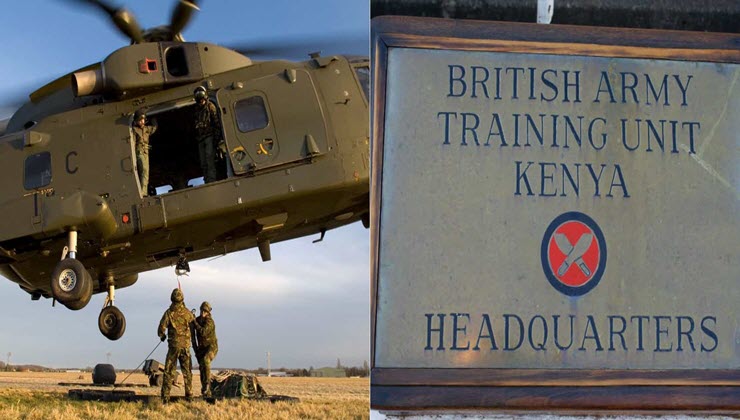
But beneath this charm lies a quiet storm, one borne of decades of military activity by British soldiers operating under the British Army Training Unit in Kenya (BATUK).
For many locals, the economic benefits brought by this military presence have come at a profound social and environmental cost.
Since independence in 1963, Kenya and the United Kingdom (UK) have maintained a Defence Cooperation Agreement (DCA) that permits British troops to conduct training in Laikipia and Samburu counties.
Nanyuki, the headquarters of BATUK, has become the focal point of this military exchange.
While the partnership is often lauded for stimulating local economies, creating jobs, and improving infrastructure, it is also mired in controversy over accusations of blatant sexual abuse, unresolved morbid killings, environmental degradation, and legal immunity for offending soldiers.
Recently, Members of Parliament demanded that BATUK officials appear before them to respond to alleged human rights abuses committed by British soldiers while training in Kenya.
Legislators rejected a Ministry of Defence request to answer questions on BATUK’s behalf, citing the bilateral agreement which allows the UK to directly respond to such queries.
“This is a sensitive matter that involves rape and murder. It is only prudent that we hear directly from BATUK leadership. These are not minor issues,” said National Assembly’s Defence, Intelligence and Foreign Relation Committee Chairperson Nelson Koech.
The MPs referenced a series of unresolved incidents, including the recent arrest of a British soldier accused of raping a woman near the BATUK barracks in Nanyuki.
The soldier was flown back to the UK under military custody and is under investigation by the UK Defence Serious Crime Unit, which handles crimes by British personnel abroad.
“Unacceptable and criminal behaviour has absolutely no place in our Armed Forces and any reporting of a serious crime by serving personnel is investigated independently from their chain of command,” said the Ministry of Defence in a statement.
Perhaps the most damning case tied to BATUK was the 2012 murder of Agnes Wanjiru, a 21-year-old mother of one.
Her mutilated body was found in a septic tank at Lions Court Hotel in Nanyuki two months after she disappeared, reportedly last seen with a British soldier. Wanjiru, who was a sex worker, had reportedly been lured to the hotel by soldiers.
For years, the case languished in silence. It wasn’t until a 2021 exposé by the Sunday Times of London revealed that a British soldier had confessed to a comrade about the killing that the story returned to public consciousness.
Despite this revelation, no arrests have been made, and justice for Wanjiru’s family remains elusive.
The case sparked outrage across the country.
Sex workers in Nanyuki staged demonstrations demanding justice, and decried the continued stigma and exploitation they face from foreign soldiers.
“We have rights like anyone else. We are tired of being mistreated and ignored. Justice for Wanjiru must be served,” said Maryanne Wangui, chairperson of the sex workers’ association in Nanyuki.
Former Laikipia Governor Ndiritu Muriithi joined the chorus of condemnation, calling for a review of the Defence Cooperation Agreement (DCA).
“If prosecuting foreign soldiers threatens the DCA, so be it. No pact should give foreign troops the licence to kill our citizens with impunity. We cannot talk about democracy while tolerating such abuse,” Muriithi said then.
The sentiment echoed across civil society, with many questioning the legitimacy of a defence pact that appears to protect foreign soldiers from accountability.
One of the most destructive environmental incidents linked to BATUK occurred in March 2021, when a fire broke out at Lolldaiga Hills Conservancy in Laikipia during a military training exercise.
The blaze consumed over 12,000 acres of land, affecting local wildlife, ecosystems, and livestock.
Pastoralist communities in the area, who depend on grazing land, suffered significant losses.
In response, 1,496 affected residents filed a class-action lawsuit against the British Army, demanding compensation for the environmental damage and health issues caused by smoke inhalation.
Kelvin Kubai, a lawyer representing the community, told The Informer Media Group that the incident underscored the need for a more sustainable military presence.
“Our current DCA is outdated. We need a human rights monitoring desk outside the barracks and environmental oversight similar to UK agreements with Canada and Cyprus,” Kubai said.
The community, with support from the African Centre for Corrective and Preventive Action, has called for broader reforms in how military training is conducted on Kenyan soil.
Every year, approximately 3,000 British soldiers train in Kenya, primarily at Lolldaiga and Archers Post in Samburu County.
Their presence boosts Nanyuki’s hospitality and real estate sectors, with over 550 Kenyans employed in permanent positions at BATUK facilities.
But this economic activity rarely trickles down to the broader community.
Small traders see limited benefits, and women and girls are left exposed to sexual exploitation.
With no binding legal mechanisms requiring British soldiers to take responsibility for fathering children in Kenya, many women are abandoned and left to raise the children alone.
“This is not just about isolated crimes. It is about power imbalance, impunity, and how we as a country value our people and our land,” said Julius Irungu, a Nanyuki-based environmental activist.
In 2023, the National Assembly ratified a revised Defence Cooperation Agreement that includes an addendum establishing oversight and compensation mechanisms.
However, critics argue the reforms don’t go far enough.
While the UK maintains that its troops are subject to local laws, in practice, many cases are quietly resolved or ignored under diplomatic protections.
Community leaders and human rights advocates are now pushing for the establishment of a local human rights office and independent investigative units for crimes involving foreign soldiers.
The British High Commission has repeatedly assured the Kenyan public of its commitment to justice and accountability, but residents say action has been slow and largely symbolic.
To the outside world, Nanyuki appears to be thriving. A town on the rise thanks to foreign investment and global connections.
But for many of its residents, the price of that prosperity is too high.
The soldiers come and go, but the scars they leave behind remain in the families still waiting for answers, the communities displaced by fire, and the children growing up without recognition or support.
“This is about dignity. Our lives are not collateral for military diplomacy,” said Wangui, the sex workers’ chairperson.
As Kenya continues to weigh its strategic partnership with the UK, the town of Nanyuki stands as both a beneficiary and a casualty, emblematic of a deeper struggle between sovereignty, justice, and global alliances.