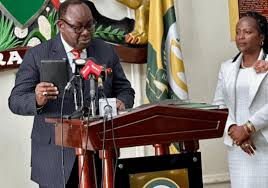
Oily scam: KNTC bosses admit Sh6.6billion loss in Sh16billion scandalous edible oil importation deal


Top bosses of the then little known government parastatal, the Kenya National Trading Corporation (KNTC) have finally admitted the management presided over plundering of taxpayers’ money amounting to over Sh6.6billion through the controversial Sh16billion edible oil importation deal that bear all the hallmarks of a premeditated heist scheme.
While appearing before the Trade, Industrialisation and Tourism Senate committee chaired by Seki Lenku Ole Kanar, in an apparent admission of guilt and blatant procurement and tendering flaws committed, KNTC acting Managing Director Peter Njoroge said the management and board of KNTC owes the country an apology.
Njoroge said the corporation spent a total of Sh14.4billion to import cooking oil and later sell it at a lower price.

Shockingly, only three companies were awarded the multi-billion contracts.
Among the companies that imported the oil were Multi Commerce FZC, which was paid $69,894,300 (Sh11.18 billion) to bring in 1.97 million jerricans; Charma Holdings Limited (499,174 jerricans for $14,976,720); and Shehena Holdings (13,420 jerricans for $402,600).
“It’s unfortunate that this happened. It’s not a good thing and as part of the KNTC management, we owe this country an apology…Moving forward, we have learnt our lesson and those who will be moving this organisation to the next stage will use the lesson and will not make the same mistakes.” Njoroge said.
He appeared before the committee alongside KNTC board chairman Hussein Tene.
Njoroge noted that the corporation lost money because it not only sold the oil at a lower price but also due to fluctuations in the dollar exchange rate ($160 to the shilling to now $130).
He blamed the loss on the previous management of the organisation, saying they had made several mistakes that led to taxpayers losing over Sh6billion.
At the time, sacked former MD Pamela Mutua was the head of the corporation and has since been charged in court alongside other officials.
He added that procuring the cooking oil in US dollars “was unfortunate”. “However, progressively the board has guided that future procurement should be done in Kenyan shillings. The board has haltered the importation,” he added.
To make a profit, KNTC should have sold each jerrican of oil for Sh4,813 and not Sh3,700.
“It’s unfortunate this happened and we take responsibility for the mishandling…There were many overheads arising from foreign exchange losses, clearance of the commodity and housing charges. Yes, this could have caused the loss of Sh 6.6billion.” Purity Kimathi, the corporation’s General Manager for Finance and Business Development said.
Further, besides the Sh6.6billion lost, Senators were dumbfounded to learn that a recent sale of un-cleared jerricans at the port to a company identified Enviro Pro Kenya Limited to have it reshipped back to the country of origin was also made at a loss.
The uncleared jerricans were owned by the three companies – Multi Commerce, Charma and Shehena – that shipped in the oil on behalf of KNTC.
Documents presented to the committee showed that a total of 797,574 uncleared 20-litre jerricans were sold to Enviro Pro Kenya for Sh3,028 per jerrican, translating to Sh2.4billion.
The sale to Enviro Pro Kenya – owned by Nicholas Mathenge, Tervin Charlo and Abdikadir Ali – resulted in a loss of about Sh500million, as KNTC sold the same jerrican of oil to Kenyans for Sh3,700.
But Njoroge explained to senators that KNTC sold the commodity at a lower price because it was not subjected to taxation, unlike what was sold to Kenyans.
KNTC sold the oil to have it reshipped to the country of origin because it was to expire in May next year and thus had to be on shop shelves six months before that for it to be fit for consumption.
“What we spent at Sh3,700 was inclusive of the Value Added Tax (VAT), but on this customer, we were able to sell it at that price because we did not pay for VAT…The oil was to be sold to try to stabilise the prices, but because it had an expiry period, we had to sell it because we could have ended up losing [it].” Njoroge said.
“The consignment, however, is yet to be shipped out of this country.” He added.
The admission by KNTC managers drew anger from committee members, who accused the corporation of trying to kill Kenyans by selling substandard oil.
Marsabit Senator Mohammed Chute who raised a question about the cooking oil on the floor of the Senate, claimed KNTC was run by “crooks” and action needed to be taken against those behind the mess.
“This organisation is run by criminals and crooks. If the investment was of Sh9 billion and you have lost Sh6 billion, what are you going to tell Kenyans, and yet people who occasioned this are walking around freely?” He posed.
In August this year, the Senate Committee on Trade, Industrialization, and Tourism grilled the director of Charma Holdings, Ruth Waithira Kinyanjui and demanded that she furnishes the House with all documentation related to the contentious procurement of edible oil through the KNTC.
The Parliamentary watchdog also sought to know from Kinyanjui the whereabouts of a significant consignment linked to the firm that was neither received nor distributed in the country.
“This country has lost a lot of money. This deal was initiated by cartels who increased the cost of edible oil instead of decreasing it. I am not saying she is a cartel.” Marsabit Senator Mohammed Chute said.
“The edible oil was meant to lower the cost of living, but the opposite happened.” Uasin Gisgu Senator Jackson Mandago noted.
The committee sought to establish from Kinyanjui under what circumstances she obtained a Letter of Credit to purchase such a large volume of the commodity.
“How did you secure the Letter of Credit to import edible oil? Because that primarily lies with KNTC.” The Senators posed.
“We secured it through KNTC, and the bank provided us with security.” Kinyanjui responded.
“Out of what you supplied, were all goods delivered?” They continued.
Kinyanjui openly admitted that part of the consignment failed to be delivered and distributed, with its whereabouts unknown.
“About 25 containers lacked proper documentation and were returned. I don’t know where the oil went.” Kinyanjui said.
Legislators faulted the KNTC for using middlemen to import the edible oil instead of dealing directly with the suppliers, expressing concerns as to whether there was value for money in the entire deal.
“Did you sell the commodity at a cheaper price compared with the prevailing market prices?” The committee posed.
“No, we traded at existing rates.” Kinyanjui answered.
The genesis of the alleged Sh16billion edible oil scandal began with a November 15, 2022, memo giving the KNTC the mandate to import essential commodities to stabilize prices.
“The purpose of the memorandum was to seek the approval of the Cabinet for KNTC to import essential commodities (maize, beans, rice, sugar, wheat, soya, and cooking oil/fat) and fertilizer as an interventional measure to lower the current cost of living.” The letter read in part.
On November 20, 2022, the National Treasury ordered the Kenya Revenue Authority (KRA) to facilitate the exemption of duty on 150,000 tonnes of cooking fat, 200,000 tonnes of sugar, 800,000 tonnes of beans, and 25,000 tonnes of wheat.
Thus, duty on edible oil was operationalized through a November 2022 gazette notice establishing the National Steering Committee on Drought Response.