The ‘hidden’ owners behind Sh1.2billion SHA fee row
While Finsprint has been identified in the court proceedings as the private company allegedly managing aspects of the HIMS System Utilization Fee, Health Cabinet Secretary Aden Duale denied the suggestion that the two per cent charge is paid to a private company. In a statement dated August 4, Duale said the fee is channelled to the Digital Health Agency (DHA), a State body established under Section 5 of the Digital Health Act, 2023, to support the Comprehensive Integrated Health Information System.

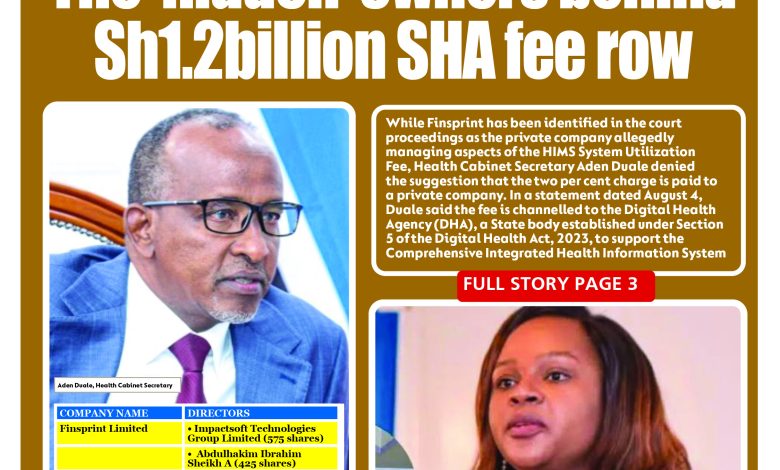
Investigations by The Informer Media Group can now lay bare the much-hidden identities and ownership structure of Finsprint Limited, the private technology company at the centre of a legal battle over a controversial two per cent fee deducted from billions of shillings in Social Health Authority (SHA) healthcare claims.
Official company records show that Finsprint Limited is owned by Impactsoft Technologies Group Limited, which holds 575 shares, and Abdulhakim Ibrahim Sheikh A, who holds 425 shares. Issa Sheikh Mohamed is listed as a director of Finsprint but holds no shares in the company.
Further our investigations have established that Impactsoft Technologies Group Limited is itself wholly owned by Issa Sheikh Mohamed and Abdullahi Abdi Sheikh, each holding an equal 500 shares.
| Company Name | Directors |
| Finsprint Limited | · Impactsoft Technologies Group Limited (575 shares)
· Abdulhakim Ibrahim Sheikh A (425 shares) · Issa Sheikh Mohamed (zero shares) |
| Impactsoft Technologies Group Limited | · Issa Sheikh Mohamed (500 shares)
· Abdullahi Abdi Sheikh (500 shares) |
The ownership trail provides a fresh dimension to mounting questions surrounding Finsprint’s role in the SHA payment ecosystem, particularly as healthcare providers continue to demand answers over deductions made from their claims.
When contacted for comment on how Finsprint Limited, a private technology company opaquely contracted to facilitate payments under the Social Health Authority (SHA) was onboarded without competitive tendering process, neither the Health Cabinet Secretary Aden Duale nor SHA Chief Executive Officer Dr. Mercy Mwangangi responded to our queries sent via mail, and short text messages.

Similarly, Finsprint Limited and Impactsoft Technologies Group Limited could not explain how they were onboarded to provide a public service payable using taxpayers’ money.
Finsprint has been drawn into a constitutional petition filed at the High Court by Nakuru-based surgeon Dr Magare Gikenyi Benjamin, Busia Senator Okiya Omtatah and Eliud Karanja Matindi, who are challenging the legality of the two per cent Health Information Management System (HIMS) utilisation fee.
According to the petitioners, approximately Sh60.7 billion in SHA claims had been processed by July 1, 2026, translating into about Sh1.2 billion allegedly deducted through the disputed two per cent charge.
The Sh1.2 billion figure is the petitioners’ calculation and has not been determined by the court.

The petitioners sought conservatory orders suspending the deductions and preventing the respondents from implementing any circular, letter, gazette notice or other instrument authorising the fee until the case is heard and determined.
They argue that the charge has no proper statutory foundation, was imposed without adequate public participation and amounts to an unlawful deduction from money owed to healthcare providers.
“The 2 per cent HIMS System Utilization fee is not based on any legislation,” the petition states in part.
The petitioners further contend that the constitutional framework governing public revenue does not permit government agencies to divert money to private entities outside the established taxation, budgeting and appropriation processes.
They have also raised questions about accountability, transparency and the handling of sensitive health information, arguing that the involvement of private entities in the digital health infrastructure requires strict safeguards for patients’ and hospitals’ data.
In documents filed in court, Dr Magare says he first discovered the deduction on April 8 while processing claims at a SHA-accredited health facility. He subsequently wrote to SHA, the Digital Health Agency, the Ministry of Health and the National Treasury on July 1 seeking an explanation for the deduction and the role of Finsprint.
According to the petition, the authorities did not provide a satisfactory explanation.
“The respondents did not give any explanation or any feedback nor did they provide the role of the second respondent (Finsprint Limited) who is believed to be the beneficiary of the 2 per cent HIMS System Utilization fee,” the petition states.
The dispute has been further complicated by conflicting accounts over who actually receives the money and the precise role played by Finsprint in the SHA payment chain.
While Finsprint has been identified in the court proceedings as the private company allegedly managing aspects of the HIMS System Utilization Fee, Health Cabinet Secretary Aden Duale denied the suggestion that the two per cent charge is paid to a private company.
In a statement dated August 4, Duale said the fee is channelled to the Digital Health Agency (DHA), a State body established under Section 5 of the Digital Health Act, 2023, to support the Comprehensive Integrated Health Information System.
The CS said the charge is authorised under Regulation 11(2) of the Digital Health Data Exchange Component Regulations, 2025, with the Third Schedule providing that the Health Information Management Service fee shall not exceed Sh5,000 per transaction.
“The service fee is not a discretionary charge,” Duale said. “It is a capped fee for the use of a system. It is not an open-ended share of any hospital’s earnings.”
However, the government’s position has not ended the controversy.
Hospital owners say their experience suggests that the two per cent deduction has been applied across claims, raising questions over whether the Sh5,000 statutory ceiling is being observed in practice.
One hospital owner illustrated the concern by noting that two per cent of a Sh100,000 claim amounts to Sh2,000 and therefore falls below the cap. But on a Sh500,000 claim, the same percentage amounts to Sh10,000 — double the stated maximum.
“If a hospital submits a claim for Sh100,000, two per cent is Sh2,000, below the Sh5,000 cap. But if a hospital submits a claim for more than Sh500,000, which the majority of hospitals handling complex procedures or high patient volumes do, two per cent is more than Sh10,000, which exceeds the stated cap. Which is which?” the facility owner asked.
Duale maintains that the regulations underwent regulatory impact assessment, public participation and stakeholder consultation before being approved by Parliament.
But hospitals contend that the issue is not merely whether regulations existed, but whether healthcare providers were clearly informed that a percentage of their approved claims would be deducted.
The government’s explanation that the regulations have been publicly available since April 2025 has not fully addressed complaints from facilities that say the charge was not clearly disclosed when they were onboarded onto SHA.
Questions have also persisted over Finsprint’s place in the payment architecture.
Hospital owners say Finsprint is encountered in payment-related processes and sits at the final stage of the payment pipeline between SHA and healthcare providers’ bank accounts.
Duale’s statement refers instead to the Safaricom Consortium as the contracted system operator and says subcontracting arrangements are lawful commercial transactions.
However, the statement does not explain Finsprint’s specific contractual role or how it fits into the payment architecture.
It is this gap that has fuelled further scrutiny of the private company’s ownership, contractual arrangements and relationship with the government agencies responsible for SHA and digital health.
Dr Brian Lishenga, former chairperson of the Rural Urban Private Hospitals Association and a prominent critic of the deductions, said healthcare facilities should have been informed directly and transparently about the charge from the beginning.
He held the position that whatever the legal basis of the fee, hospitals should not have had to discover it through unexplained shortfalls in their reimbursements.