How murdered Kitengela landowner ‘sold’ his property from the grave

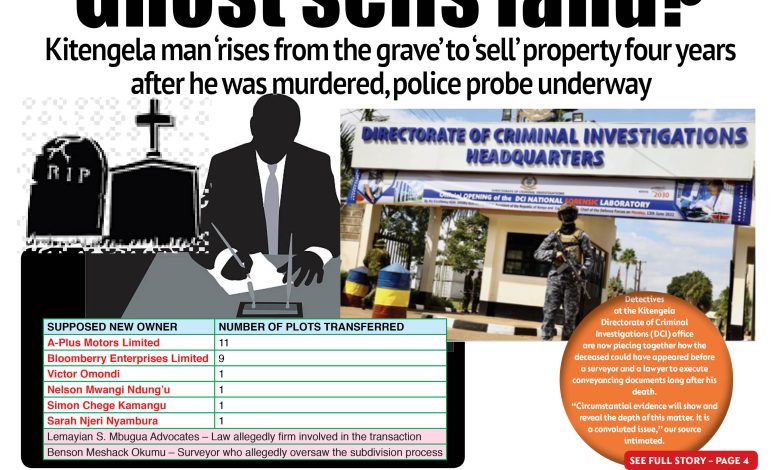
A chilling land fraud probe in Kitengela has exposed what is suspected to be one of the most bizarre property transactions in recent memory, a case in which a man murdered and buried in 2011 allegedly resurfaced four years later to subdivide and transfer his land to a string of new ‘owners’ in 2015.
| Supposed new owners | Number of plots transferred |
| A-Plus Motors Limited | 11 |
| Bloomberry Enterprises Limited | 9 |
| Victor Omondi | 1 |
| Nelson Mwangi Ndung’u | 1 |
| Simon Chege Kamangu | 1 |
| Sarah Njeri Nyambura | 1 |
| Lemayian S. Mbugua Advocates- law allegedly firm involved in the transaction | |
| Benson Meshack Okumu – Surveyor who allegedly oversaw the subdivision process | |
Kitengela-Kajiado Block 3223 owned by Masharen Ole Nanapu which was controversially transferred to new owners in 2015, four years after he was murdered in 2011.
At the centre of the investigations is land parcel Kitengela-Kajiado Block 3/223, originally owned by the late Masharane Ole Nanapu, who died on July 29, 2011, aged 48.
According to records and official documentation seen by The Informer Media Group, Nanapu’s death was confirmed and his burial conducted the same year following a fatal attack.
Yet official land registry records indicate that in 2015, four years after his burial, the property was subdivided into at least 23 plots and subsequently transferred to various individuals and companies, allegedly with Nanapu as the transferor.
Detectives at the Kitengela Directorate of Criminal Investigations (DCI) office are now piecing together how the deceased could have appeared before a surveyor and a lawyer to execute conveyancing documents long after his death.
“Circumstantial evidence will show and reveal the depth of this matter. It is a convoluted issue,” our source intimated.

Records show the subdivision process was overseen by surveyor Benson Meshack Okumu and facilitated through the law firm of Lemayian S. Mbugua Advocates.
Transfer documents indicate that A-Plus Motors Limited acquired 11 plots, while Bloomberry Enterprises Limited received nine. Additional plots were reportedly transferred to individuals identified as Victor Omondi, Nelson Mwangi Ndung’u, Simon Chege Kamangu and Sarah Njeri Nyambura.
Crucially, none of the alleged beneficiaries, the conveyancing lawyer or the surveyor responded to questions regarding whether they physically met Nanapu, the mode of payment, or how identity verification was conducted.
The new owners also did not respond to our queries on whether or not they visited normal Lands Control Board or a Special Land Control Board alongside the seller, the supposed slain owner Masharen.
The new development comes against the backdrop of rampant and increasingly sophisticated land fraud schemes plaguing Nairobi and its satellite towns, particularly in fast-growing areas such as Kitengela, Ngong, Kiserian and parts of Kajiado and Narok counties.
Investigators say criminal networks often exploit gaps in land registry systems, collude with rogue professionals, or forge identity documents, signatures and death records to illegally transfer property.
In recent years, courts have handled numerous disputes involving forged title deeds, fraudulent subdivisions and double allocations.
Rapid urban expansion, rising land values and historical land adjudication challenges in pastoralist regions have created fertile ground for cartels targeting absentee owners, deceased proprietors and families with incomplete succession documentation.
Legal experts note that in many cases fraudsters move quickly to subdivide land into multiple plots, complicating recovery efforts once third-party buyers enter the picture. By the time irregularities are detected, the property may have changed hands several times.
In the Nanapu case, detectives are expected to examine signature authenticity, identity verification procedures, company registration records and possible collusion within land administration offices.