Ruto signs Sovereign Wealth Fund Bill into law despite oversight concerns
However, before the Bill became law, Controller of Budget Margaret Nyakang'o raised far-reaching constitutional and governance concerns, warning that, as drafted, the legislation could create a parallel financial system outside Kenya's established public finance framework.

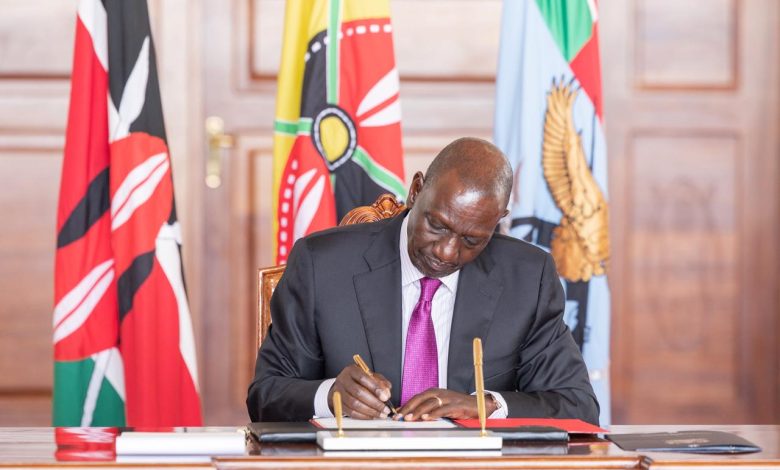
President William Ruto has signed the Sovereign Wealth Fund (SWF) Act, 2026 into law, paving the way for the establishment of Kenya’s first sovereign wealth fund despite strong reservations from the Controller of Budget (CoB), who had warned that the proposed framework could weaken constitutional oversight of public finances.
The new law creates a legal framework for the prudent management and investment of revenues generated from mineral and petroleum resources, dividends from public investments and a portion of proceeds from the privatisation of state assets through a dedicated national fund.
The government says the fund is intended to safeguard Kenya’s economy against external shocks such as pandemics, global conflicts and commodity price volatility, while preserving wealth for future generations and financing strategic national development.
The Sovereign Wealth Fund will operate alongside the National Infrastructure Fund (NIF), which the government has identified as a key financing vehicle for President Ruto’s ambitious Sh5 trillion infrastructure development programme over the next decade.
However, before the Bill became law, Controller of Budget Margaret Nyakang’o raised far-reaching constitutional and governance concerns, warning that, as drafted, the legislation could create a parallel financial system outside Kenya’s established public finance framework.
Nyakang’o argued that the Bill does not clearly require revenues from mineral and petroleum resources to first be deposited into the Consolidated Fund, as required under Article 206 of the Constitution, before being appropriated by Parliament.
She warned that allowing revenues to flow directly into the Sovereign Wealth Fund would bypass both Parliament and constitutional oversight mechanisms.
“The clause is silent on the fund’s relationship with the Consolidated Fund and with the Controller of Budget’s authorisation powers,” Nyakang’o noted in her submissions.
According to the Controller of Budget, failure to channel the revenues through the Consolidated Fund risks creating an unconstitutional parallel financial architecture beyond the national budget process.
She further cautioned that the Bill grants the National Treasury Cabinet Secretary broad powers over withdrawals and investment decisions, describing it as one of the most significant accountability gaps in the proposed framework.
Nyakang’o maintained that withdrawals from the fund should only be made after parliamentary appropriation and with written authorisation from the Controller of Budget, in line with Articles 206 and 228 of the Constitution.
The CoB also questioned the governance structure of the Fund, warning that the appointment process for board members lacks sufficient safeguards against executive influence.
To strengthen accountability, her office proposed that all board appointments be subjected to competitive recruitment and parliamentary approval, alongside the inclusion of an independent, non-voting observer at board meetings.
She further recommended the establishment of a statutory investment policy approved by Parliament and reviewed every three years, as well as an independent investment advisory committee to monitor compliance and report directly to Parliament.
The Controller of Budget also proposed a statutory cap on annual withdrawals from the fund to protect its long-term sustainability, arguing that any officials who authorise withdrawals beyond the prescribed limit should face personal civil and criminal liability.
Her office warned that the concerns are particularly significant because mineral and petroleum revenues—the fund’s principal source of income—are finite and non-renewable, meaning poor investment decisions could permanently erode national wealth.
Under the new law, the Sovereign Wealth Fund will comprise three separate funds.
The Stabilisation Fund will cushion the economy against macroeconomic shocks arising from events such as global conflicts, natural disasters and commodity price fluctuations.
The Strategic Infrastructure Investment Fund will mobilise capital for major infrastructure projects through partnerships with the private sector.
The legislation also establishes a governing board chaired by a presidential appointee. The Cabinet Secretaries responsible for the National Treasury, Mining and Petroleum will serve on the board alongside four competitively recruited members selected based on their expertise.
The board will be responsible for managing investments, determining investment strategies and ensuring that the Fund avoids high-risk investments such as speculative derivatives and private equity ventures.
The government says the Sovereign Wealth Fund will help generate sustainable long-term returns while preserving national wealth for future generations and reducing Kenya’s vulnerability to global economic disruptions.