Raila reiterates defence of Adani’s JKIA deal, terms cancellation ‘unfortunate’
Ruto stopped the plan after controversy arose over the lack of transparency and public participation in handing over JKIA, which is a national asset, to a foreign entity

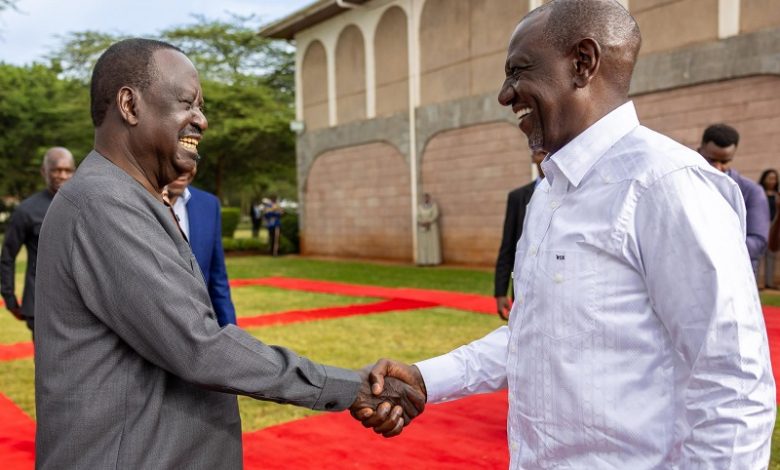
ODM leader Raila Odinga says he was very disappointed when President William Ruto cancelled the contract to lease the Jomo Kenyatta International Airport (JKIA) in Nairobi to India’s Adani Group for 30 years, saying it would have made the country a bigger hub in the continent.
Addressing the Third National Executive Retreat at KCB Leadership Centre, Raila said Kenya needs to compete with Ethiopia, which has built modern airports, which is likely to give Ethiopian Airlines an advantage over Kenya Airways.
“Kenya is very strategically situation where we are, we are very fortunate. So, I very disappointed when we could not move on with the airport project, that was really, so unfortunate. You know we has started the Greenfields airport contract before we left government with Kibaki, that was in 2012. That contract was cancelled before it was given to the same contractor later and then it was cancelled again because of disagreements in the middle,” said Raila, who was the key note speaker on the second day of the retreat.
“Then we brought in Adani and they brought in all this politics and the contract was cancelled,” he noted, adding that Nairobi risks being dormant and could even be overtaken by Kigali.
The proposed Adani deal was cancelled following questions over the secrecy surrounding the plan to award the US$1.84 billion to expand and modernise JKIA under the Public Private Partnership (PPP).
The Indian conglomerate was to undertake the project under a Build-Operate-Transfer (BOT) agreement for 30 years after which the airport would be returned to the Kenya Airports Authority (KAA).
However, controversy arose over the lack of transparency and public participation in handing over JKIA, which is a national asset, to a foreign entity.
Despite stiff defence from within Cabinet, President Ruto cancelled the plan and ordered for the search for a new contractor in the wake of court orders and intense scrutiny that ensued after a Kenyan student in France, Nelson Amenya, blew the whistle about it.
He also cancelled another contract awarded to Adani Energy Solutions to construct two powerlines for the Kenya Electricity Construction Company (KEPTACO) worth Sh95.68 billion, which had also been blocked by courts on similar grounds.
The move, however, coincided with the indicted of the owner of the Indian giant, Gautam Adani, one of world’s richest people, along with seven others in the United States over alleged bribery related to power supply deals in India, in what US authorities called “The Corrupt Solar Project”.
But Raila’s position is not different from his initial posture in October last year when he defended the Indian billionaire, saying he was introduced to him by now Indian Prime Minister Narendra Modi while serving as prime minister in the grand coalition government.
“When I was the Prime Minister of Kenya, I was introduced to Adani by Prime Minister Narendra Modi, who was then Chief Minister of Gujarat. In Mumbai, I witnessed how they transformed a collapsing airport into a world-class facility, and their power projects benefit millions,” he said.
“Adani is a credible partner. They have proven their capabilities in projects that surpass what we have seen in East Africa. If we scare away investors like Adani, we risk stalling critical infrastructure development at a time when our neighbours are pulling ahead,” he warned at the time.
At the time, five members of his ODM party, had joined Ruto’s Cabinet when he formed the broad-based government in the aftermath of the Gen Z revolt in June.
Several others have since joined as principal secretaries, advisors, parastatal heads and in other ranks in the public service.
His reference to Ethiopia at the retreat comes in the wake of plans by Ethiopian Airlines to construct an ultra-modern airport , which, once completed by 2029, will have the capacity to handle 110 million passengers per year, making it the largest on the continent and one of the busiest globally.
The Abusera Mega Airport is expected to cost US$6 billion and will be constructed in multiple phases. Phase one, targeted for completion by 2029, will accommodate 60 million passengers annually. The project includes four runways, 270 aircraft parking bays, a terminal covering 1.1 million square meters, over 126,000 square meters allocated for airline support, and more than 100,000 square metres for cargo and airport operations.
Last year, the airline also unveiled Jinka airport project in the South Ethiopia Regional State, comprising a new stat-of-the-art terminal and support facility buildings.
Addis Ababa Bole International Airport in Addis Ababa is also being expanded and will reportedly have a capacity of 60 million passengers once it is also completed in 2029.
While there is agreement that attracting private capital is one of the best ways Kenya can undertake mega projects such as airport expansion, the lack of transparency makes PPPs highly vulnerable to corruption stemming from unethical behaviour, which could include bribery, bid shopping, unbalanced bids, bypassing competition and extortion.