Prime CS Mudavadi urge millers to champion nutrition as Kenya pushes for food sufficiency

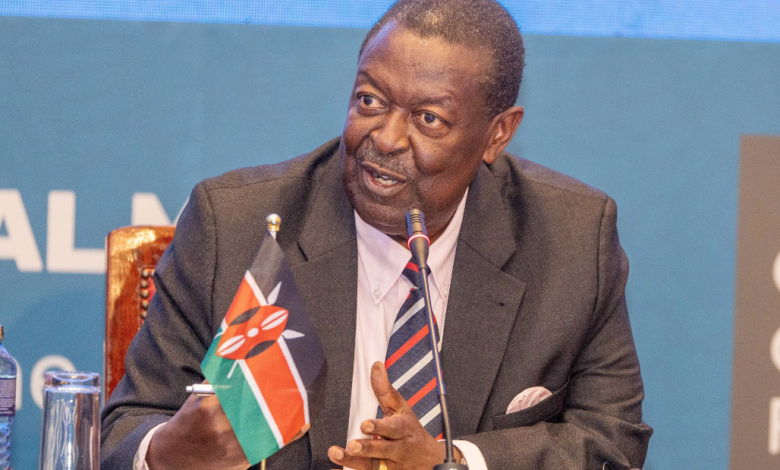
Prime Cabinet Secretary and Cabinet Secretary for Foreign and diaspora Affairs Musalia Mudavadi has urged millers to scale up their contribution to fortification as Kenya intensifies efforts to guarantee food sufficiency and nutrition security for its citizens.
Speaking in Nairobi today during the Kenya Millers Fortification Index (KMFI) 2025 Awards Ceremony, Mudavadi said the country must now view food security as an urgent national priority and not as a distant aspiration.
“Food security is no longer a luxury; it is a necessity. Food sufficiency is not merely about the ability to put a meal on the table. It is about family stability, it is about national productivity, and it is about the socio-economic growth that underwrites our future,” said Mudavadi.
He described fortification as one of the most strategic interventions in combating hidden hunger, malnutrition, and stunted growth.
“Fortification is the vitamin in our ugali, the iron in our flour, and the promise of healthier children and stronger generations. It is no longer an option but an obligation,” he added.
Mudavadi praised the expansion of the KMFI initiative, noting its remarkable progress since its inception in 2022. What began with only five companies and 41 brands has grown into a platform of 34 companies, 155 brands, and 122 active participants.
He emphasized that the inclusion of the edible oils sector for the first time in 2025 was a sign of greater industry commitment to both reach and impact.
“What makes KMFI remarkable is that it is more than a compliance mechanism. It is a catalyst for continuous improvement, a framework for transparency, and a mechanism for equity across the industry. In this arena, no miller is too small to shine, and no effort goes unseen,” Mudavadi observed.
He linked the industry’s role to the broader reforms in the agriculture sector being implemented under President William Ruto’s administration.
Mudavadi highlighted interventions such as the registration of 6.5 million farmers, distribution of 21 million bags of subsidized fertilizer, dismantling of entrenched cartels, and the expansion of export markets for agricultural produce.
He gave the example of tea, where reforms have seen prices rise from Sh51 to Sh64 per kilo, with earnings growing from Sh138 billion to Sh250 billion, and projections to reach Sh280 billion by 2027.
“These are not abstract figures. They are real stories of farmers whose labour is beginning to yield dignity and prosperity,” he said.
Mudavadi further highlighted the Galana-Kulalu Food Security Project, describing it as a flagship of agricultural transformation. He noted that the project is anchored by a 450-million-litre reservoir, electrified irrigation systems, and modern canals that will turn arid lands into productive food baskets.
“This project is set to significantly scale up maize production and fortify our path to self-sufficiency,” he said.
Mudavadi also stressed the importance of partnerships in supporting the food security agenda. He referenced collaborations with the Food and Agriculture Organization on digital land governance and climate-resilient systems, Spain on advanced irrigation technologies, and the Tony Blair Institute on technology-driven efficiency.
“These partnerships complement our domestic efforts and reaffirm Kenya’s commitment to stand on its own feet. We shall not beg for bread; we shall bake it, fortify it, and share it,” he said.
Turning to food safety, Mudavadi said that consistency and rigor in fortification processes remain essential in addressing threats such as aflatoxin contamination.
“This rigor translates into broader public health triumphs: fewer illnesses, stronger immunity, and a population primed for productivity,” he stated.
He also emphasized equity in the milling industry, saying both small-scale and large-scale millers must be supported to thrive.
“Fair competition breeds excellence. Every miller, whether operating in a village or a major city, has a role to play in delivering safe, fortified, and nutritious food to our people. No effort is too small in the fight against hunger,” said Mudavadi.
He congratulated the award winners, describing the recognition as a collective salute to higher standards.
“These awards are not just framed certificates. They are symbols of the industry’s resolve to elevate standards and deliver a healthier nation,” Mudavadi remarked.
He added that the event itself was a reminder that when an industry unites in pursuit of quality, the benefits extend to every Kenyan family.
In attendance at the ceremony were Kris Ansin, Country Director of TechnoServe Kenya; Samburu Wa-Shiko, Regional Representative of the Bill & Melinda Gates Foundation, Rizwan Yusufali, Program Director for Millers for Nutrition, James Nyutu, Managing Director of UNGA Group Limited, and Bimal Kantaria, Chairperson of the Agriculture Sector Network and Director at KEPSA, alongside development partners and captains of industries.
The Kenya Millers Fortification Index Awards were established in 2022 as an innovation to monitor, evaluate and encourage compliance with national fortification standards. Designed as a transparent and competitive platform, the awards promote accountability, innovation, and consumer confidence.
The 2025 edition marked a new milestone with the inclusion of the edible oils sector, further broadening the scope and impact of the initiative.