President Ruto dispatch 900 troops to DRC to quell rebel advance

President William Ruto has announced the deployment of the Kenya Defence Forces (KDF) troops to the eastern part of the Democratic Republic of Congo (DRC) in a combined regional effort against the rebel advance in the country.
The effort is kindled after attacks by armed groups in the eastern DRC increased, reigniting old rivalries and escalating tension with neighboring Rwanda.
In order to support reestablishing security in the region, East African Community (EAC) leaders decided to form a combined force in April.
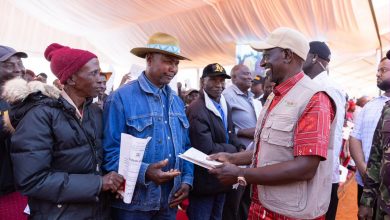
While speaking during an event in Nairobi county, Ruto stated that the troops were on a mission to preserve mankind.
“The future of the DRC is tied to our own since we are neighbors. We won’t let any armed gangs, criminals, or terrorists prevent us from enjoying our common wealth,” he said.
The army, which also consists of soldiers from Burundi, Uganda, and South Sudan, will be commanded by Kenya.
After Kinshasa objected Kigali’s involvement in any operations within the DRC, a detachment from Rwanda will be stationed at the border.
Nairobi military officials cited “clear security considerations” for their refusal to disclose the precise number of Kenyan soldiers engaged.
In the DRC, there already exists a UN force called MONUSCO, abbreviated in French.
Earlier, the Congolese government encouraged Uganda and Burundi to send troops to DRC.
The M23 rebels, a largely Congolese organisation, started fighting again in late 2021 after going years without engaging in combat.
They accuse the DRC government of breaking a deal to incorporate its members into the army.
In the North Kivu region, recent militia advances prompted the UN peacekeeping operation to step up its alertness and support the Congolese army last month.
It has been established that the rise of the M23 has severely affected relations in central Africa.
However, Rwanda denies supporting the militia, as claimed by DRC.
Kinshasa made the decision to expel Rwanda’s ambassador on Saturday while it countered by claiming that Kinshasa was “on the path of sustained military escalation.”
The African Union has called for a ceasefire because the rise in violence has worried the international community.