Owalo leads tour of Government projects in Narok
Upon completion, Uhuru Modern Market will provide secure, modern trading spaces for over 1,500 traders, positioning it as a key driver of local economic growth

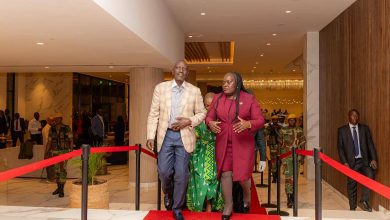
The Deputy Chief of Staff in the Executive Office of the President, Performance and Delivery Management Eliud Owalo led a high-profile inspection of several national government projects in Narok County.
The visit, which covered critical infrastructure developments, highlighted the ongoing efforts to transform the region’s economic landscape and improve the livelihoods of residents.
During the tour, Owalo was accompanied by Governor Patrick Ole Ntutu, County Commissioner Kipkech Letitia, officers from the Government Delivery Unit and key project implementing agencies, security chiefs, and other local leaders.
The team inspected the Uhuru Modern Market in Narok Town, a pivotal project implemented by the State Department for Housing and Urban Development. With an investment of Ksh 357.8 million, the market is 28 per cent complete and is expected to be fully operational by July 2026.
“This is one of the economic stimulus projects (ESP) market that the government is rolling out all over the country. In our bottom-up economic transformation agenda, we did say that we are going to facilitate economic empowerment of those who are domiciled at the bottom of the economic pyramid. An integral stakeholder in this pyramid is the small trader (mama mboga),” Owalo said.
Upon completion, Uhuru Modern Market will provide secure, modern trading spaces for over 1,500 traders, positioning it as a key driver of local economic growth. The project construction has already created employment for over 100 direct workers and more than 400 indirect jobs, bolstering both the local job market and small businesses.
The team also inspected Narok town’s link roads that are funded by the Kenya Urban Roads Authority (KURA) to the tune of Ksh 680.4 million. The roads project is 79 per cent complete and includes the tarmacking of 7.7 kilometres of vital roads within the town. These new roads will significantly ease the movement of goods and passengers, alleviate congestion along the main Narok-Bomet highway, and improve transport efficiency. Phase 2, which involves the construction of the Narok Town Bypass, is already in the mobilization stage.
“There is a bridge that is integral to facilitating this interconnectivity next to the Narok Prison and the national government has allocated Ksh.125 million for the purposes of constructing that bridge,” said Owalo.
The team also participated in a stakeholder meeting at TM Grounds in Narok Town, where residents voiced their opinions and concerns about government projects and programmes. The meeting, attended by Governor Ntutu and other county leaders, is part of the Kenya Kwanza administration’s ongoing efforts to foster transparency and people-centered governance.
The team also inspected the ongoing construction of the Ntulele ESP Market and Suswa ESP Market that are being implemented by the State Department for Housing and Urban Development. The government has pumped in Ksh 56.7 million for the construction of Suswa market. The Suswa ESP Market is already 85 per cent complete. Upon completion, the markets are expected to transform the trading environment for small-scale traders across Narok, Kajiado, and Nakuru counties, and significantly contribute to local economic growth and job creation.
The team also inspected the Ngong-Suswa Road project that is being upgraded to bitumen standards. This project is being implemented by the Kenya Rural Roads Authority (KeRRA) to the tune of Ksh 3.9 billion. It covers 70 kilometres, including access to Suswa trading Centre. Traversing through Kajiado North and Kajiado West sub counties, the road’s progress status is 90 per cent complete.
The road is a critical trans-county link road connecting Kajiado and Narok counties and is part of a broader strategy to enhance transport networks across the region by improving trade and connectivity between Narok and neighboring counties.
The Ngong-Suswa road will also decongest the Maai Mahiu escarpment road section. It stalled in 2022 due to delayed payment of contractor bills but was revived in September 2024 through the Presidential Directive of 2023.
The 47 kilometre section was completed and handed over for maintenance; other works are ongoing. The road requires an additional budgetary allocation of about Ksh 500 million.
Other projects inspected during the tour included:
- Expansion and modernisation of Ewaso Ng’iro Tannery & Leather Factory: The implementing agency is the Ewaso Ng’iro South Development Authority (ENSDA) at a cost of Ksh.1 billion. The Tannery expansion is 100 per cent complete and operational. Modernisation of machinery and equipment of the shoe plant are ongoing. Expansion of the wastewater treatment plant to support the increased operational capacity has not started. The Tannery’s installed capacity has doubled from 1,200 metric tons of hides annually to 2,400 metric tons. Phase 3 will increase the installed capacity by another 100 per cent from 2,400 metric tons to 4,800 metric tons annually.
- Kilgoris-Lolgorian Road Upgrade to bitumen standards: This Ksh 1.5 billion project, spanning 40 kilometres, is 53 per cent complete, with 20 kilometres of tarmac already laid. Once completed, it will significantly improve regional connectivity and enhance security for the communities in the Transmara region.
- Kilgoris & Lolgorian Water Supply and Sanitation: The implementing agency is Central Rift Valley Water Works Development Agency (CRVWWDA) at a cost of Ksh 598.8 million. The scope includes intake, water treatment works, storage and pipeline. The water project will provide clean, reliable water for 6,700 households, positively impacting thousands of residents. However, it requires an additional budgetary allocation of Ksh 300 million for last-mile connectivity for greater impact and sustainability.