New police uniform opens old wounds of tender wars, political fights
One of the most politically charged episodes occurred in 2022, when Ruto, then Deputy President, launched a scathing attack against the then Inspector General of Police Hillary Mutyambai, accusing him of incompetence and questioning the independence of the police command ahead of the August 2022 General Election. The remarks triggered a sharp response from then Interior Cabinet Secretary Fred Matiang’i, who accused Ruto of attacking Mutyambai out of frustration over procurement deals allegedly pushed by his political allies.

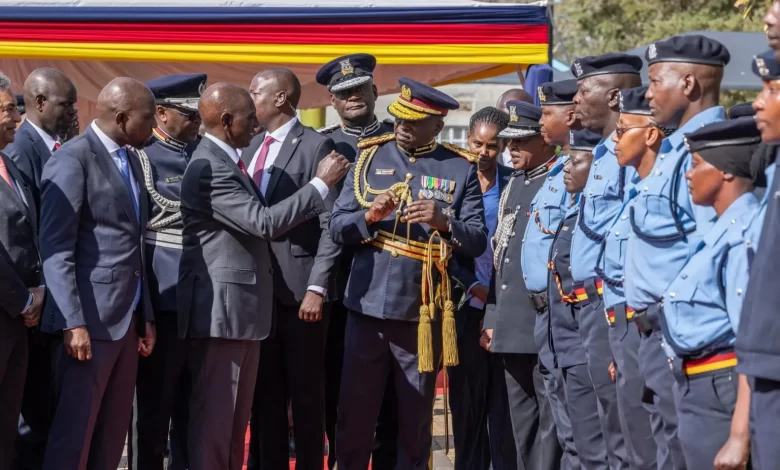
President William Ruto yesterday unveiled a redesigned uniform for Kenya’s General Duty police officers, reviving memories of past political battles over police procurement and the long-running controversy surrounding tenders for uniforms and other equipment.
The president launched the new attire on Friday, August 28, 2026, at the National Police College in Kiganjo, Nyeri County, where he presided over the passing-out parade of more than 6,000 newly trained police constables.
The new uniform consists of sky-blue shirts, dark-blue trousers and berets, while female officers will also have dresses as part of the redesigned attire. Officers serving in the General Service Unit (GSU) and Administration Police Service (APS) will not be affected by the changes.
Interior Cabinet Secretary Kipchumba Murkomen said the uniform change was not an overnight decision but the outcome of recommendations by the presidential task force on police welfare and working conditions, as well as consultations with officers and the public.
“Thank you for also looking at even their uniform, Your Excellency. The task force you established recommended that the national police uniform needs to be changed,” Murkomen said.
“The uniform that you unveiled today is as a result of rigorous public participation, and the police officers themselves chose their uniform,” he added.
The unveiling nevertheless comes against a history of fierce political and procurement disputes surrounding police supplies, including uniforms, boots and protective equipment.
One of the most politically charged episodes occurred in 2022, when Ruto, then Deputy President, launched a scathing attack against the then Inspector General of Police Hillary Mutyambai, accusing him of incompetence and questioning the independence of the police command ahead of the August 2022 General Election.
Speaking to a joint delegation from the International Republican Institute (IRI) and the National Democratic Institute (NDI) at his Karen office, Ruto described Mutyambai as the “most incompetent Inspector General of the Police in the whole world”.
“We doubt the command. We have a serious problem with the command of the police. We have the most incompetent Inspector General of the Police,” Ruto said at the time.
He further claimed that the police command was effectively controlled by then-President Uhuru Kenyatta, whom he accused of taking over the duties and command of the National Police Service.
The remarks triggered a sharp response from then Interior Cabinet Secretary Fred Matiang’i, who accused Ruto of attacking Mutyambai out of frustration over procurement deals allegedly pushed by his political allies.
Addressing a political rally in Kisii in July 2022, Matiang’i claimed Mutyambai had resisted attempts to purchase police equipment at inflated prices.
“Hii mambo ambayo Mutyambai anatusiwa hapa kuambiwa ati he is the most incompetent police IG we have had. The only problem with Mutyambai is that he refused to buy police boots for Sh13,000 that were being sold by your friends. Mutyambai accepted to buy boots for Sh2,900,” Matiang’i said.
He further alleged that Mutyambai rejected an offer for bulletproof vests priced at $900 from companies linked to Ruto’s associates and instead opted to procure directly from manufacturers.
“The problem with Mutyambai is refusing to buy bulletproof vests for 900 dollars sold by your friends and opted to buy it directly from manufacturers,” Matiang’i said, accusing Ruto of being frustrated by the procurement decisions.
The exchange became one of the most striking examples of how police procurement could become entangled in Kenya’s political battles, with competing claims over who controlled the service and who benefited from government tenders.
Four years later, Ruto is now the president overseeing another major change to police uniforms, although officials insist the latest redesign is driven by welfare considerations and public participation rather than political or commercial interests.
Inspector General of Police Douglas Kanja said the current navy-blue uniform had been rejected by police officers during a public participation exercise and that the service was reverting to an earlier design that had been approved.
“We have been using the deep blue uniform, but we are reverting to the one that was agreed upon. I must note that on Monday I must also wear the new uniform,” Kanja said.
He said the new attire would be introduced to General Duty officers over the coming weeks and was expected to improve morale.
“In the next few weeks, we should be seeing the new uniform that was approved sometimes back, and I think this is also going to be a force multiplier,” Kanja said.
The uniform change formed part of a broader reform agenda outlined during the Kiganjo ceremony, with Ruto urging the newly trained officers to exercise their powers responsibly, uphold the Constitution and remain accountable to citizens.
“Wherever you are deployed, you must remain disciplined, impartial, incorruptible, protect the vulnerable, treat every citizen with dignity, and reject every inducement to compromise your duty,” Ruto told the recruits.
He warned officers against corruption, excessive force and abuse of office, particularly as the country heads towards the 2027 General Election.
“Do not arrest only the young people holding a weapon while allowing the person who recruited, transported, and paid them to escape responsibility,” Ruto said, warning against politically sponsored violence.
The president said police officers would have a constitutional duty to protect Kenya’s democratic space while taking lawful action against those who finance, organise, incite or perpetrate violence.
Kanja said the additional officers would strengthen the National Police Service, while Murkomen said the latest recruitment formed part of the government’s plan to address personnel shortages and modernise policing.
The more than 6,000 recruits underwent nine months of training covering law, police procedures, firearms, field tactics, counterterrorism and violent extremism, national security, traffic management, criminal investigations, human rights and community policing.
The government also highlighted investments in police technology, vehicles, housing, air support and crowd-management equipment.
Ruto said police welfare must accompany demands for professionalism, announcing that entry-level basic pay for police constables had risen from Sh21,000 to Sh29,000 following a three-phase remuneration review.
“We cannot demand professionalism, integrity and sacrifice from our police officers while remaining indifferent to their remuneration, housing, health care, equipment, career progression, and psychological well-being,” he said.