Nakuru farmers practicing smart farming, preserving seeds through community seed banks
Wanjama started the initiative in 2009 to reduce the dependency of farmers on commercial seeds, which are mostly imported and struggle in the local soil

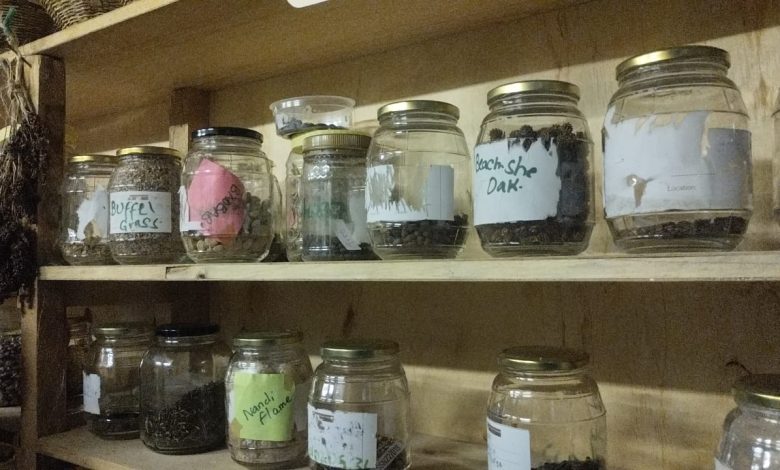
In the face of increased climate change and continuous loss of Indigenous crop varieties, farmers in Nakuru have a solution to saving their seeds through a seed bank, an initiative by a national grassroots-based Seed Savers Organisation Network in Elementaita, Gilgil.
Small-scale farmers in county can access traditional high-quality seeds, which are rare in the commercial seed markets and better suited to the ravaging effects of climate change.
The seeds are brought to the centre by farmers organised in groups.
When at the centre, they undergo a moisture test (done traditionally in a bottle with salt), when found well dried, a germination test is then done before the seeds are kept in the seed bank.
“When we do a germination test and 80 per cent or below of the seeds have germinated, we do not place the seeds in the bank because when you plant them, they’ll not fully germinate. Only those above 80 per cent are placed in the seed bank,” Beatrice Ndungu, a leader for one of the farming groups in Gilgil, explained.
She adds that the seeds are kept in glass bottles to avoid being destroyed by weevils.
“We have a house seed bank and a farm seed bank where sweet potato vines, indigenous trees, onions, sugarcane, among others, are planted and preserved,” Ndungu explains.
Some of the seeds stored at the seed bank freezer can be stored up to ten years, while the normal refrigerator can keep the seeds safe up to five years.
An underground seed bank where the seeds are kept in a freezer, the seeds can take up to 15 years and remain intact, as the farmers explain.
“We have 47 varieties of beans, 8 varieties of local maize, and twelve varieties of indigenous vegetables. When it rains, I decide on when to plant because I already have my seeds, hence my farm cannot be without anything every time. Unlike my counterparts who depend on hybrid seedlings, who have to wait when they have money to buy the seeds before planting,” Ndungu states.
According to Peninah Ngahu, who is also a leader of a farmers group in Nakuru, the seed banks have helped cut the cost of production because in the hard economic times, they do not have to purchase seeds as they only replant from what they harvested in the previous seasons.
“Many farmers come to us asking where we get the seeds, and that’s how we win them into agro ecology, because when they start practicing it, they do not have to go to the agrovets each time to buy seeds, especially keeping in mind the hard economic times,” she explains.
Seed Savers Network Director Daniel Wanjama explains that some seeds cannot be accessed in the commercial markets but can only be found at their centre, even as farmers under their network share and multiply them.
“It is hard to get some seeds in the Kenyan Commercial markets, and the only way they can be accessed is through farmers having their network and sharing seeds and multiplying them,” Wanjama stated.
He explains that’s he started the network in 2009 to reduce the dependency of farmers on commercial seeds, which are mostly imported and struggle in the local soil.
“Kenya imports over 95 per cent of vegetable seeds, and that means if we are unable to import, we shall be unable to feed ourselves. If we are unable to feed ourselves, then that is a very serious problem,” he explains.
He adds that the seed bank has a wide range of indigenous seeds including legumes, nuts, vegetables, maize and tree seedlings, which are overlooked in the commercial space.
The indigenous seeds are adapted to local climate conditions and can be replanted, unlike commercial seedlings.
The centre is also a hub for traditional agriculture knowledge with facilities for composting, tree nurseries, vegetable dehydration, and soil conservation.
“Baringo, Turkana, Kakamega, and the eastern Part where we have been working with our partners, but we shall be there ourselves now. We have an outlook to serve the entire country and hopefully also regionally with our partners,” Julia Kamau, the head of programmes at Seed Savers Network, stated.
She adds that they aim to ensure farmers’ rights are well taken care of and communities are climate resilient.
“Our mission is conservation of agrobiodiversity because communities are losing their food at an alarming rate and as a network we are coming in to bridge that gap by working together with communities to ensure they are growing their food in an agro ecological way and that way they can be climate resilient because the rains cannot be predictable anymore,” she added.
The seed bank is also a training centre empowering farmers to manage their seed systems. 74,000 farmers have so far been trained to identify and collect seeds facing extinction and hope to have seed banks in several of the 47 counties, as 54 are already up and running.
Seed Savers aims to ensure that 80 per cent of the small-scale farmers practice organic farming, as they add that the percentage can comfortably feed Kenya.
“When farmers come for training, we ensure they get the why, and mostly the why is always is our countries food sovereign? Why are we still depending on donors for food, when we import almost everything? What can we do to utilize our local indigenous foods?” Kamau explained.