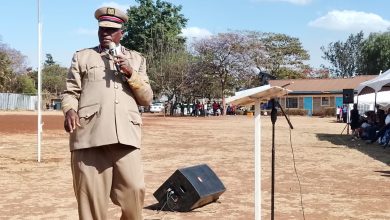
Murkomen plans upgrade of Kiganjo to police university

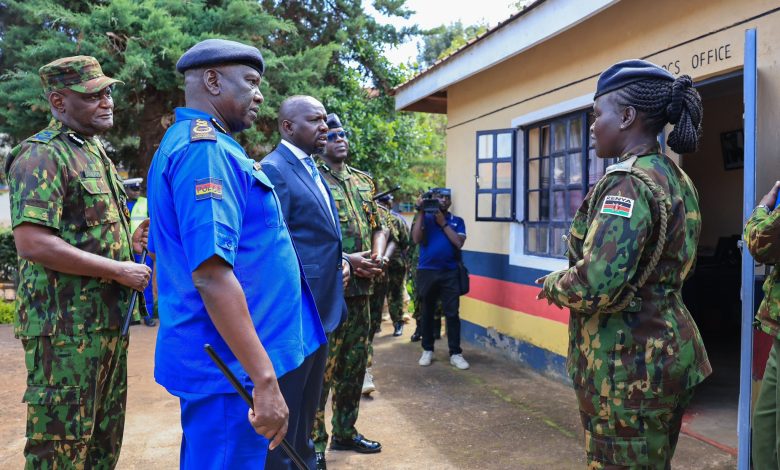
The government is planning to elevate the Kiganjo Police Training College in Nyeri County into a fully-fledged National Police Service university, in a major reform aimed at strengthening police training, professional development and regional policing cooperation.
Interior and National Administration Cabinet Secretary Kipchumba Murkomen announced the proposal on Thursday during an inspection visit to the institution, where he assessed progress of the Basic Recruit Training Course.
Murkomen said the upgrade would transform the college into a degree-awarding institution, enabling police officers to attain university-level qualifications while undergoing specialised training in law enforcement.
“We think it is now time that we upgrade this institution from just a mere training college to become a police university so that police officers can have an institution where largely we are training them up to the university level to get their degree from this institution,” he said.
He added that the envisioned university would also serve as a regional centre of excellence, attracting police officers from across East Africa, the continent and beyond through exchange programmes and international collaborations.
“But also we shall be a resource centre for other police officers in the region from other policing services in East Africa, Africa and beyond,” Murkomen said.
The CS noted that the move aligns with broader reforms within the National Police Service (NPS), including a comprehensive review of training curricula to incorporate modern policing approaches such as human rights, law, investigations and emerging crime trends.
He urged the Inspector General of Police to fast-track the development of a National Training Policy for the service, which he said would guide ongoing reforms and standardise training across all police institutions.
Murkomen further revealed that the government is overhauling policing systems to incorporate technology-driven solutions, including the migration from the Integrated Command Control and Communication Centres to Integrated Command, Control, Communication and Computation Centres.
He said the new system would improve coordination, surveillance and response capabilities, supported by modern digital infrastructure across police stations.
According to him, the government is in the final stages of procuring systems that will establish one national command centre and six regional centres in Nairobi, Nyeri, Mombasa, Kisumu and Eldoret.
“The centres will harness modern technology, including surveillance cameras and advanced communication systems to enhance coordination,” he said.
Murkomen also announced that future police stations would be digitised, including the introduction of a digital Occurrence Book that will allow members of the public to report crimes electronically.
He added that the integration of data analytics and artificial intelligence would help identify crime patterns and improve policing efficiency.
At the same time, the CS called for stricter recruitment standards in the National Police Service, saying the process would be enhanced to include psychometric testing, background checks and drug testing to ensure only qualified and disciplined individuals are enlisted.
“Recruitment processes must change, especially on psychometric assessment and drug testing. We will be tougher,” he said.
Murkomen praised the NPS for recently dismissing 54 recruits from Kiganjo over disciplinary and integrity issues, saying the move reflected the government’s commitment to strengthening professionalism within the service.
The CS also emphasised the importance of preparing officers for modern security challenges, including cybercrime, organised gangs and politically sponsored violence.
“The men and women who we will send out to keep order must be ready for a world that does not stand still. Crime is increasingly sophisticated, borderless and technology driven,” he said.
He added that emerging threats, including those linked to social media and digital platforms, require officers who are technologically aware and well-trained in modern investigative techniques.
Murkomen noted that there is growing demand for Kenyan police training expertise from neighbouring countries, saying a properly structured police university would position Kenya as a regional hub for policing excellence.
“There is a huge appetite from our neighbours for our training facilities. We have a great opportunity if we establish a properly structured Police University in Kenya,” he said.
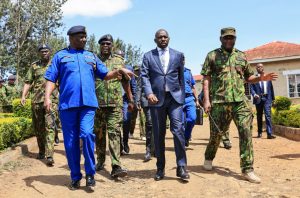
The CS was accompanied by Inspector General of Police Douglas Kanja, Deputy Inspector General Eliud Lagat, Central Regional Commissioner Joshua Nkanatha and senior police commanders during the visit.
The proposed reforms come as the government intensifies efforts to modernise the National Police Service through training, technology adoption and institutional restructuring aimed at improving efficiency, accountability and public trust.