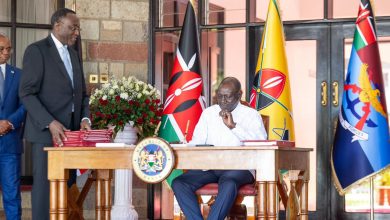
Key highlights as CS Yatani presents Uhuru’s last budget

National Treasury Cabinet Secretary Ukur Yatani is expected to present President Uhuru Kenyatta’s Sh3 trillion budget amid mounting public debt, high cost of living, incomplete legacy projects and impoverished population.
The skyrocketing cost of living has overstretched families, with prices of commodities such as cooking oil, cooking gas, milk, sukuma wiki and bread continue to rise, cutting the value of money for workers and their households.
Yatani will today be the man of the moment when he lays bare the plans of government from July, with people questioning if he will break or restore the nation’s hope by easing the cost of living and doing business in his Sh3.3 trillion 2022/2023 budget.
The expenditures comprise recurrent Sh2.17 trillion and development of Sh712.0 billion.
Early last month while announcing the budget presentation date, Treasury gave a hint of what to expect.
According to the notice signed by National Treasury PS Julius Muia, the proposals will be centred on enhancing economic resilience and accelerating economic recovery.
It will also focus on improving livelihoods, cushioning vulnerable citizens and generating more employment opportunities.
“The budget will also look at how to fast track implementation of Government priority programmes under the ‘Big Four’ Agenda,” Muia said.
Despite the good intentions, the government has a huge task of generating domestic revenue in order to cut borrowing, with the public debt already above Sh8 trillion.
It is also facing tough demands from the International Monetary Fund (IMF) which saw it introduces VAT on fuel and gas, whose spiral effect has flared up the cost of living.
The IMF’s push for the fuel tax was revealed in an advisory to the government after the fund’s board approved a new loan for Kenya valued at $2.34 billion to help the country continue responding to the Covid-19 pandemic and address its debt vulnerabilities.
The introduction of the standard 16 per cent VAT on fuels, which has been pushed back several times previously, is part of the latest attempts to raise state revenues.
In May, IMF is expected to complete the third review of a Sh256 billion credit facility it has with Kenya, and will be looking at the country’s performance in the six months to December, 2021.
The Treasury projects to increase the tax collection by nearly a fifth to Sh2.14 trillion in the next financial year, with a big chunk of the taxes coming from valued added tax (VAT), the 16 per cent sales tax that is levied on nearly all goods and service sold in the country, including school books.
In the current financial year ending June, the Kenya Revenue Authority (KRA) is projected to collect Sh1.8 trillion in taxes and other levies.
In the next year, starting July, it is expected to collect an additional Sh341.6 billion that will come from, among others, new tax measures.
The new tax measures the government will be relying on to finance its Budget is contained in the Finance Bill that might be tabled in the National Assembly either today or tomorrow.
VAT collection is expected to increase by more than a fifth to Sh584.7 billion in the coming financial year, compared to a projected collection of Sh477.1 billion to be collected in the current period.
Another tax head that the government will rely on in the next Budget, which will largely be implemented by President Kenyatta’s successor, is income tax from profits made by companies and salaries paid to workers.
Income tax, the largest tax head, is estimated at Sh997.3 billion, an increase of 21.9 per cent, compared to Sh817.9 billion in the current financial year.
Excise duty – popularly known as sin tax as it is levied largely on luxury products like alcohol and cigarettes – is estimated at Sh297.2 billion.
KRA also expects to collect Sh144.9 billion in import duty which is charged on goods and services that come outside of the country.
In his budget brief today, the exchequer chief is expected to outline a series of tax and expenditure measures, but experts warn that households and businesses should not expect much to change.
On Monday, PKF CEO Alpesh Vadher said that although VAT on fuel and gas should be scrapped as a matter of priority to ease the cost of living, this is not likely to happen.
“Easing the high tax regime on fuel will automatically ease the cost of living.
However, the treasury is not likely to go against its promise to IMF, meaning tougher times ahead,” Vadher said.
According to Vadher, the exchequer is keen to raise enough resources to complete President Uhuru Kenyatta’s legacy projects under the Big 4 Agenda while cutting the accumulation of public debt.
This being Kenyatta’s last Budget, however, he will need to raise enough revenue to complete his legacy projects while manoeuvering the minefield of high debt levels and high taxation that have characterised his time in office in the last 10 years.
If taxpayers’ wishes could be granted, then the financial year starting July should deliver tax cuts on food and fuel, for the government to spend less on loans while spending more on development projects.
Revenue collection including Appropriation-in-Aid (A.i.A) is projected to increase to Sh2,4 trillion (17.2 per cent of GDP) up from a projection of Sh2.036 trillion (16.3 per cent of GDP) in the current fiscal year.
Ordinary revenues will amount to Sh2.14 trillion (15.3 per cent of GDP) from the estimated Sh1.8 trillion (14.4 per cent of GDP), this year.
It is, therefore, no wonder that the Parliamentary Finance Committee is pushing for the reduction of VAT on fuel to four per cent from the current eight per cent through the Petroleum Products (Taxes and Levies) Amendment Bill, 2021.
This being a political season, all eyes will be on lawmakers who would like to endear themselves to both the electorate and their party leaders which might turn into a dicey situation for vote-hunting.
Deputy President William Ruto’s side has already dissociated itself from the current government and has been quick to blame it for high cost of basic commodities including fuel, wheat, cooking oil and milk.