Kenya Railways in Sh4.3billion irregular payments scandal
“It is plainly manifest that they have neglected to act diligently as ordered by the cabinet and the KRC board in their approval for this transaction,” the audit reads

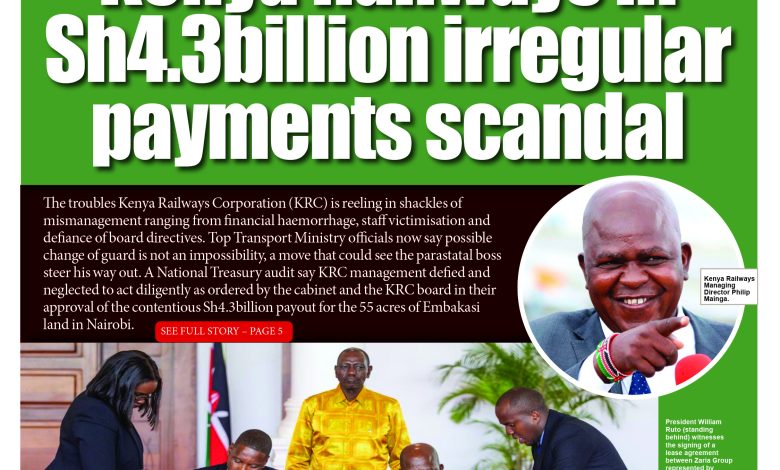
An audit by the National Treasury has fingered Kenya Railways Corporation (KRC) over Sh4.3 billion in irregular payments that relate to the acquisition of land in Nairobi against the advice of the cabinet, and the questionable inflation of the land compensation budget and single sourcing of legal services.
According to the audit by the National Treasury, KRC paid Sh2.8 billion on December 16, 2023, to Sankale & Company and Johnson for the acquisition of 55 acres of land in Embakasi, Nairobi, to compensate the Dupoto settlement scheme beneficiaries for railway infrastructure development against the decision of the cabinet.
The audit also queries the Sh1.4 billion in excess disbursement to the National Land Commission (NLC) as payment for compensation of 382 beneficiary entities and Project Affected Persons (PAPs), as well as the single sourcing of legal services to the tune of Sh403.8 million without involving the Attorney-General.
This, even as the audit reveals that the Sh2.8 billion transaction “in our view does not promote high standards of professional ethics” as “we did not find any record of the membership of the Dupoto society as a manifestation of the beneficiaries represented by the trustees.”
“In our assessment, this transaction was irregular and unprocedural. It does not promote high standards of professional ethics, involvement of the people in the process of policy making and accountability for administrative acts as advised by the cabinet,” the audit says.
Other than the cabinet, the audit reveals that the transaction also went against the advice of the KRC board, the Railway Development Levy Fund (RDLF) advisory committee.
“We did not find an auditable trace of any prior correspondence between KRC, seller, trustees or the recipient law firm.”
It further notes that the audit raises a moral question as to what defense in law or at equity do the actors from KRC management have, “were this matter to escalate to a judicial filing for recovery of public funds.”
“It is plainly manifest that they have neglected to act diligently as ordered by the cabinet and the KRC board in their approval for this transaction,” the audit reads.
The audit traces the acquisition of the land to the August 24, 2018, letter by the State Department for Transport Principal Secretary informing the KRC management of the cabinet decision through the Head of Public Service (HoPS), approving the acquisition of additional land by KRC for railway development activities.

The KRC board, in a resolution of October 31, 2023, considered and approved the proposal to acquire the land and the provision for the budget and directed the KRC management to undertake proper due diligence of the land.
According to the RDLF advisory committee minutes of November 2023, the KRC affirmed that “they had undertaken due diligence on the land and established that the title was free of encumbrances.”
The audit reveals that in the memo of December 13, 2023, an authority to the release of funds to the joint accounts of Sankale company and Johnson and Advocates at the Kenya Commercial Bank (KCB) was granted. In a land lease agreement to Dupoto, the seller, the national government granted a 99-year lease “with effect” from April 1, 2023.
“We could not verify how the government allocated the land to Dupoto,” the audit notes, adding that section 12 (3) of the Land Act gives the National Land Commission (NLC) the mandate to allot.
Section 134 of the Land Act dictates that an allotment letter is issued by the NLC, the statutory body which presides over land allocation.
“We failed to ascertain the key reasons why the KRC management neglected to follow their own precedents in compensating land owners vide NLC as contained in this report,” says the audit.
The letter of allotment is an initial document that outlines the terms and conditions of the property purchase, and it serves as proof of intent to transfer ownership.
“The Land Act regulations define the issuance of letters of allotment to public entities. In this transaction, the allotment letter has preceded the issuance of a title. This is fraud,” says the audit, adding, “it therefore expressly means that the land in question was in the government’s hands before the beginning of the disputed transaction.”
The matter of whether the KRC management identified a public land for acquisition by a government is an audit question “for which no answer is provided in the records.”
“If indeed this was a public land being offered for sale, then how did KRC identify this land? The instruments on any prior classified information between the entity, the seller and the NLC before payment are not provided on record,” says the audit.
The applicable legal framework for land acquisition, in this circumstance, upon due diligence, bears that” the KRC management once identified the need, presented to the board for approval to have considered adherence to government procedures, regulations and the law.
However, the avenue and means employed by KRC management, “as an advertisement or other means engaged to identify this land is not provided on record.”
Land valuation, pricing for a public entity, is an exclusive mandate of the NLC, though the audit reveals that it is not provided on record and “thus we could not ascertain how the valuation advice that informed the Sh50 million valuation per acre retail offer was arrived at, negotiated and adopted by the buyer.”
Under the allocation of public land, the Land Act and its regulations provide that NLC should have advertised or applied for the compulsory acquisition of the land.
However, to meet the requirements for allocation to a targeted group- Dupoto- presented as a society by a group of squatters, the society, the audit says, should have applied for allocation.
“Evidence of such a significant procedure is not available on records, and therefore, the allocation could not have happened in law.”
Public land under the Land Act belongs to the national government, and it is held in trust on behalf of the county government.
“As part of undertaking due diligence, a report prepared by the Nairobi City County government recommending the Dupoto group for the allocation of the 55 acres should have been in the file to supportthe legal ownership claim by the group.”
To address the constitutional requirements of public participation, such a report, approved by the County Assembly and as presented by the CEC land, is critical but is not made available to the auditors.
The document shows that the KRC board approved a land compensation claim payout of Sh1.107 billion paid to NLC for the compensation of Miritini-Mombasa terminus Meter Gauge Railway (MGR) link beneficiaries.
However, the KRC management paid Sh1.108 billion, which is Sh1.4 million above the NLC valuation and board advisory contrary to the NLC document on the valuation list and costs to the beneficiary entities and PAPs.
KRC is among 35 State Owned Enterprises (SOEs) in the agriculture, energy, finance, health, transport and water sectors whose total on-lent loans amount to Sh874.91 billion, representing approximately 17 per cent of Kenya’s total external debt of Sh5.2 trillion.
SOEs are legal entities established by the government, wholly or partly owned by the State, to implement priority projects and programmes.
“The audit established that the Kenya Railways Corporation (KRC) was not meeting its loan obligations.
Review of loan records revealed that the Corporation received three on-lent loans in 2014 and 2015 for the implementation of the Standard Gauge Railway Line Project,” reads the report.
Also, KRC’s financial health is under severe strain.
Auditor-General Nancy Gathungu revealed that the corporation has failed to meet repayment obligations on a Sh569.3 billion loan secured for the SGR project.
The report shows that only Phase 1 and Phase 2(a) of the railway have been completed, limiting the project’s ability to generate expected revenue.
The audit also wants KRC to terminate its engagement with Africa Star Rail Operations Company (Afristar), contracted for the Standard Gauge Railway (SGR) maintenance, “as a matter of priority to ease the burden on the taxpayer for expenditure functions which are within the control of KRC.”
Additionally, the audit recommends the termination of KRC’s engagement with Africa Star Rail Operations Company, warning that continued payments to the operator place an unnecessary burden on taxpayers. Afristar has reportedly demanded Sh18 billion to exit the contract.
Gathungu warned that persistent defaults by State-owned enterprises could ultimately shift the debt burden to the national government, increasing pressure on an already constrained budget.
Afristar, contracted under China Road and Bridge Company (CRBC) through a novation, has since issued a demand of Sh18 billion, being its unpaid dues to exit, to pave the way for the takeover by KRC.