Is Kenya’s budget too rigid? A look at non-discretionary spending
Growth of Consolidated Fund Services (CFS), driven primarily by public debt servicing, risks trapping Kenya in a vicious cycle where a larger portion of current revenues is diverted to past commitments, leaving insufficient resources for future prosperity-growth and development of the country


By Faith Nzomo
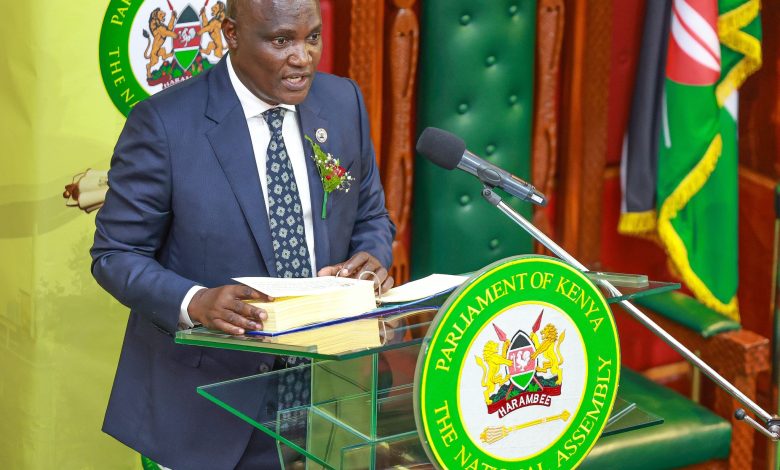
On Thursday, June 12, 2025, the Cabinet Secretary for the National Treasury and Economic Planning John Mbadi presented the Kenya’s Budget Statement for the Fiscal Year 2025/26 to the National Assembly. His speech outlined the government’s proposed policies, revenue-raising measures, and expenditure plans for the upcoming fiscal year, which is set to commence on July 1, 2025. Key figures highlighted during the speech included, a total budget of approximately Sh4.2 Trillion, equivalent to 22.3 per cent of the projected GDP. To support this ambitious spending plan, total revenues are projected at Sh3.3 trillion, or 17.2 per cent of GDP.
The executive budget as presented by the CS comprises of two main components namely, discretionary spending on the one side, and the non-discretionary spending on the other. The latter is often referred to as the Consolidated Fund Services (CFS). The discretionary part of the budget refers to spending or allocations made to Ministries, Departments and Agencies (MDAs) and requires parliament’s approval via the Appropriations Act. On the other hand, CFS or the non-discretionary spending category encompasses the obligatory payments that are legally mandated by either the law or arise from prior commitments and are usually a must-make, hence do not require annual parliamentary approval via the Appropriations Act. The CFS therefore, is the rigid component of the national budget. It includes crucial expenditure items such as:
- Public Debt Repayment:which constitutes both interest payments and principal (redemption) payment of government loans.
- Pensions:These are payments to retired civil servants and other government employees.
- Salaries and Remuneration of Constitutional Office Holders:They include remuneration for officials such as the President, Deputy President, Judges, the Auditor-General, and chairpersons and members of Constitutional Commissions-whose financial independence is protected by law. For example, chairs of Salaries and Remuneration Commission (SRC), Teachers Service Commission (TSC), Kenya National Human Rights Commission (KNHRC) among others.
- Subscriptions to International Organisations: Constitute mandatory contributions for membership in various international bodies such as the IMF and World Bank.
The Growing Burden of CFS on Kenya’s Budget
In the current budget estimates, an allocation of Sh2.1 trillion was made towards CFS representing 51 per cent of the national budget. While this remains a dominant share, it marks a nominal reduction from Sh2.2 trillion in the previous financial year (FY 2024/25) where CFS constituted 52 per cent of the national budget. In the last five years, CFS expenditure allocation as a percentage of the total expenditure outlays has grown by 13 percentage points from 38 per cent in FY 2021/22 to the projected rate 51 per cent in FY 2025/26. (see figure 1 below).

The growth in CFS stems from the increase in debt repayment particularly interest repayment which have increased to over Sh1 trillion in the current budget estimates. This significant rise in interest payments is a direct consequence of borrowing in a high-interest rate domestic environment. For instance, the average yield for the 91-day Treasury bill rose from 6.64 per cent in July 2021 to 16 per cent in July 2024, hence the sharp increase in the cost of government borrowing.
Increase in CFS spending relative to the total budget has led to the crowding out of spending in other crucial sectors. For instance, Figure 2 below, illustrates that budgetary allocation towards development takes up less than 20 per cent of the total budget . This falls short of the statutory requirement outlined in section 15 of PFM Act of 2012 on fiscal responsibility principles which stipulates that: Over the medium term, a minimum of thirty percent (30 per cent) of the national and county governments’ budget shall be allocated to development expenditure.
The reduced funding for development has led to a surge of stalled projects, with many remaining incomplete long after their completion dates has elapsed. According to Audit Reports from the office of the Auditor General, a portion of the stalled projects are now incurring penalties, primarily due to delayed payments for completed milestones. Others have seen their original contract sums being revised upwards, leading to significant cost escalations.
Overall, underfunding development initiatives leads to reduction in government investment hence reduced job creation-a critical challenge for Kenya’s rapidly growing population. Vital sectors like health and education also suffer disproportionately from the lack of sufficient hospitals and schools-directly impacting the overall welfare and human capital development of the nation.

Figure 2 above also highlights the significant decline in allocations to county governments relative to the total national budget, falling from 13 per cent in FY 2019/20 to just 9 per cent in FY 2025/26. This reduction translates to decreased actual financial transfers to counties, exacerbating existing fiscal pressures and undermining service delivery at the county level.
A growing share of CFS in the budget not only shrinks the portion of budget allocated to discretionary spending, but also severely impedes the government’s ability to implement the much needed fiscal adjustments-necessary for achieving fiscal consolidation agenda. This agenda, in place since the mid-2010s, has consistently fallen short of its goals to reduce deficits and controlling the annual increase in public debt. Its success depends on the government’s capacity to both rationalise spending and enhance revenue mobilization. Rationalizing spending is severely constrained by the growing mandatory payments.
The growing burden of CFS on Kenya’s Sharable Revenue
Figure 3 below illustrates a worrying trend of increasing share of CFS, particularly public debt repayments relative to the sharable ordinary revenue. This has significantly diminished the amount of tax revenue available for other critical expenditures.
Between FY 2019/20 and FY 2023/24, CFS consumed a larger portion of government revenues, rising sharply from 55 per cent to the highest recorded rate of 81 per cent. Within CFS, the share dedicated to public debt servicing also saw a substantial increase, jumping from 49 per cent to 73 per cent of ordinary revenues over the same period.

Current projections indicate a further increase for both CFS and public debt payments in the present financial year (FY 2024/25), before an anticipated decline in FY 2025/26. This sustained dominance of non-discretionary spending highlights the severe constraint on Kenya’s fiscal flexibility.
Conclusion
The country’s budget is facing a worrying trend of an expanding portion of non-discretionary spending-the rigid component of the budget. Consequently, these rigid payments are consuming an alarming 81 per cent of government revenues by FY 2023/24, with public debt payments alone accounting for 73 per cent of revenues in the same period. This means that the government’s fiscal flexibility is severely constrained. This dominance of obligatory payments has led to the crowding out of vital discretionary spending, and it also forms a barrier to achieving the much-needed fiscal consolidation agenda which has been a policy priority since the mid-2010s. While the government aims for fiscal consolidation through expenditure rationalisation and enhanced revenue mobilisation, the rigidity of CFS-requiring complex policy changes to reduce, makes fiscal adjustments incredibly difficult. Growth of CFS, driven primarily by public debt servicing, risks trapping Kenya in a vicious cycle where a larger portion of current revenues is diverted to past commitments, leaving insufficient resources for future prosperity-growth and development of the country.
On the positive note, a potential end of the monetary tightening cycle, which had driven Central Bank Rate to record highs in recent years, is expected to contribute to a reduction in domestic interest payments. To secure more affordable financing, Kenya needs to shift it’s debt landscape away from expensive, short-term, and commercial borrowings, to more favorable, long-term, and cheaper concessional loans. This shift will help address the challenge of growing CFS driven by interest payments, restore fiscal space and enhance budget credibility-ultimately ensuring effective service delivery and setting the country on a sustainable growth path.
The writer is a Programme Officer at Institute of Economic Affairs Kenya. This article was first published in ieakenya.or.ke.