How now haunted Harley Berry Ltd bagged Sh2.9billion Kenya Power meter tender
Last year, in an exclusive exposé, The Informer Media Group gave a blow-by-blow account on how Kenya Power awarded contracts worth a whooping over Sh2.3billion through the Supplies Branch, an obscure department tasked with procuring items used by several government institutions, which, when the Public Procurement and Disposal Act 2007 (PPDA 2007) first came into force in 2007, it was largely expected that the Supplies Branch would be scrapped and competitive bidding done by all State agencies.

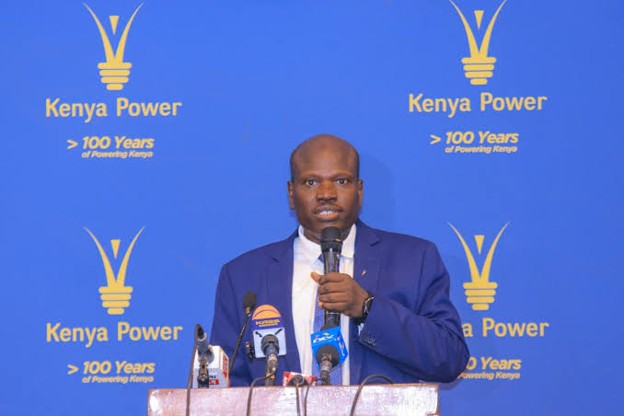
In 2023, Harley Berry Limited, still owned by Dennis Mbwika Muthenya, then aged 31 years old controversially bagged a Sh2.9billion Kenya Power tender awarded raising questions over the procurement process and the emergence of young “tenderpreneurs” in government-linked contracts.
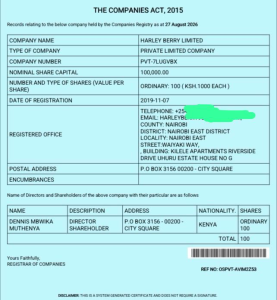
The now troubled firm facing over Sh300million tax bill awas awarded a contract worth Sh2.9 billion to supply 320,800 smart electricity meters.
The selection was handled by the relatively little-known Supplies Branch unit that normally handles procurement of Common User Items (CUIs) under the State Department for Public Works instead of the usual currently known as Kenya Procurement and Disposal Agency (KEPDA) and domiciled under the National Treasury.
KPLC Group Managing Director Eng. Joseph Siror could not explain how multi-billion contracts were awarded through KEPDA instead through a competitive tendering process since the requisitioned items were not common user commodities.
Last year, in an exclusive exposé, The Informer Media Group gave a blow-by-blow account on how Kenya Power awarded contracts worth a whooping over Sh2.3billion through the Supplies Branch, an obscure department tasked with procuring items used by several government institutions, which, when the Public Procurement and Disposal Act 2007 (PPDA 2007) first came into force in 2007, it was largely expected that the Supplies Branch would be scrapped and competitive bidding done by all State agencies.

Our investigations established that Kenya Power awarded tenders worth billions of shillings using the Supplies Branch without publicly advertising for common consumer goods for competitive bidding process.
Among them include East Africa Meter Company that was awarded Sh1.54billion tender for the supply of cables, fuse link wedges and smart meters.
On the other hand, Briskmove Investment Ltd was paid Sh0.4billion for the supply of Surge arresters, fuse carriers, stay rods and copper earth rods while Waterfall Agencies was paid 176million for the supply of Double cutout, fuse link wedges and circuit breakers.
Doublelink Enterprises Ltd and Skydrop Merchants were each paid Sh60million and Sh74million for the supply of conductors, cables and fuse link wedges respectively.
From using the obscure Supplies Branch to award contracts worth billions instead of individually sourced goods and serviced advertised competitively to inflated tenders for transformers, cables, and meters to ghost suppliers who deliver nothing but get paid in full, the company’s procurement system has become a conduit for looting public resources.
Past investigations by the Ethics and Anti-Corruption Commission (EACC) and Parliament’s Public Investments Committee have in the past unearthed patterns of collusion between senior managers and politically connected contractors. In many cases, tenders are seemingly pre-determined long before they are advertised, with the bidding process seemingly to serve as a mere formality. Those who resist the system, especially mid-level procurement officers or whistleblowers face intimidation, transfers, or outright dismissal.
The Sh2.9billion tender award placed Mbwika, then aged just 31, at the centre of one of the largest electricity-meter procurement deals by the power utility, despite the company being relatively little known in the market.
The investigation raised questions about how Harley Berry emerged ahead of established players to secure the lucrative contract and the role of procurement procedures in determining the winner.
The tender also attracted attention because Kenya Power relied on a colonial-era law in the procurement process.
The contract covered hundreds of thousands of smart meters as Kenya Power pursued modernisation of its metering infrastructure and efforts to improve revenue collection and reduce losses.
The revelation has fuelled wider scrutiny of procurement at State corporations, particularly contracts running into billions of shillings that are awarded to relatively young or little-known companies.