How bicycles are saving lives in Kenya’s rural communities

In rural western Kenya, Community Health Promoters (CHPs) form the backbone of primary health care. Charged with the monumental task of delivering essential health services directly to people’s homes, they are often the first and only point of contact between communities and the health system.
Yet, their work is hampered daily by one of the most pressing but overlooked challenges in rural health delivery.
Across 19 sub-counties in Busia County, CHPs support more than 100 households each, often traveling an average of four kilometres on foot per day while carrying medical supplies and registers.
The terrain is tough, the sun relentless, and the roads, where they exist, are often rough or impassable. In emergencies, where every minute matters, these mobility barriers can mean the difference between life and death.
“For years, CHPs have been trained, equipped with digital tools, and provided stipends, but the most basic need for transportation remained unmet. Their potential to serve communities was limited not by skills or willpower, but by how far their feet could take them,” a representative from World Bicycle Relief said.
On a quiet night in March, that challenge came to a head for Phaustine Omasete, a dedicated Community Health Promoter in the Katotoi Community Unit of Teso North Sub-County.
At 10 pm, a frantic knock rang out at his door.
Standing outside was a young couple in distress. The 22-year-old woman had suffered a miscarriage two weeks earlier and was now experiencing severe, uncontrolled bleeding.
She needed urgent medical care. Phaustine immediately assessed the situation, calmed the couple, and issued a referral to Ang’urai Health Centre, the closest facility with emergency services. But time was not on their side.
Just weeks before, Phaustine had received a Buffalo Bicycle Living Goo
That bicycle became the lifeline. It was used to swiftly transport her to the health facility, where she received emergency treatment. The bleeding was controlled. By 1 am, they were back home safe and alive.
“That night showed me the power of a bicycle,” Phaustine said.
“Without the bicycle, I don’t know what would have happened.”
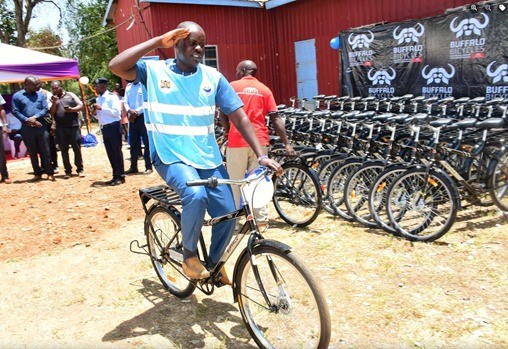
Phaustine’s story is one of many emerging from Busia County, where 350 Buffalo Bicycles have been distributed to 324 CHPs and 26 Community Health Assistants (CHAs).
The goal is to strengthen primary healthcare by improving reach, speed, and service delivery in hard-to-reach communities.
With bicycles, CHPs are now reaching more households per day, conducting timely follow-ups, and responding swiftly in emergencies.
In a region where malaria remains a leading health challenge, mobility has also improved the delivery of test kits and medications. According to Living Goods, CHPs currently handle 70 per cent of confirmed malaria cases directly at the household level.
The Buffalo Bicycles, built for rough terrain with reinforced frames and heavy-duty carriers, are designed for durability.
A network of trained local mechanics supports ongoing maintenance, ensuring sustainability beyond initial distribution.
While the intervention is modest in design, it is profound in impact. For CHPs, the bicycles reduce physical fatigue and eliminate costly transport expenses. For patients, they bring health services closer, sometimes just in time.
“This is more than a logistics solution. It’s about dignity, access, and equitable care. When CHPs can move faster and farther, the whole system becomes more responsive,” World Bicycle Relief regional director Maureen Kolenyo said.
Early results from the Busia program are informing plans for scale-up across other counties.
By centering the needs of community health workers and aligning with national health goals, the program exemplifies a sustainable model of public-private collaboration.
As the world marks World Bicycle Day, the message from Busia is clear: mobility is not a luxury; it is a necessity in rural healthcare.
Whether responding to emergencies at night or ensuring children receive timely malaria treatment, bicycles are helping CHPs close the distance between families and the health system.
For communities scattered across Kenya’s rural communities, these two wheels represent access, hope, and survival.
“In my work, every minute counts,” Phaustine said. “With this bicycle, I can save time and sometimes, I can save a life,” She added