Exit of LSK President from rights abuses victims’ compensation panel was inevitable
The tragedy is not that Faith Odhiambo left it is that she had to. Her exit is an indictment of a justice system that continues to pay lip service to the victims of state abuse while shielding those responsible. Until Kenya builds institutions strong enough to outlast politics, justice for victims will remain a promise deferred

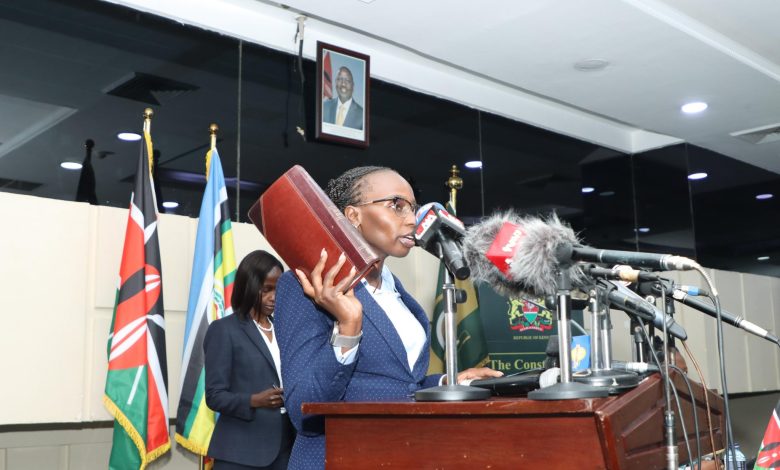
The exit of the Law Society of Kenya (LSK) President Faith Odhiambo from the Panel of Experts on Compensation of Victims of Demonstrations and Public Protests signals more than just a personal decision, it reflects structural tensions in Kenya’s accountability architecture.
The legal challenges, time constraints, and perceptions of compromised institutional independence suggest that the panel was never fully equipped to deliver. Whether or not reforms will follow, the victims waiting for justice may yet find that the promises of this panel remain unfulfilled.
Her resignation has reignited debate over the credibility and future of yet another state-created body that promised justice but was seemingly designed to fail. Her exit was not an impulsive act of protest, it was, in truth, inevitable.
In fact, Odhiambo’s departure from the controversial body established by President William Ruto’s administration in August 2025 to remedy losses suffered by those harmed in anti-government demonstrations stretching back to 2017 was a matter of when, not if.
From the very beginning, the panel was a house built on weak foundations. It was launched with political fanfare, but without the critical legal and financial architecture needed to deliver justice to victims of police brutality, extrajudicial killings, and historical injustices.
The panel was gazetted on August 25, 2025 (Gazette Notice No. 12002) under presidential directive and placed under Professor Makau Mutua as Chair, with Faith Odhiambo (LSK President) serving as Vice-Chairperson.
Tokenism masked as justice
This withdrawal exposes what many within the legal fraternity have whispered for months — that the panel was little more than a public relations tool, conceived to create an illusion of accountability rather than to pursue it.
While the idea of compensating victims of rights abuses is noble, the framework under which this committee operated was fundamentally flawed. There were no clear timelines, budgetary allocations, or binding mechanisms to enforce compensation awards. Instead, it relied heavily on goodwill from the same institutions accused of perpetrating the violations.
In such a setup, the presence of an outspoken reformist like Odhiambo was always going to create friction. Her insistence on transparency, adherence to law, and independence of process was incompatible with a structure seemingly designed for control and political appeasement.
A reformer cornered
Odhiambo’s record at the helm of the LSK has been marked by a principled defiance of state overreach and an unyielding defense of the rule of law. Her inclusion in the panel had raised hopes that this time, the victims’ voices would not be drowned out by bureaucracy or political interests.
For a lawyer who has consistently championed institutional integrity, remaining in such a compromised space would have amounted to legitimizing dysfunction. Her decision to walk away, therefore, was not a failure of leadership, it was a reaffirmation of principle
The deeper problem
The debacle underscores a deeper, recurring problem in Kenya’s governance culture, the politicization of justice mechanisms. Instead of empowering truly independent commissions or tribunals to address rights violations, the state often creates ad hoc committees with limited mandates and questionable autonomy.
These bodies are typically short-lived, underfunded, and staffed with well-meaning individuals who are soon frustrated by political control and bureaucratic inertia. The result is predictable: lofty promises, disillusioned members, and victims left waiting in vain.
Faith Odhiambo’s exit is a stark reminder that no credible justice process can thrive without independence, transparency, and political will. Without these pillars, even the most well-intentioned initiatives are reduced to mere symbolism.
A necessary wake-up call
Rather than lament her resignation, Kenya should treat it as a wake-up call to rethink how it approaches redress for victims of human rights abuses. If the government is truly committed to justice, it must ensure that such committees are grounded in law, adequately funded, and insulated from political interference.
The LSK president did what any principled leader would do when confronted with systemic failure she refused to lend legitimacy to a hollow process. Her departure may have weakened the committee’s image, but it has strengthened the moral argument for genuine reform.
The tragedy is not that Faith Odhiambo left it is that she had to. Her exit is an indictment of a justice system that continues to pay lip service to the victims of state abuse while shielding those responsible. Until Kenya builds institutions strong enough to outlast politics, justice for victims will remain a promise deferred.