Elusive justice for protest victims as demands for accountability continue

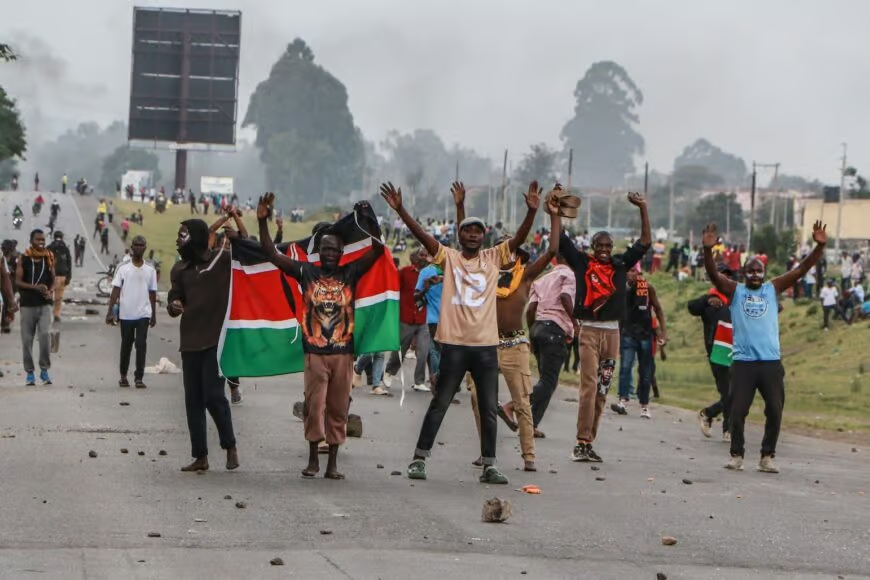
Last month’s unveiling of the Kenya National Commission on Human Rights (KNCHR) Framework for Reparations for Victims of Human Rights Violations has been hailed as a significant milestone in Kenya’s ongoing pursuit of truth, justice, accountability, and reparations for human rights defenders and families of those killed and injured by police in street protests have kept the demands to bring the officers to justice alive.
According to George Morara, the Executive Director of Amnesty International Kenya, reparations alone cannot deliver justice, noting that accountability for police and security agencies remains the weakest link.
“Kenya has witnessed over 200 killings during demonstrations between 2024 and 2026, yet only a handful of cases have reached the courts. Victims and families deserve more than financial redress; they deserve truth, accountability, and justice” he said in a statement welcoming the publication of the framework.
“Publication of this framework is an important acknowledgment of victims’ rights. Yet no amount of compensation can restore lives lost, erase the trauma of torture, or undo the devastation of enforced disappearances. Reparations must proceed alongside urgent efforts to investigate, prosecute, and hold perpetrators accountable, ensuring such violations never happen again,” Morara added.
While the rights groups and families say the police officers involved in the killing of protestors, most of which were captured on camera, are known, there has been no sustained efforts to bring them to justice.
During the recent commemoration of the second anniversary of the June 2024 Gen Z protests, Gillian Munyao, the mother of Rex Masai, who was the first to be killed during the demos, which saw at least 60 people killed by police, was firm that compensation alone cannot replace justice.
“The police officers are known. Arrest the killer cops, that is my message to the government,” she said.
While unveiling the framework, President William Ruto said the report is the beginning of a journey towards the recognition of injustice done to the victims.
“A nation does not heal by choosing whose pain matters,” he said when he received the report at State House, Nairobi.
He added: “It heals by acknowledging all suffering, pursuing justice for all and committing itself to doing better.”
An 18-member Panel of Experts appointed by President Ruto, led by Prof Makau Mutua, played an advisory role in the preparation of the report.
Outlining the recommendations of the report, KNCHR Chairperson Claris Ogangah said the commission had received 1,937 claims from the public and other independent organisations covering the period between 2017 and 2025, out of which it had verified 1,101 cases.
The violations considered in the report include extra-judicial killings, torture, abductions and enforced disappearances, illegal evictions, sexual and gender-based violence, loss of property and livelihoods.
“For far too long, whenever Kenyans have exercised their democratic rights to assemble, picket, demonstrate and petition, too often the outcome has been violence, injury and loss of life, destruction of property, bitterness and division,” the President said.
He announced that the Government has set aside Sh2billion to compensate victims, but added that this can never be the price of the pain quietly borne by thousands of families across the country for loss of loved ones and businesses.
“The Sh2billion we have committed cannot replace a son or a daughter. It cannot restore years lost to trauma. It cannot fully compensate a family, a trader, or a community for all that has been taken from them,” he said.
The impunity in the National Police Service was once against during the recent commemoration demos when officers were accused of abducting some of the activists, used teargas and acoustic devices to disperse crowds in the Nairobi city centre, in addition to barricading major roads.
Some officers also wore balaclavas while others operated in plain clothes, carried firearms and used vehicles with concealed registration plates, contrary to court orders.