Duale’s Ebola statement riddled with date errors as Kenya confirms first case
However, the date discrepancies in the CS’s statement are likely to draw scrutiny, particularly because the government had repeatedly emphasised the importance of accurate surveillance, screening and timely communication in preparing Kenya for the threat of Ebola.


A deadly Ebola alert has exposed a potentially embarrassing lapse at the Ministry of Health, with Cabinet Secretary Aden Duale’s announcement of Kenya’s first case and death carrying glaring date errors—including a 2025 release date and a reference to the patient arriving in Kenya in 2023.
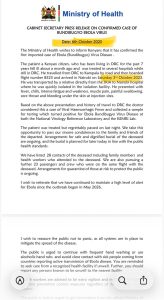
Duale’s announcement confirming Kenya’s first imported case and death from Ebola Bundibugyo virus disease has been overshadowed by glaring errors in the official press statement issued by the Ministry of Health.
An initial statement released today, Tuesday, October 6, 2026, contains an apparent copy-and-paste error that dates the press release October 6, 2025, a year earlier than the actual announcement.
It has since, however, been rectified.
An even more glaring discrepancy appears in the account of the patient’s arrival in Kenya. While the Ministry’s statement and subsequent reports indicate that the Kenyan arrived in Nairobi on Saturday, October 3, 2026, the original release reportedly refers to the date as October 3, 2023.
The conflicting dates have raised questions over the accuracy of an official communication issued during a public-health emergency, when precise information is critical to contact tracing and public confidence.
Despite the errors, Duale confirmed that Kenya has recorded its first imported case of Ebola Bundibugyo virus disease (BDBV), with the patient dying while receiving treatment at Nairobi Hospital on Monday night.
The patient, a Kenyan citizen who had lived in the Democratic Republic of Congo (DRC) for seven years, had fallen ill about a month before travelling to Kenya. He had reportedly sought treatment at several health facilities in the DRC before travelling by road to Kampala, Uganda.
From Kampala, he boarded Jambojet flight 8523, arriving at Jomo Kenyatta International Airport at about 1.10pm on Saturday, October 3.
Duale said the patient underwent routine public health screening at JKIA before passing through immigration. He was subsequently picked up by a relative and a friend and driven directly to Nairobi Hospital in a Toyota Fielder.
“He underwent the normal public health scrutiny at JKIA and was transported by a relative and friend from JKIA using KDG 699Z Toyota Fielder to Nairobi Hospital, where he was isolated in an emergency room,” Duale said.
The patient was later moved to the hospital’s East Wing isolation facility, which was used during the Covid-19 pandemic and has more than 145 beds.
He presented with fever, chills, intense fatigue, weakness, muscle pain, painful swallowing, sore throat and bleeding under the skin at injection sites.
Doctors suspected a viral haemorrhagic fever and collected samples that subsequently tested positive for Ebola at the National Virology Reference Laboratory and Kenya Medical Research Institute (KEMRI) laboratories.
“The doctors considered his case as that of a viral hemorrhagic fever and collected samples which turned positive for Ebola,” Duale said.
Despite supportive treatment, the patient died at about 11.30pm on Monday. His burial was scheduled for Tuesday under safe and dignified Ebola burial protocols.
The Ministry has identified 28 contacts who interacted with the deceased, including relatives and health workers, while authorities are tracing 23 passengers and four crew members who were aboard the Jambojet flight. Arrangements have also been made to quarantine people considered to be at risk.
The confirmation comes against the backdrop of a major Bundibugyo Ebola outbreak in the DRC, which began in May 2026 and has spread within the region. Uganda previously reported cases but was declared Ebola-free by the World Health Organisation in August.
Kenya had maintained heightened surveillance since the outbreak began. By October 6, the Ministry said it had screened 652,584 travellers, tested 267 samples in five laboratories and trained 4,971 health workers on Ebola prevention and management.
The Ministry has notified the WHO of the confirmed case under the International Health Regulations and urged Kenyans not to panic.
However, the date discrepancies in the CS’s statement are likely to draw scrutiny, particularly because the government had repeatedly emphasised the importance of accurate surveillance, screening and timely communication in preparing Kenya for the threat of Ebola.
In June, Duale told Parliament that Kenya had activated national preparedness systems because of the regional outbreak and the country’s position as a major regional transport hub.
The Ministry has advised Kenyans to maintain hand hygiene, avoid close contact with sick people arriving from areas experiencing active Ebola transmission and seek medical attention if they develop symptoms.