Retirement politics and police leadership crisis
According to publicly available information, IGP Kanja and DCI Director Amin have attained the age of 60. Public records indicate that Kanja joined the police service in 1985, while Amin reportedly turned 60 in October 2024 and was subsequently granted a two-year extension.

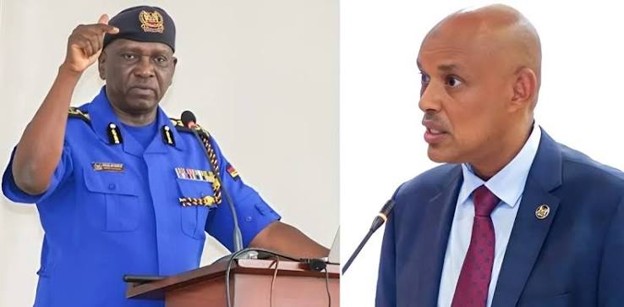
Kenya’s escalating wave of political violence, criminal gangs and goonism has exposed troubling questions about the leadership, independence and effectiveness of the National Police Service as the country heads towards the 2027 General Election.
There is growing concern surrounding Inspector-General of the National Police Service (NPS) Douglas Kanja and Director of Criminal Investigations Mohamed Amin, whose leadership has come under increasing scrutiny following a series of violent incidents despite President William Ruto’s directive that criminal gangs, organised violence and lawlessness be dealt with decisively and within the law.
Lobbyists, political leaders and the church have called for their exit from office over escalating anarchy by militia-like youthful groupings whose operations have continued unabated.
The President Ruto’s July 21, 2026 directive came amid rising political tensions and reports of intimidation and disruption of lawful political activities. It was widely interpreted as a warning that the government would not tolerate the emergence of politically sponsored gangs.
Yet subsequent events have raised questions about whether the security agencies have acted with the urgency expected of them.
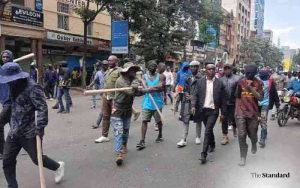
The most disturbing incident occurred in Homa Bay County, where suspected hired goons disrupted rallies associated with the Linda Mwananchi movement.
The violence left at least two people dead, including a police officer, and more than 50 others injured. Property was also destroyed, while images of armed and violent groups operating with apparent confidence circulated widely.
Questions are lingering over the whereabouts of the police as the violence unfolded, and why senior police commanders appeared unable or unwilling to prevent it.
“The problem goes beyond operational shortcomings and is linked to the politics surrounding the tenure and retirement of senior commanders,” a source within the National Police Service intimated.
The controversy has its roots in amendments introduced through the Statute Law (Miscellaneous Amendments) Act of 2015, which altered Section 29(1) of the National Police Service Act. The changes have been interpreted as strengthening presidential influence over the tenure of senior police commanders.
The Inspector-General, Deputy Inspectors-General and Director of Criminal Investigations are State officers under Article 260 of the Constitution.
Questions have consequently arisen over how continued service beyond the mandatory retirement age interacts with presidential authority and the constitutional requirement for an independent, professional police service.
According to publicly available information, IGP Kanja and DCI Director Amin have attained the age of 60. Public records indicate that Kanja joined the police service in 1985, while Amin reportedly turned 60 in October 2024 and was subsequently granted a two-year extension.
“There is a growing morale issue within the National Police Service,” our source added.
Some officers reportedly question why senior commanders who have reached retirement age continue occupying positions that could be filled by younger officers, while others fear that the possibility of further extensions could encourage caution rather than decisive action.
The concerns have been amplified by allegations of politically sponsored violence including recent accusations concerning alleged organised disruption of opposition activities, including claims surrounding the so-called “Hammer Boys” blamed for the Homa Bay violence.
Former Deputy President Rigathi Gachagua has alleged that millions of shillings were allocated to finance such operations.
Homa Bay Town Member of Parliament (MP) Peter Kaluma who has also been summoned by the National Cohesion and Integration Commission (NCIC) alongside Gachagua among other leaders over alleged hateful remarks have separately quoted colossal amounts of monies spent allegedly to mobilise goons in counter-accusations.
The critical issue, however, is not simply the existence of the accusations. It is whether the police have investigated them with sufficient speed, transparency and professionalism.
In a functioning democracy, allegations of politically organised violence should attract prompt investigations regardless of who is implicated.
Failure to demonstrate such impartiality risks creating the perception that politically connected actors are protected while ordinary citizens and opponents face the full weight of the law.
Such perceptions are dangerous. They weaken confidence in security institutions, undermine police legitimacy and can encourage impunity at precisely the moment Kenya needs stronger institutions.
The controversy has also revived debate over the long-delayed police reform agenda.
Retired Chief Justice David Maraga has given President Ruto seven days to release the report of the National Taskforce on Improvement of Terms and Conditions of Service and Other Reforms for members of the National Police Service, Kenya Prisons Service and National Youth Service. Maraga has indicated that he could make the report public if the deadline is ignored.
The taskforce report, handed to the President in November 2023 after extensive consultations, was intended to provide a comprehensive blueprint for addressing structural weaknesses in Kenya’s security services.
Its mandate covered welfare, leadership, accountability, operational effectiveness, institutional culture, recruitment, promotions, transfers and legal reforms.
Nearly three years later, the continued absence of the full report from the public domain has become increasingly difficult to reconcile with the country’s security challenges.
The irony is stark: Kenya possesses a reform blueprint prepared at public expense, yet concerns about police leadership, accountability, political interference and operational effectiveness continue to deepen.
The government therefore faces a choice that goes beyond the fate of individual commanders. It must demonstrate that the National Police Service is governed by law, professional standards and constitutional principles rather than political calculations or questions of personal tenure.
With the 2027 elections approaching, the stakes are exceptionally high. Kenya cannot afford a security apparatus perceived as hesitant, compromised or politically selective.
Releasing and implementing the police reforms report, clarifying the retirement and tenure of senior commanders, and ensuring credible investigations into politically linked violence would be important steps towards restoring public confidence.
The credibility of the National Police Service—and the country’s democratic stability—may ultimately depend on whether the government confronts these questions before political temperatures rise even further.