Bankrupt Juba? South Sudan embassy in Nairobi sued over four years of unpaid salaries
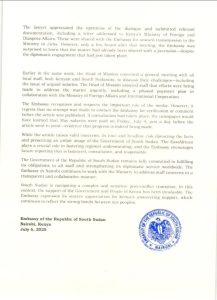
In a quick rejoinder through a statement dated July 6, 2025, Juba admitted the financial turmoil its mission in Nairobi is facing adding that both Kenyan and South Sudanese workers have been affected

In a classical scenario where a cash-strapped mission of a foreign country is facing a complete operational paralysis in a host country, the embassy of South Sudan in Nairobi is not only glaring at a total shutdown but also a legal nightmare for non-payment of salaries and wages to local employees stretching for 53 months now in a row.
The extent of the financial struggle by the embassy came to the fore after nine Kenyan nationals sued the government of the Republic of South Sudan, accusing it of failing to pay them salary arrears worth $320,195 (approximately Ksh41.7million and SSP 1.47 billion) spanning for a period of four years.
In a quick rejoinder through a statement dated July 6, 2025, Juba admitted the financial turmoil its mission in Nairobi is facing adding that both Kenyan and South Sudanese workers have been affected.
“The Embassy acknowledges that there are accumulated salary arrears affecting both Kenyan and South Sudanese local staff…Many South Sudanese staff have also been affected, depending on their individual contracts and periods of service,” a stamen by the embassy read in part.
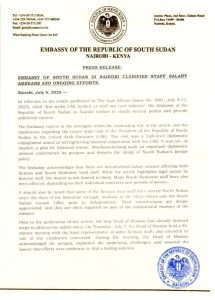
“It should also be noted that some of the Kenyan local staff have served South Sudan since the days of the liberation struggle, working in the SPLA offices and the South Sudan Liaison Office prior to independence. Their contributions are deeply appreciated, and they are often regarded as part of the institutional memory of the mission.” The embassy added.
The group employed at the South Sudanese embassy in Nairobi claim the unpaid wages have accumulated over a 53-month period in a case that has revealed a crisis over civil servant pay both within and outside South Sudan’s borders.
The employees work in different sections of the embassy including foreign affairs, immigration and security.
In separate but coordinated lawsuits filed at the Milimani Law Courts in Nairobi, the workers argue that they were never issued written employment contracts despite serving the embassy since 2012.
One of the claimants, Charles Erika Eloto, stated in court filings that while he had worked diligently, he had only received partial or irregular salary payments since 2016. He said salary payments between 2013 and 2015 were the only consistent ones during his 13 years of service.
The staff allege that salary inconsistencies began in 2016, with some months unpaid and others paid in half.
They claim to have received no payment between October and December 2016, and again from August to December the following year. In 2025, they report missing pay between April and June.
In their legal submissions, the workers argue that their agreed working hours were from 8:00 am to 5:00 pm, six days a week, but they were often required to work beyond this without additional pay contrary to the Kenyan labour laws.
They claim to have repeatedly requested their dues both verbally and in writing, but without success.
Letters submitted as evidence include multiple salary demands addressed to the embassy and a formal complaint sent to Kenya’s Ministry of Foreign Affairs on April 14, 2025, before filing the lawsuit.
The workers are represented by lawyer Nicodemus Ouma, who has cited a 2020 Kenyan Court of Appeal decision that limits the use of diplomatic immunity in labour disputes.
In that case, the court ruled that diplomatic protections do not apply to employment matters, especially when local labour laws are allegedly violated.
That precedent may influence the current case. Judges Wanjiru Karanja, Hannah Okwengu and Fatuma Sichale, who presided over the earlier case involving Sweden’s embassy in Nairobi, concluded that embassies are not immune from legal claims involving commercial or labour related activities.
The suit comes in the middle of broader financial pressures on the South Sudanese government.
The country has long struggled to meet salary obligations for its public servants. In 2016, 2020, and again in 2024, Juba admitted it was behind on wage payments.
In one widely reported incident, a South Sudanese diplomat in Rome, Gai Lel Ngundeng, was filmed sobbing on the streets after being evicted for failing to pay rent due to delayed salary payments.
In December 2024, South Sudan’s Ministry of Finance announced the gradual release of salary arrears following a directive by President Salva Kiir.
Officials blamed the delays on disruptions to oil revenue, particularly after pipeline damage in neighbouring Sudan. Members of Parliament had reportedly gone four months without pay, while military personnel had waited up to ten months.
The Nairobi claimants are seeking full payment of their alleged arrears with interest at court rates of 12 percent, in addition to legal fees.
Impeccable sources at the South Sudanese embassy in Nairobi intimated that the mission is seeking to have an out of court settlement instead of engaging in a full-blown legal battle.
This comes at a time the President Salva Kiir led administration is facing deep financial quagmire.
In May this year, South Sudan was ordered by the High Court in London to pay Afreximbank $657 million over loans for pandemic and infrastructure support.
This is the equivalent of 47 per cent of South Sudan’s government revenue. According to the court filing, Afreximbank lent $400 million to South Sudan in 2019 for trade-enabling infrastructure.
Afreximbank lent a further $63 million in August 2020 for Covid pandemic support, followed by a further $193 million in December 2020.
The High Court has agreed with Afreximbank that all three loans are in default, and has been ordered South Sudan to pay the principal plus interest.
Currently, South Sudan is facing a dire hunger crisis and disease outbreaks including cholera, exacerbated by ongoing droughts and flooding related to the climate emergency, years of conflict and waves of returnees and refugees fleeing the civil war in Sudan.
In 2017, Bishop Edward Hiiboro Kussala of Tombura-Yambio, South Sudan and the head of the Sudan Catholic Bishops’ Conference in Juba hit headlines after he dared the South Sudan government to declare bankruptcy.
Hiiboro challenged South Sudan to admit it is bankrupt after it failed to raise the funds to host Independence Day celebrations for a third year running.
Hiiboro said it would be courageous for the government “to declare that there is no money in South Sudan.”
“When a country can no longer pay the interest on its debt or convince anyone to lend it money, it has reached bankruptcy,” Hiiboro said in a statement.