Abass Khalif sets sight on Lang’ata seat, taking aim at Jalang’o ahead of 2027

South C Ward Member of County Assembly (MCA) Abass Khalif has formally declared his intention to contest the Lang’ata parliamentary seat in the 2027 General Election, setting the stage for what is shaping up to be one of the most competitive political battles within the Orange Democratic Movement (ODM) in Nairobi.
Khalif, a businessman-turned-politician and a long-serving grassroots mobiliser in South C, is positioning himself as an insider challenger to incumbent Member of Parliament (MP) Felix Odiwuor, popularly known as Jalang’o.
While careful to avoid direct personal attacks, Khalif’s entry into the race signals growing discontent within sections of ODM’s grassroots over representation, party loyalty and development delivery in the constituency.
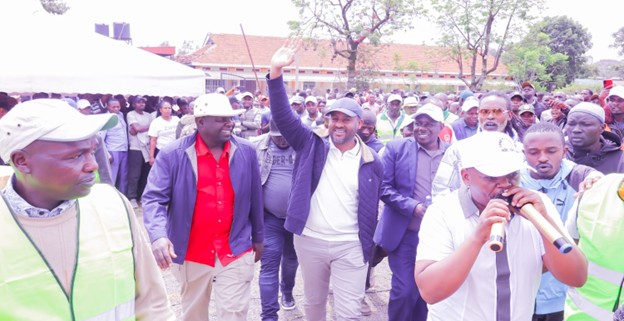
On Sunday, December 14, 2025, Khalif convened more than 4,000 registered voters at the Technical University of Kenya parking grounds, where he publicly announced his bid.
While addressing a mammoth crowd drawn largely from South C, Nyayo Highrise, Mugoya and surrounding estates, Khalif framed his candidacy as a continuation of ODM’s core political philosophy, unity, inclusivity and people-centred leadership.
“I am a member of ODM and I support the Broad-Based Government,” Khalif told the gathering.
“We fully support the president as things stand. We are here to make sure things work for Nairobi and the country at large. I wish to formally inform you that I will be seeking to be the next MP for Lang’ata come 2027.”
His remarks place him firmly within the camp of ODM leaders backing the broad-based political arrangement pact between President William Ruto and the late former Prime Minister Raila Odinga, a stance that has reshaped Kenya’s political landscape but also stirred debate within opposition ranks.
Khalif has been keen to cast himself as a stabilising figure at a time when national politics remains fluid. He repeatedly called for unity and an end to divisive politics, arguing that political infighting has historically slowed development in urban constituencies such as Lang’ata.
“We should shun divisive politics and embrace unity. Unity brings development for all,” he said. “Discrimination and bad politics only hold our people back.”
Unlike many aspirants who emerge close to election cycles, Khalif has built his political brand from the ward level. As South C MCA, he has cultivated a reputation for hands-on engagement with residents, particularly on issues of urban infrastructure, youth empowerment and business regulation.
His supporters argue that his experience at the county assembly has given him a firm grasp of budget-making processes, oversight and intergovernmental relations skills they say are critical for an MP in a constituency that straddles middle-income estates and informal settlements.

Khalif’s background as a businessman has also featured prominently in his political messaging.
He frequently speaks about efficiency, accountability and value for money, themes that resonate in a constituency where voters are increasingly demanding measurable outcomes rather than rhetoric.
“He understands how money works and how systems fail,” said one ODM mobiliser at the Sunday meeting. “That’s why many of us believe he can fight for better planning and transparency at the national level.”
Khalif has been explicit about his loyalty to ODM, making it clear that his ambition is to secure the party’s nomination rather than pursue alternative political vehicles. This places him on a collision course with Jalang’o, whose political journey has at times drawn scrutiny from ODM diehards over perceived ideological flexibility.

While Jalang’o faces incumbency backlash from the Lang’ata residents, particularly among younger voters and media-savvy constituents, Khalif’s camp believes the ODM primaries will favour a candidate with deeper party roots and a stronger grassroots network.
“Khalif represents ODM values,” said a party official allied to his campaign. “The party will have to decide whether it wants popularity or ideological consistency.”
Khalif has already begun urging residents to intensify voter registration, signalling an early focus on numbers and mobilisation rather than last-minute alliances.
“Register as voters and mobilise others to register,” he told supporters. “We will use the vote to elect the leaders we want.”
Khalif’s decision to openly support the Broad-Based Government while contesting on an ODM ticket reflects a calculated political strategy aimed at straddling party loyalty and national pragmatism.
By aligning himself with both ODM and the current power-sharing arrangement, he is appealing to voters who prioritise stability and access to government resources.
Political analysts note that Lang’ata, with its mix of working-class voters, professionals and politically active youth, is fertile ground for a message that blends reformist ideals with cooperation across political divides.

However, Khalif’s challenge will be to translate ward-level popularity into constituency-wide appeal and to withstand the intense scrutiny that comes with taking on a high-profile incumbent.
As the 2027 race slowly gathers momentum, Khalif is betting that discipline, organisation and ideological clarity will give him an edge in what promises to be a bruising ODM primary and a closely watched parliamentary contest.
Whether that gamble pays off will depend on how successfully he can convert grassroots enthusiasm into a constituency-wide movement capable of reshaping Lang’ata’s political future.