Ruto signs tax laws extending 8 per cent VAT on fuel, cuts duty on construction materials

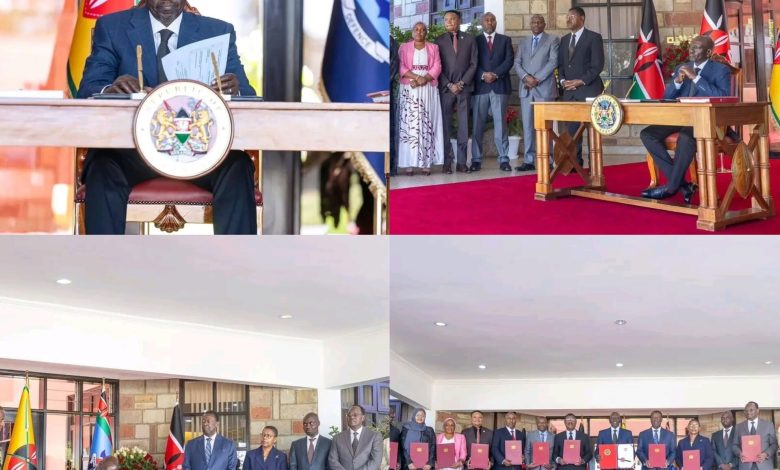
President William Ruto has this morning signed into law two tax measures extending the reduced Value Added Tax (VAT) rate on petroleum products to cushion consumers against rising fuel costs while introducing changes to the taxation of construction materials and the operations of the Kenya Revenue Authority (KRA).
Ruto assented to the Tax Laws (Amendment) Act, 2026, and the Kenya Revenue Authority (Amendment) Act, 2026, at Eldoret State Lodge in Uasin Gishu County on Friday, October 16.
The Tax Laws Amendment Act retains the eight per cent VAT rate on petrol, diesel and paraffin for an initial 90 days, with the possibility of a further 90-day extension by the Cabinet Secretary for the National Treasury through a Gazette notice.
The extension follows the expiry on October 14 of the previous tax relief introduced in April, as global oil markets continued to experience volatility linked to the crisis in the Middle East.
Deputy Chief of Staff Josephat Nanok told the President that the measure was intended to shield households and businesses from the economic effects of international oil market disruptions.
“The Bill first sustains the 8 per cent VAT application on petroleum products, that is, petrol, diesel, and paraffin, to ensure that the effect of the crisis that has been seen in the part of the Middle East does not affect the Kenyan economy without the public being cushioned,” Nanok said.
He added that consultations with the Energy and Petroleum Regulatory Authority (EPRA) and the Ministry of Energy had ensured the reduced rate was incorporated into fuel price calculations.
“Had that 8 per cent not been factored, the price of fuel announced by EPRA was going to be higher than announced,” he said.
The law also changes the basis for calculating excise duty on tiles from weight to surface area, setting the rate at Sh400 per square metre. The change addresses concerns that weight-based taxation had increased construction costs.
Excise duty on ceramic sanitary ware, including sinks, wash basins and toilets, has also been reduced from Sh50 to Sh30 per kilogramme.
Additionally, the Act revises the classification of imported flat glass to align taxation with East African Community customs protocols.
Separately, the KRA Amendment Act changes the authority’s board composition by removing ex-officio membership provisions for specified officials and introducing the managing director of the Kenya Ports Authority (KPA) to strengthen coordination between revenue collection and port operations.
The law guarantees KRA funding equivalent to at least two per cent of its estimated annual revenue collections. It also provides an incentive equivalent to three per cent of revenue collected above quarterly targets.