Mount Kenya University overtakes UoN as Kenya’s most popular varsity as enrolment surges past 700,000
The latest 2025 University Statistics Report by the Commission for University Education (CUE) places MKU at the top with 49,294 students, making it the only institution in the country with an enrolment approaching the 50,000 mark.

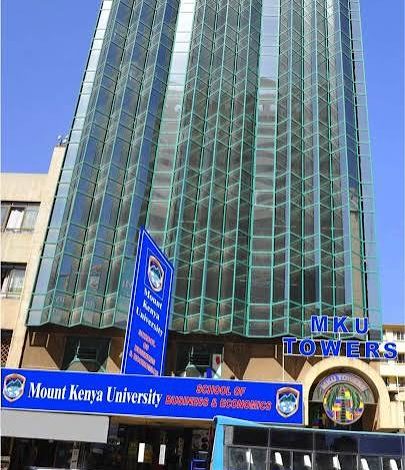
Mount Kenya University (MKU) has emerged as Kenya’s largest university by student enrolment, overtaking traditional public university giants including the University of Nairobi (UoN), Jomo Kenyatta University of Agriculture and Technology (JKUAT) and Kenyatta University (KU).
The latest 2025 University Statistics Report by the Commission for University Education (CUE) places MKU at the top with 49,294 students, making it the only institution in the country with an enrolment approaching the 50,000 mark.
UoN follows with 45,526 students, while JKUAT has 44,946 and Kenyatta University 43,358.
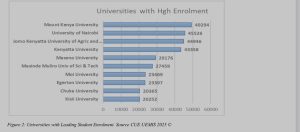
The figures mark a significant shift in Kenya’s higher education landscape, where large public universities have traditionally dominated student numbers. MKU’s position at the top highlights the growing role of private universities in absorbing the rising demand for higher education and expanding access beyond the public university system.
The report shows that Kenya’s university population has crossed the 700,000 mark for the first time, rising to 707,150 students in 2025, from 628,431 in 2024.
According to CUE, university enrolment increased from 559,620 students in 2023 to 628,541 in 2024 before climbing to 707,150 in 2025.
“Kenya’s university enrollment expanded markedly from 559,620 students in 2023 to 628,541 in 2024 and 707,150 in 2025,” the report says.
“This represents a 12.3 per cent growth between 2023 and 2024, followed by a stronger 12.5 per cent increase between 2024 and 2025, and an overall 26.4 per cent rise over the three years.”
MKU leads private university expansion
MKU’s emergence as the country’s largest university by enrolment is particularly significant because it comes against a backdrop of continued dominance of the public university sector.
CUE reports that public chartered universities collectively enrolled 534,942 students, up from 469,688 in 2024. Chartered private universities, meanwhile, enrolled 153,099 students.
The remaining students were distributed among public and private constituent colleges and institutions operating under Letters of Interim Authority.
The report says the concentration of students in a small number of institutions demonstrates clear tiers within Kenya’s university system.
“It is evident from the figure that a small group of universities absorbs a disproportionately large share of students, with Mount Kenya University, the University of Nairobi, Jomo Kenyatta University of Agriculture and Technology, and Kenyatta University each enrolling over 40,000 students,” CUE says.
“This concentration illustrates a clear tiering within the sector, where a handful of large institutions dominate, followed by a middle group of universities with enrollments between 20,000 and 30,000, and a smaller tier just above 20,000 students.”

MKU’s leading position underscores how private universities have increasingly become an important part of Kenya’s response to growing demand for university education.
Rather than operating only as alternatives to public institutions, large private universities are now enrolling tens of thousands of students and helping accommodate a rapidly expanding population seeking higher education.
CUE notes that the prominence of MKU at the top of the enrolment table “underscores the increasing role of private universities in expanding access, complementing the still-dominant public sector.”
The development also reflects changing patterns in the university market, with students distributed across institutions offering different programmes, locations, learning models and entry pathways.
Public universities still dominate
Despite MKU’s position as the single largest university by enrolment, public universities collectively remain the dominant providers of university education.
After the four institutions above the 40,000-student threshold, Maseno University had 29,176 students, followed by Masinde Muliro University of Science and Technology with 27,459.
Moi University had 23,469 students, while Egerton University recorded 23,397.
Chuka University and Kisii University had 20,365 and 20,252 students respectively.
CUE says the uneven distribution of students reflects the massification of higher education, but also creates disparities among institutions.
“The pattern reflects the massification of higher education in Kenya, where demand for university education has grown rapidly and institutions, particularly large public universities have scaled up to accommodate this demand,” the report says.
“At the same time, the uneven distribution of students suggests that many smaller or newer institutions are attracting significantly fewer students, reinforcing disparities within the system.”
Gender gap narrows
The expansion of university education has also been accompanied by a narrowing gender gap.
Male enrolment increased from 321,778 to 381,165 students, representing an 18.4 per cent rise.
Female enrolment grew faster, increasing from 237,191 to 325,985 students, a 37.4 per cent increase.
The figures point to a substantial increase in women’s participation in university education as overall access expands.
However, CUE warns that rapid growth in enrolment could put institutions under pressure to maintain educational standards.
“The expansion reflects improved access to higher education and stronger human capital development prospects. However, the pace of growth raises concerns about quality assurance, as universities may struggle to match rising enrolment with adequate infrastructure, staffing and resources,” the report says.
CUE also warns that the growing number of graduates could increase pressure on the labour market, making closer alignment between university programmes and employment opportunities increasingly important.
More universities, more students
The number of institutions offering university education also increased, rising from 79 to 83 as of May 2026.
The growth was driven mainly by an increase in chartered private universities and public university constituent colleges.
Chartered public universities remained at 38, while chartered private universities increased from 28 to 32.
Public university constituent colleges rose from five to eight, while private constituent colleges remained at two. Institutions operating under Letters of Interim Authority declined from seven to three after four institutions received full university charters.
MKU builds global career pathways as student welfare takes centre stage
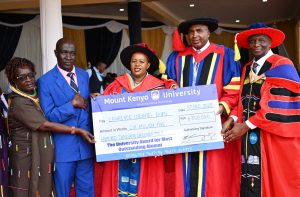
MKU is increasingly linking student welfare, practical training and global exposure to employability, rolling out initiatives designed to prepare learners for both Kenyan and international labour markets.
A key pillar is the university’s international career pathways.
Since 2023, 81 Kenyan nursing students have benefited from MKU’s Germany Nursing Apprenticeship Programme, with the fifth cohort of 27 apprentices departing in April 2026.
The programme, supported by German partners including Hochschule Koblenz University of Applied Sciences and AG-Career Hub, combines practical training, mentorship and exposure to the German healthcare system.
Varsity’s Vice-Chancellor Prof Deogratius Jaganyi earlier said MKU is also pursuing approval to become a TELC examination centre, enabling students to undertake German-language proficiency examinations locally.
The university is similarly expanding opportunities in the maritime sector.
Its Maritime Academy in Malindi has trained 1,065 students in STCW-related courses, with more than 400 graduates securing placements with international cruise companies, including Royal Caribbean, Norwegian Cruise Line, Carnival, MSC and Princess Cruises.
MKU has also invested in student welfare and social impact.
In 2024, MKU Founder and Chairman Prof Simon Gicharu directed the unconditional release of certificates withheld over fee arrears, waiving balances amounting to Sh82 million.
The MKU Foundation has further introduced scholarships, including a full scholarship for environmentalist Truphena Muthoni, while the university’s Sh100 million, 10-year alumni grant programme is supporting graduates undertaking community-impact initiatives.

Meanwhile, MKU’s partnerships, including its 2025 pact with Abu Dhabi Maritime Academy, are expanding opportunities for curriculum development, internships, exchanges, cadetships and industry engagement.
Prof. Gicharu said the MoU signed on November 18, 2025 is a significant step in strengthening world-class maritime education in Kenya, empowering our seafarers for the global industry.
Together, the initiatives illustrate an institutional strategy focused not only on awarding degrees, but also on welfare, practical skills, international exposure and transition into employment.