Brown, bows and big names: Inside Charlene Ruto’s grand Koito
The ceremony, which formally brought together the families of Charlene and Tanzanian technology entrepreneur Isaya Yunge, combined Kalenjin cultural traditions with the unmistakable glamour of a high-profile family occasion.

The helicopters came first, their blades slicing through the quiet of Kilgoris as they ferried some of Kenya’s most recognisable political figures to Intonna Heritage Farm.

Then came the motorcades.
One after another, vehicles carrying Cabinet secretaries, governors, senators, MPs, senior State officials and celebrities made their way into President William Ruto’s expansive Narok property.
But yesterday, Saturday, August 8, the attention at the farm was not on politics.
It was on Charlene Ruto.
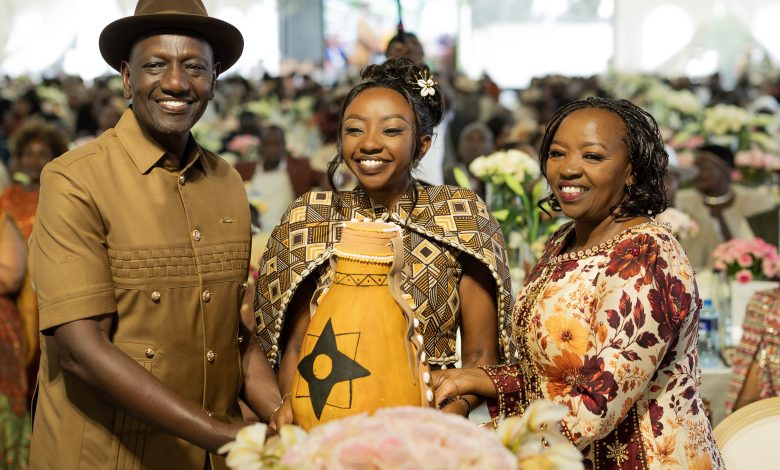
Dressed for one of the most important traditional ceremonies in her life, the President’s daughter was at the centre of a colourful Koito — the Kalenjin traditional engagement ceremony through which her family formally welcomed Tanzanian technology entrepreneur Isaya Yunge into the fold.
For a day, the politics that usually surrounds the Ruto family gave way to family, culture and celebration.
Brown was the colour of the day, with guests embracing the carefully chosen theme in their outfits. The expansive farm was transformed into a carefully choreographed celebration, blending traditional Kalenjin customs with the polish and grandeur expected of an event involving the President’s family.
The ceremony brought together the two families to formally recognise Charlene and Yunge’s union and begin discussions around customary obligations, including bride price.
A Koito is more than a colourful gathering. It is a cultural bridge between families, bringing relatives together through negotiations, gifts, food, song, dance and traditional ceremony.
And at Intonna, that bridge stretched beyond Kenya’s borders.
The man Charlene is marrying
Away from the glamour of the ceremony, much of the curiosity surrounding the occasion centred on the man who has won Charlene’s heart.
Yunge is a Tanzanian technology entrepreneur whose career has been built around an ambition to use technology to expand opportunities for young Africans.
He is co-founder and chief executive of SomaApps Technologies, the company behind SomaApp, a mobile platform designed to connect students with scholarship opportunities.
The idea was born from a problem Yunge and his team identified: scholarships are often available but remain unclaimed because young people who could benefit from them do not know they exist.
SomaApp seeks to close that information gap by bringing scholarship opportunities together and matching students with programmes for which they may qualify.
But education technology is only one part of Yunge’s ambitions.
He has also founded KAYA, a smart speaker using artificial intelligence to collect Africa-related data, and Somafit, a smartwatch designed to monitor health indicators including blood pressure and heart rate in real time.
His vision extends to accelerating the adoption of mobile software, artificial intelligence and Internet of Things technologies in Tanzania and across Africa.
His work has brought international recognition.
In 2017, his startup won the GSMA Mobile Money Africa Hackathon award for best startup in Africa. He was subsequently named among Forbes Africa’s 30 Under 30, which recognises young entrepreneurs and change-makers on the continent.
In 2018, he received the Queen’s Young Leaders Award from the late Queen Elizabeth II for his work using technology to develop sustainable solutions and improve communities.
A year later, he was named among Tanzania’s 50 most influential young people.
Yet the polished image of the technology entrepreneur tells only one part of his story.
Yunge has described a childhood far removed from the privileged circles he now moves in. Raised by his grandmother, he spent part of his early years herding goats and cattle and working around rice plantations.
His journey eventually took him from rural Tanzania into international technology and leadership circles.
He holds a bachelor’s degree from the Institute of Finance Management and studied at the University of Cambridge. He also underwent training by the Swedish Institute on sustainable business models and pursued studies in leading change at Cambridge.
His interest in young people and leadership predates his technology ventures.
In 2006, Yunge was elected chairperson of the Junior Council of the United Republic of Tanzania. He later represented young people at international forums, including speaking at a G8 Summit in Berlin after being selected as a UNICEF Africa Youth Ambassador.
On Saturday, however, it was not his technology credentials that mattered most.
It was the joining of two families.
When politics took a back seat
The guest list reflected the stature of the Ruto family.
Deputy President Kithure Kindiki attended with his wife, while Prime Cabinet Secretary Musalia Mudavadi led a large Cabinet delegation.
Among those present were Interior CS Kipchumba Murkomen, Health CS Aden Duale, Mining, Blue Economy and Maritime Affairs CS Hassan Joho, Energy and Petroleum CS Opiyo Wandayi, Roads and Transport CS Davis Chirchir, Defence CS Soipan Tuya, Gender CS Hanna Cheptumo, Lands CS Alice Wahome, Public Service CS Geoffrey Ruku, Attorney General Dorcas Oduor and Information, Communications and Digital Economy CS William Kabogo.
National Assembly Speaker Moses Wetangula and Senate Speaker Amason Kingi were also among the guests.
Others included Secretary to the Cabinet Mercy Wanjau, Chief of Staff and Head of Public Service Felix Koskei and presidential adviser Charles Keter.
There was also a notable presence from the family of former Prime Minister Raila Odinga.
Ida Odinga, Kenya’s representative to the United Nations Environment Programme and Raila’s wife, was among those who escorted Charlene to the ceremony. She was accompanied by her children, EALA MP Winnie Odinga and Raila Odinga Jr.
The governors’ contingent included Nairobi’s Johnson Sakaja, Baringo’s Benjamin Cheboi, Embu’s Cecily Mbarire, Nandi’s Stephen Sang, Kirinyaga’s Anne Waiguru, Bungoma’s Kenneth Lusaka, Tharaka-Nithi’s Muthomi Njuki, Uasin Gishu’s Jonathan Bii, Narok’s Patrick Ole Ntutu, Elgeyo-Marakwet’s Wisley Rotich and Nakuru’s Susan Kihika.
The Senate was represented by ODM leader Oburu Oginga, alongside Karen Nyamu, Hilary Sigei, Jackson Mandago, Aaron Cheruiyot, Irene Mayaka and Allan Chesang.
Among the MPs were Majority Leader Kimani Ichung’wah, Lang’ata MP Phelix Odiwuor, popularly known as Jalang’o, Nairobi Woman Representative Esther Passaris, Kapseret MP Oscar Sudi, Bomet Woman Representative Linet Chepkorir Toto, Nelson Koech, Silvanus Osoro, Mwengi Mutuse, Musa Sirma, Leo Wamuthende and Gathoni Wamuchomba.
Principal Secretaries Raymond Omollo, Julius Bitok, Judith Pareno, Dr Ouma Oluga, Dr Chris Kiptoo and Nixon Korir also attended, alongside KRA Commissioner General Adan Mohammed and Deputy Inspector-General of Police Eliud Lagat.
CNN journalist Larry Madowo was among the other prominent guests photographed with the President, while Naiyanoi Ntutu Ng’eno, widow of the late Emurua Dikirr MP Johana Ng’eno, was also present.
Yet for all the familiar political faces, the ceremony belonged to Charlene and Yunge.
The presence of the country’s political elite may have added spectacle to the occasion, but the essence of the day remained unmistakably traditional.
In the songs, colours, gifts, family gatherings and negotiations was an age-old Kalenjin ritual — one that turns a relationship between two people into a bond between families.
And so, as the helicopters lifted off and the motorcades eventually wound their way out of Intonna Heritage Farm, the political theatre of Nairobi seemed a world away.
In Kilgoris, it was simply a daughter beginning a new journey, surrounded by family, friends and a remarkable cross-section of Kenya’s establishment.
For Charlene Ruto and Isaya Yunge, the day was not about the offices held by their guests or the headlines that would follow.
It was about two families saying yes to a future together.