President Ruto’s US visit and its link to the peace process in DRC

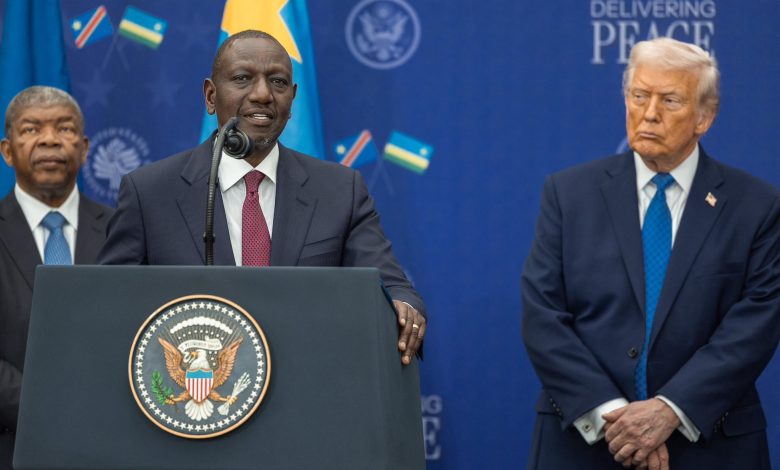
President William Ruto’s visit to the United States at a time of heightened geo-political tensions in the African Great Lakes region underscores the complexity of Kenya’s diplomatic positioning.
His engagement with key US officials and business stakeholders takes place amid the unfolding peace process between the Democratic Republic of Congo (DRC) and Rwanda, the potential for Kenya to act as a peacekeeper in the DRC, and the backdrop of Kenya’s growing relations with China.
These developments are shaping the contours of Kenya’s foreign policy, highlighting its strategic importance within the broader framework of US-African relations and the increasing competition between global powers for influence on the continent.
At the heart of Ruto’s visit lies the ongoing tension in the DRC and the involvement of external powers, particularly Rwanda. The fragile peace process between DRC President Félix Tshisekedi and Rwandan President Paul Kagame, mediated by the United States; has made significant strides in recent months, culminating in a planned summit hosted by US President Donald Trump.
This summit aims to formalise a peace agreement, with high hopes that it will address the long-standing conflict, especially in the resource-rich eastern DRC, where fighting between government forces and rebels backed by Rwanda has escalated.
While the United States has taken a leading role in pushing for peace in the region, its interests are far from purely humanitarian. The DRC is home to critical resources such as cobalt, lithium, copper, and rare earth elements (REEs), vital for the manufacturing of semi-conductors, batteries, and other advanced technologies.
The US has a vested interest in ensuring regional stability not only for human rights reasons but also for access to these strategic minerals, which are central to its technological ambitions in artificial intelligence (AI) and renewable energy sectors.
The significance of this summit is amplified by the growing role of US businesses in the African continent, particularly in the tech and energy sectors. For Kenya, which has emerged as a key regional partner in peacekeeping and diplomatic efforts, the resolution of the DRC-Rwanda conflict could lead to a greater role in stabilising the region, potentially through peacekeeping missions funded by the United States.
Kenya’s strategic location on the Horn of Africa, bordering the Indian Ocean and acting as an economic hub for East and Central Africa, has long made it a key player in regional peacekeeping missions, notably in Somalia. It is this regional influence, coupled with its growing economic footprint, that has cemented Kenya’s importance in US foreign policy.
The US has positioned Kenya as a cornerstone of its engagement with Africa, underscoring its role in counter-terrorism efforts, particularly against Al-Shabaab, and its commitment to fostering economic growth on the continent.
The recent escalation of violence in eastern DRC and the potential for Kenya to contribute to peacekeeping efforts through the deployment of peacekeepers would align with Washington’s strategic priorities.
However, this is contingent on Kenya’s capacity to navigate its relationships with both the West and China, two global powers with competing interests in Africa.
Ruto’s visit comes at a time when Kenya’s foreign policy is facing scrutiny, particularly regarding its relations with China. His provocative statement in Beijing about Kenya and China being “co-architects of a new world order” raised eyebrows in Washington, as it seemed to signal a potential pivot towards China.
The US, under President Trump’s administration, has been increasingly wary of China’s Belt and Road Initiative (BRI) and its growing influence in Africa, particularly through infrastructure investments funded by Chinese loans.
This rhetorical shift has prompted a series of diplomatic responses, including the cancellation of a high-level visit by US Vice President JD Vance to Nairobi in November. The US administration’s concerns are not only rooted in economic competition but also in the ideological implications of Kenya’s growing ties with China.
As Kenya was recently designated a Major Non-NATO Ally (MNNA) by the US, this designation carried expectations of strategic alignment with Western interests, particularly in matters of security and governance.
Ruto’s visit to the US, therefore, is part of a delicate balancing act, where Kenya seeks to reaffirm its commitment to strengthening trade and diplomatic ties with the US while maintaining its growing relationship with China. The diplomatic implications are clear: Kenya must demonstrate that it can be a reliable partner to both the US and China without jeopardising its standing with either.
Despite the concerns raised by Washington, Ruto’s visit to the US was framed as an opportunity to deepen economic and diplomatic ties. Discussions with key stakeholders such as the Chief Executive Officer of the United States International Development Finance Corporation (DFC), Ben Black, focused on the areas of food security, infrastructure, energy, and ICT. These sectors are pivotal for Kenya’s economic growth and align closely with US investment priorities.
The expansion of Kenya’s energy sector, particularly in renewable sources like geothermal, wind, and solar power; is a priority for both Kenya and its US partners. The DFC’s willingness to engage with Kenya on these projects, including infrastructure development like the modernisation of Jomo Kenyatta International Airport and major road expansions, underscores the growing convergence of interests between the two countries.
The proposed National Infrastructure Fund, which has attracted attention from international financial institutions such as the International Finance Corporation (IFC) and the International Monetary Fund (IMF), further reflects Kenya’s proactive approach to securing global investment.
Kenya’s focus on innovation, sustainable growth, and technology has positioned it as a competitive destination for global investors. Ruto’s emphasis on the country’s young, skilled workforce and its robust legal framework for business is aimed at reassuring investors of the security and transparency of their investments.
Ruto’s visit to the US, combined with the ongoing peace process in the DRC and the growing competition for African resources, signals a broader geopolitical shift.
The US is increasingly viewing Africa as a battleground for influence between China, Russia, and the West. While Kenya has sought to position itself as a neutral player, the expectations from Washington are clear: Kenya must choose a strategic direction that aligns with its long-term interests.
As the US looks to expand its investment footprint in Africa, Kenya’s role as both a diplomatic bridge and a stabilising force in the region will be tested. Should the peace process between DRC and Rwanda succeed, Kenya’s role in peacekeeping operations, potentially funded by the US, will be pivotal.
However, as Kenya continues to cultivate relations with China, it risks straining its relationship with the West, especially if its rhetoric and actions are perceived as favouring Beijing.
President Ruto’s visit to the US is emblematic of the complex geopolitical dynamics facing Kenya as it navigates the competing interests of global powers.
At the core of this balancing act is Kenya’s ability to maintain its strategic partnerships with both the United States and China while playing a leading role in regional peace and security. As the peace deal between the DRC and Rwanda moves toward fruition, Kenya’s potential involvement as a peacekeeper reflects its growing geopolitical importance.
The visit also underscores the necessity for Kenya to clarify its diplomatic posture. While the country seeks to position itself as a neutral player, the reality of geopolitical competition demands greater clarity in its strategic alignments.
The US has made it clear that it values Kenya as a partner, but it also expects consistency and strategic coherence in its foreign policy approach. How Kenya navigates its international relationships, between East and West, and between security, economic growth, and regional stability; will determine its future role in the global arena.