Ruto blame predecessors for Northern Kenya’s marginalisation, issues apology

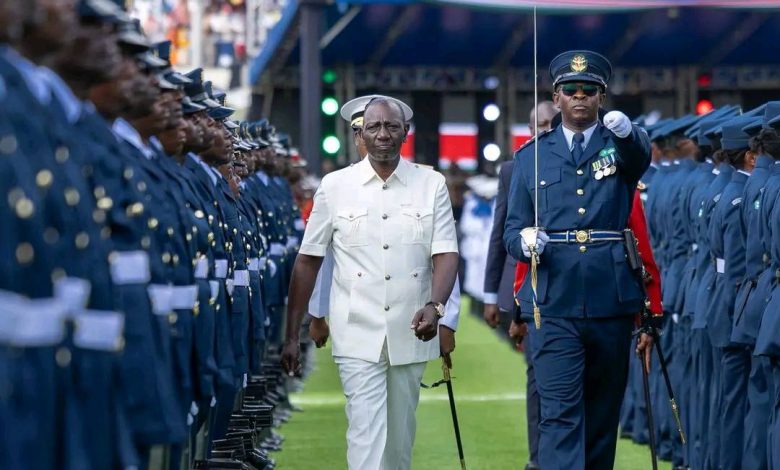
President William Ruto has used this year’s Madaraka Day celebrations in Wajir today, June 1, 2026 to issue a historic apology to the people of Northern Kenya for what he termed as decades of marginalisation ostensibly shifting blame to his predecessors, while unveiling an ambitious package of reforms and investments aimed at accelerating development, expanding educational opportunities, and transforming the region into a key driver of Kenya’s economic growth.
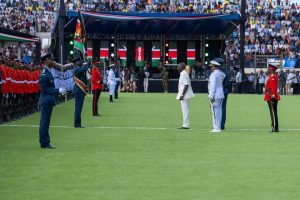
Addressing thousands of residents at Wajir Stadium during the 63rd Madaraka Day celebrations — the first time the national event has been held in Northern Kenya — the President acknowledged that successive governments had failed to provide equal development opportunities to the region, leaving communities grappling with poor infrastructure, limited access to education and healthcare, and economic exclusion.
Ruto pointed to Sessional Paper No. 10 of 1965, which prioritised public investment in areas deemed to have high economic potential, as one of the policies that entrenched regional inequalities.
“The people of Northern Kenya have borne the burden of marginalisation for decades,” he said.
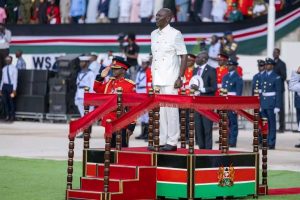
“On behalf of the people of Kenya today, as I stand here as president and leader of our great nation, to the people of Northern Kenya, for this marginalisation, I want to apologise on behalf of the nation of Kenya. Poleni sana. It was never meant to be this way.”
The president said his administration was committed to correcting the historical imbalance through targeted investments in roads, schools, healthcare facilities, water projects, housing and other critical infrastructure.
He also defended his government’s decision to abolish the controversial vetting process previously imposed on residents of Northern Kenya seeking national identity cards, saying the move was intended to end decades of discrimination against legitimate Kenyan citizens.
“We did not abolish verification of citizenship. We abolished discrimination. We abolished the targeting of entire communities simply because of their ethnicity or place of birth,” he said. “A strong nation does not choose between security and justice. A strong nation protects both.”
The reforms, introduced through the Presidential Declaration on Registration and Issuance of IDs and Birth Certificates in Northern Kenya signed in Wajir in February 2025, have already enabled thousands of young people to obtain identification documents without undergoing additional vetting procedures.
However, locals are decrying infiltration of non-Kenyans who are taking advantage of the abolition of vetting exercise to illegally obtain Kenyan legal documents from Somalia and Ethiopia.
Education featured prominently in the president’s address, with Ruto describing learning as the next frontier of Kenya’s liberation and development.
“Unlike in 1963, the next frontier of Kenya’s liberation will not be fought on conventional battlefields. It will be won in classrooms and lecture halls, laboratories and workshops, and in innovation hubs,” he said.
To promote educational inclusion, Ruto directed Education Cabinet Secretary Julius Ogamba to begin consultations on formally integrating Duksi, Madrassa and pastoral instruction programmes into Kenya’s education system.
The president said many children in marginalised regions remain outside the formal education system because alternative learning pathways are not recognised.
“I direct the Cabinet Secretary for Education to engage all relevant stakeholders and take the necessary measures under the Basic Education Act to consult widely and recommend appropriate measures for the formal integration of the same,” he said.
“This will ensure that every child, regardless of background or circumstance, has a recognised pathway into learning, skills and opportunity. Every child deserves a door into learning. It is our duty to open every door.”
Ruto highlighted the government’s growing investment in education, noting that the sector’s budget has risen from Sh500 billion in 2022 to more than Sh702 billion today.
He said more than 100,000 teachers have been recruited over the past three years, with an additional 20,000 expected to be employed this year.
The President also cited affirmative action measures aimed at addressing teacher shortages in Northern Kenya, including the operationalisation of teacher training colleges in Wajir, Kotulo and Mandera alongside Garissa Teachers Training College.
According to Ruto, 1,800 teachers from Wajir, Mandera and Garissa counties have already been recruited and deployed within the region, while 4,616 students from the area are currently enrolled in teacher training institutions.
He further announced plans to establish a university in Wajir County, saying construction would begin this year.
“You, people of Wajir, will help me identify the site for the construction of the university as we spur development in this region and Kenya at large,” he said.
The President also outlined a major economic empowerment programme targeting pastoral communities, unveiling a Sh5 billion County Livestock Investment Company initiative that will enable more than 350,000 pastoralists across 21 Arid and Semi-Arid Lands (ASAL) counties to establish and own livestock investment companies.
Drawing comparisons with the Kenya Tea Development Agency (KTDA) and dairy cooperatives, Ruto said pastoralists should also become shareholders in enterprises built around their livestock.
“Just as tea farmers own their factories through KTDA and dairy farmers own their cooperatives, pastoralists too must own and control the businesses built around their livestock,” he said.
The initiative will provide access to markets, financing, insurance services and value-addition opportunities, helping transform livestock farming from a subsistence activity into a modern commercial enterprise. The first phase is expected to benefit more than two million household members.
Ruto also announced plans to operationalise the Livestock Enterprise Development Fund, establish a national strategic food and fodder reserve, strengthen pastoral cooperatives, roll out a nationwide animal identification and traceability system, and expand infrastructure required to access premium export markets.
The President noted that livestock contributes about 12 per cent of Kenya’s Gross Domestic Product and 42 per cent of agricultural GDP in ASAL counties, while accounting for more than 90 per cent of employment and 95 per cent of household incomes in pastoral regions.
Governor Ahmed Abdullahi hailed the decision to hold Madaraka Day celebrations in Wajir for the first time, describing it as a defining moment for the county and the wider northeastern region.
He said the event had reinforced the message that Northern Kenya is fully integrated into the country’s future and praised government investments in infrastructure, healthcare, housing and roads.
In a symbolic gesture of appreciation, the governor announced that Wajir elders would present President Ruto with 100 camels, describing the gift as the highest honour in the local culture.
“In our culture, when you honour someone, the highest honour is given to kings,” Abdullahi said. “The elders of Wajir have said that you are our king, and they will give you 100 camels to be delivered at a place of your choice. You are our sultan.”
Declaring that “Wajir is not the edge of Kenya, Wajir is Kenya,” Ruto said Northern Kenya would play a central role in the country’s future through investments in education, livestock, infrastructure, regional trade and human capital development.
“Our message is clear,” he said. “No child is too far away to deserve opportunity, and no county is too remote to deserve development.”