MPC set to meet amid calls for further cut on key interest rate
According to KBA, their analysis shows that inflation and inflation expectations remain well anchored within the target range

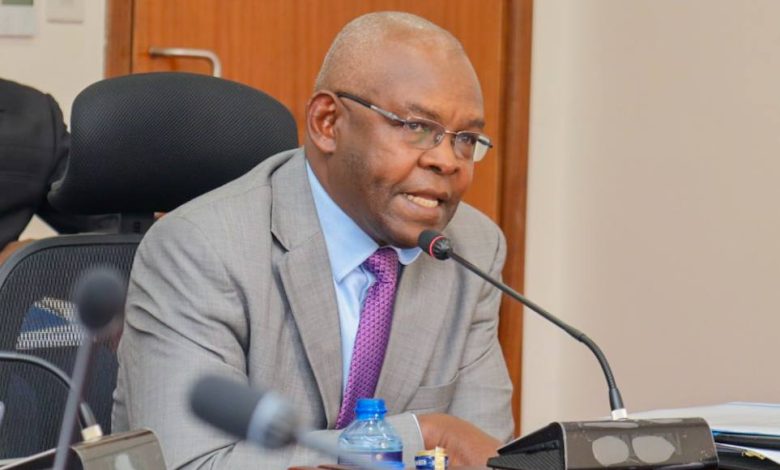
The Central Bank of Kenya Monetary Policy Committee (MPC) will meet on Tuesday amid high expectations that it will further cut the Central Bank Rate (CBR) to bolster lending to the private sector.
The Kenya Bankers Association (KBA) said in a research note last week that there is scope to cut the Central Bank Rate (CBR) to support credit growth and anchor economic growth citing a low and stable inflation and minimal threats on exchange rate stability as well as a favourable external interest rate differential.
“This will complement the structured efforts to resolve the longstanding Government pending bills that are expected to improve NPL (Non-Performing Loans) ratios in the market,” it added.
During its last meeting on June 10, the MPC, which is chaired by CBK Governor Dr Kamau Thugge, for the sixth time in a row cut the Central Bank Rate (CBR) by 25 basis points to 9.75 per cent from 10.00 per cent, saying it was aimed at stimulating lending by banks to the private sector and supporting economic activity, while ensuring inflationary expectations remain firmly anchored, and the exchange rate remains stable.
According to KBA, their analysis shows that inflation and inflation expectations remain well anchored within the target range.
“Headline inflation remained well within the target range of between 2.5% and 7.5% in July 2025, rising marginally to 4.1 from 3.8% in June 2025. The marginal rise reflected an increase in non-core inflation to 7.2% from 6.2% that was moderated by subdued demand in the economy with core inflation remaining largely unchanged at 3.1% from 3.0% in June. Furthermore, the downside risk of passthrough effects from changes in global fuel and other commodity prices remains low,” the note said.
It also warned economic growth, despite depicting resilience supported by stronger agriculture performance, is
fragile; calling for a stronger anchor.
According to its analysis, in the first quarter of 2025, Kenya’s real GDP growth stood at 4.9 per cent similar to levels recorded in the first quarter of 2024 but slower than 5.1 per cent in the fourth quarter of 2024.
“This growth was largely supported by the strong performance of the agricultural sector, which expanded by 6.0% compared to 5.6% in a similar quarter in 2024 and 4.3% in the previous quarter, largely on account of more favorable weather patterns across most parts of the country. Non-agricultural sector recorded strong performance, though slowing down to 4.6% from 4.8% in the first quarter of 2024. This was on account of a slowdown in the services sector that more than-offset the strong growth in industry during the period,” it says.
The note added that analyses of higher frequency data for the first and second quarters of 2025 also show a deceleration in economic activity month after month. In particular, the Kenya Purchasing Managers’ Index (PMI)
declined further for the second consecutive month in June 2025, stood at 48.6, down from 49.6 in May 2025.
“This reflected the sharpest deterioration in business conditions in 11 months, driven by a notable contraction
in business activity, reduced customer spending with elevated input prices, challenging macroeconomic
environment and operational disruptions linked to protests. The downturn was further exacerbated by a
steeper drop in new orders,” it said.
From a global perspective, however, the IMF’s July 2025 outlook projects global growth at a modest
3.0 per cent for 2025 and 3.1 per cent for 2026, down from 3.3 per cent in 2024, marking a slight upward revision
from its April forecast.
According to KBA, this modest improvement still reflects fragile resilience, largely influenced by trade-related
distortions in form of tariffs that have triggered heightened uncertainty.
“In fact, the World Uncertainty Index has increased , albeit with some decline in effective tariff rates. Economic
policy uncertainty is expected to persist throughout 2025 and into 2026, posing a continued risk to global
economic activity.”
The KBA analysis also noted that private sector credit growth recovery is yet to pick up despite notable reductions in lending rates, largely reflecting protracted delay in asset quality improvement and credit consumers taking a wait-and-see attitude on investments in anticipation of lower interest rates in the near to medium term, further adding that private sector credit growth is recovering, but slowly.
“In May 2025, credit to the private sector growth increased to 2.0 per cent, up from 0.4 per cent in April 2025 and -2.9% in January 2025. The slow recovery reflects largely the impact of declining lending rates, with the average commercial bank lending rates easing to 15.4% in May 2025, from 15.7% in April 2025 and 17.2% in November 2024. From the policy front, the average interbank rate continued to oscillate its defined policy corridor (shaded area in Figure 4b), but generally mirroring a decline from 11.06% on January 2, 2025 to 9.6% by August 1, 2025,” it said.
However, the analysis says the sector’s asset quality deteriorated further, with the NPL ratio edging up to 17.6 per cent in April 2025, driven mainly by the real estate, trade, manufacturing, and personal lending segments.
“While banks remain adequately capitalised and liquid, lending activity remains subdued due to weak borrower creditworthiness and tepid demand, pointing to structural frictions impeding the transmission of lower interest rates to increased credit uptake. A resolution of the NPL problem, through such initiatives as the planned securitization of bills in the construction sector, will support a faster recovery in private sector credit leading to stronger rebound of broad money supply in the economy towards its long term mean growth.”
At the same time, KBA pointed out that the yield curve on government securities has flattened for the medium to long term, reflecting increased uncertainty on economic conditions going forward.
“The Kenyan government’s expected fiscal consolidation over the medium term is projected to steadily reduce the fiscal deficit from 5.1% of GDP in FY2024/25 to 2.7% in FY2028/29, thereby lowering debt vulnerabilities and supporting a more sustainable debt-to-GDP trajectory. However, fiscal risks remain elevated due to high debt servicing costs and subdued revenue performance. Commitment to the consolidation efforts would help speed up the declines in interest rates thereby support the transmission of monetary policy signals, reduce uncertainty and entrench a well-behaved yield curve of Government securities. As of July 25th 2025, the yield curve had shifted downward, was well-behaved on the short end (reflecting some well-anchored inflationary expectations) but flat on the medium to long-end reflecting some uncertainty in the market for longer-dated securities.”
The research note also points out that there are minimal threats to exchange rate stability with the external sector performance depicting resilience buoyed by the current account deficit remaining within sustainable bounds.
“The Kenya Shilling demonstrated relative stability, trading at KSh 129.24/USD as of August 1, 2025, supported by strong external sector buffers, including a sustainable current account deficit, strong official foreign exchange reserves, which stood at USD 10.7 billion (equivalent to 4.7 months of import cover) as of July 31, 2025, and sustained diaspora remittances. With waning dollar dominance and more balanced global financial conditions, this has further alleviated external pressures on the Shilling. Despite remaining sustainable, the current account deficit widened in Q1 2025 to US$66.6 million from US$42.0 million in Q1 2024. The wider deficit reflected a temporary dip in services exports and subdued primary income inflows. Nonetheless, this was partially offset by a recovery in key agricultural exports, particularly tea and horticulture, and a significant reduction in petroleum import costs amid declining global prices.”