Mission possible: Kenya deploy fourth contingent to Haiti amid funding freeze by US
The Kenya’s decision to bolster its forces contribution to Haiti comes days after the United Nations confirmed receipt of official notification from the United States freezing the funding pending aid to support the Haiti mission to a tune of Sh1.7billion ($13.3 million)


Kenya has called the funding freeze by the United States of America (USA) to the Kenya-led Multinational Security Support (MSS) mission in Haiti a bluff and deployed a fourth contingent of 144 police officers to the volatile Caribbean nation to curb rampant gang violence despite uncertainty on the sustainability of the peace mission.
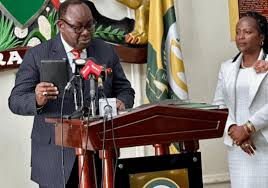
Yesterday, Interior and National Administration Cabinet Secretary Kipchumba Murkomen oversaw the flagging off of an additional 144 police officers comprising 120 men and 24 women to bolster the 600 officers deployed earlier.
The Kenya’s decision to bolster its forces contribution to Haiti comes days after the United Nations confirmed receipt of official notification from the United States freezing the funding pending aid to support the Haiti mission to a tune of Sh1.7billion ($13.3 million)
UN Secretary-General Spokesperson Stephane Dujarric said they had received the notification ordering an immediate stop of work to support the Multinational Security Support (MSS)
“We received an official notification from the US asking for an immediate stop work order on their contribution” to the trust fund to MSS,” Stephane stated.
The freeze comes as part of President Donald Trump’s push to reduce US overseas aid an effort that has included operations to shutter the operations of the government’s main aid agency, USAID.
Other countries, notably Guatemala and El Salvador, have in recent weeks deployed additional officers.
Together with Jamaican and Belizean troops, and supported by Haitian police, we’re making concerted efforts to establish order.” Murkomen said yesterday at the Jomo Kenyatta International Airport while seeing off the police contingent.
“We’re constantly in touch with the UN and countries supporting this mission including the USA whose support in equipment and funding has been invaluable and unwavering.” Murkomen added.
He was flanked by Inspector General National Police Service (NPS) Douglas Kanja, Internal Security and National Administration Principal Secretary Raymond Omollo, Dr Foreign and Diaspora Affairs PS Korir Sing’ oei, National Security Advisor to President William Ruto Ambassador Monica Juma and Deputy National Security Advisor Joseph Boinett, the former police
All the 114 Kenyan police officers, including a 24-member all-women SWAT team, arrived in Port-au-Prince.
The funding, which was allocated to the UN Trust Fund for Haiti, had been expected to help sustain operations. However, Kenyan officials have downplayed the impact, arguing that the mission remains well-funded.
Godfrey Otunge, the force commander of the Haiti operation, dismissed concerns, stating that the frozen funds account for less than 3 per cent of the total financial backing.
“I want to assure everyone, especially the people of Haiti, that the mission remains on track,” Otunge said in a statement.
He emphasised that the US and other partner countries continue to provide logistical, financial, and equipment support, with regular support flights arriving almost daily.
Kenya’s government reiterated that the security mission remains sustainable through the UN Trust Fund for Haiti, where donor nations, including the U.S., Canada, France, Turkey, Spain, Italy, and Algeria, have collectively contributed $85 million.
Government spokesperson Isaac Mwaura stated that the fund remains sufficiently resourced to sustain the mission until September 2025.
While the Multinational Security Support (MSS) mission was approved by the UN Security Council in October 2023, it is not a formal UN peacekeeping operation. Instead, it relies on voluntary contributions, making it vulnerable to financial and political shifts in donor countries.
Kenya has expressed its intention to transition the Haiti mission into a full-fledged UN operation, which would secure long-term financial backing and institutional support. However, such a move would require the approval of the UN Security Council, where geopolitical considerations could play a significant role.
Haiti continues to grapple with one of the worst security crises in its history, with heavily armed gangs controlling vast parts of Port-au-Prince and surrounding areas.
The situation has deteriorated significantly, with gang violence displacing hundreds of thousands of people, overwhelming the Haitian government’s ability to respond. Kenya’s deployment, widely seen as a diplomatic gamble, has put Nairobi at the forefront of an international effort that many wealthier nations have been reluctant to lead.
The mission was initially pitched to Canada, but Ottawa declined, citing military commitments in Ukraine and the Indo-Pacific. Instead, Kenya took up the role, a move heavily backed by Washington under President Joe Biden—but one that now faces uncertainty under the Trump administration.
Kenya’s involvement in Haiti has been both praised and questioned. While it has bolstered Kenya’s international profile, the financial and political risks remain high.
The Trump administration’s funding freeze raises concerns about future US commitments, with Washington’s broader foreign policy shifts potentially affecting the mission’s sustainability. Moreover, no African country has contributed financially to the Haiti mission, signalling donor fatigue and a reluctance to invest in an intervention many see as Washington’s responsibility.