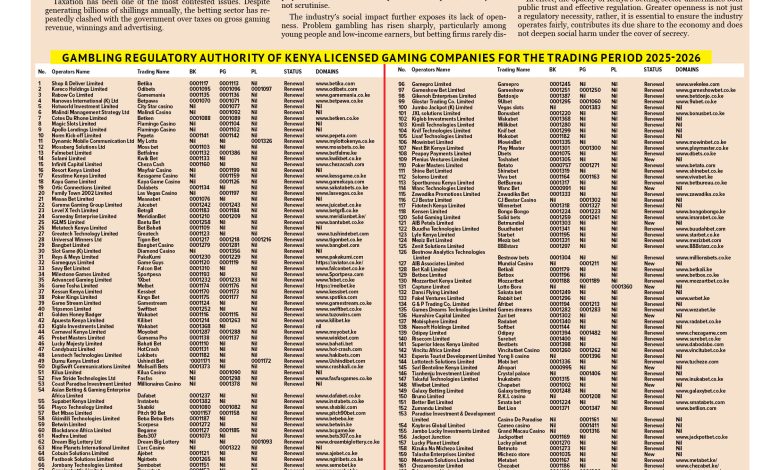
The gambling and betting industry in Kenya has grown rapidly over the past decade, fuelled by widespread mobile phone use, aggressive advertising and the promise of quick returns. Yet beneath its flashy marketing and growing popularity lies an opaque ecosystem that has raised serious concerns among regulators, policymakers and the public.
At the centre of the problem is limited transparency. While betting firms are licensed by the Gambling Regulatory Authority (GRA), the true ownership structures of many operators remain unclear.
Several companies are registered through complex corporate arrangements, including offshore entities, making it difficult to establish who ultimately controls them or where profits end up.
This opacity complicates regulatory oversight and raises questions about tax compliance, capital flight and potential links to money laundering.
Taxation has been one of the most contested issues. Despite generating billions of shillings annually, the betting sector has repeatedly clashed with the government over taxes on gross gaming revenue, winnings and advertising.
Firms have challenged tax demands in court, sometimes halting payments while cases drag on. This has created uncertainty about how much the exchequer actually earns from gambling, reinforcing perceptions that the industry operates in the shadows while exploiting regulatory loopholes.
Consumer protection is another grey area. Betting companies collect vast amounts of personal and financial data from users, yet there is little public information on how this data is stored, shared or monetised. With weak enforcement of data protection laws, punters remain vulnerable to exploitation, targeted advertising and potential breaches.
Moreover, the true odds and algorithms that determine betting outcomes are not subject to independent public audits, leaving players reliant on trust in companies whose operations they cannot scrutinise.
The industry’s social impact further exposes its lack of openness. Problem gambling has risen sharply, particularly among young people and low-income earners, but betting firms rarely disclose data on addiction rates, self-exclusion effectiveness or spending patterns. Corporate social responsibility initiatives are often highlighted in marketing, yet there is little transparency on their scale, funding or measurable impact.
Political influence also clouds the sector. Over the years, allegations have emerged of close ties between betting firms and powerful political or business interests, sometimes coinciding with regulatory leniency or abrupt policy reversals. Without clear disclosure of lobbying activities or political contributions, public confidence in the independence of regulation remains low.
Recent government crackdowns and proposed reforms, including stricter licensing rules and higher taxes, signal recognition of these challenges. However, without robust transparency requirements—covering ownership, revenue reporting, data use and social impact—the gambling industry is likely to remain a black box.
In effect, the opacity of Kenya’s betting sector undermines both public trust and effective regulation. Greater openness is not just a regulatory necessity, rather, it is essential to ensure the industry operates fairly, contributes its due share to the economy and does not deepen social harm under the cover of secrecy.