From MES to NESP: Little know Sunview Medipro International contracted to supply medical equipment worth billions to counties
Under the current framework, Sunview Medipro International has been contracted to deploy an initial 98 Diagnostic Imaging CT Scan Machines (2 per county), 2 Diagnostic Imaging Mammogram Machines, 400 Operating Theatres, and 400 Laboratories across the country

It is now official that the little known Sunview Medipro International is the new firm contracted to handle the medical equipment leasing deal under the National Equipment Service Program (NESP) by the Ministry of Health (MoH) in collaboration with the Council of Governors (CoG), an arrangement that was controversially rejected by governors at its inception stage.
The pullout by governors came days after the National Treasury allocated more than Sh9billion for the project in the 2023/24 budget with, at the time, shadowy contractors whose firms were kept away from the public knowledge and scrutiny.
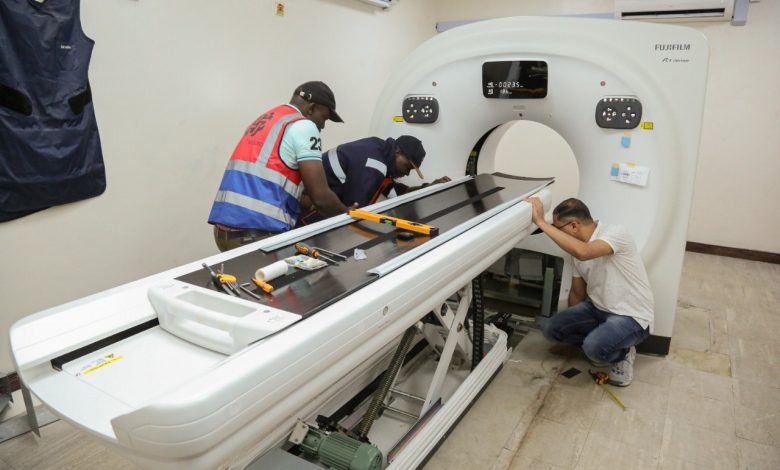
However, currently, Sunview Mediprol International is reportedly said to have already launched Phase 1 of a large-scale installation of advanced medical equipment across public health facilities at the national, county, and sub-county levels in Kenya that include 98 CT Scans, 400 theatres and labs across the counties.
In our previous initial two-part series dubbed ‘From MES to NESP’ broadcasted last year, we gave you blow by blow account of what was initially buoyed as the then Universal Health Coverage (UHC) national healing scheme to the ailing national healthcare infrastructure, in 2015, the Managed Equipment Services (MES) programme was mooted in what was supposed to be a seven years’ deal at an initial cost of Sh39billion, but until its termination nine years later in July 2023, the cost had parachuted to Sh63billion.
Successively, upon scrapping of the MES programme, MoH, in consensus with the Council of Governors (CoG) mid 2023, MoH rebranded MES to National Equipment Service Project (NESP) and fully transition under the management of the national government informing governors’ pulling out from the arrangement.
In what pointed to a probable false start for NESP, just like MES project worth tens of shillings of billions that was numerously shrouded in and marred by financial and contractual controversies, tendering and onboarding of medical equipment suppliers under NESP remains opaque.
Under the current framework, Sunview Medipro International has been contracted to deploy an initial 98 Diagnostic Imaging CT Scan Machines (2 per county), 2 Diagnostic Imaging Mammogram Machines, 400 Operating Theatres, and 400 Laboratories across the country.
Sunview Medripro will implement the project under a Fee-for-Service (FFS) model.
“Our integrated approach ensures that healthcare providers receive seamless support throughout the entire process,” Sirat Amin, the Chief Executive Officer of Sunview Medipro International was quoted saying during the flag-off ceremony at the company’s Nairobi headquarters.
Sunview will be required to deliver the equipment, install, setup and undertake comprehensive training including maintenance services.
They will also supply spare parts, consumables, and provide continuous consultation to ensure uninterrupted and high-quality healthcare delivery.
Installations are already underway in Jaramogi Oginga Odinga Teaching and Referral Hospital, King Fahd Lamu County Referral Hospital, Kerugoya County Referral Hospital and Wajir County Referral Hospital.
According to James Kamau, Principal Supply Chain Officer at the Council of Governors, the first phase will prioritize Level 5 and key referral hospitals.
“With the FFS model in place, public health facilities can now deliver high-end medical services without heavy capital costs,” Kamau said.
“This will save counties millions in maintenance costs, which can be reallocated to hire more health workers and procure essential medical supplies.”
The upgraded facilities are also expected to enable reverse referrals, where patients who would typically seek services at national referral or private hospitals can now access comparable care locally. This shift will support one-stop, quality, and free public healthcare services at the county level, aligning with the goals of the Universal Health Coverage agenda.
To ensure the public can fully benefit from these improved services, county governments are urged to fast-track registration with the Social Health Authority (SHA). This will ensure that no expectant mother or sick patient is denied care due to inability to pay.
“Equipping our health facilities with the right tools is a cornerstone of effective care. This is how we build a responsive, resilient health system,” Health Principal Secretary Dr. Oluga praised the initiative.
Sunview Medipro has partnered with globally recognized manufacturers, including GE, Fuji, and United Imaging, to deliver high-end equipment. Additional deliveries are scheduled over the next 8 to 10 weeks.
The new equipment will enhance diagnostics and treatment across critical specialities, including: Cardiology, Oncology, Neurology, Pulmonology, Urology and Gastroenterology.
Sunview Medipro is also working with regional healthcare professionals — including cardiologists, paediatricians, orthopaedic surgeons, and interventional radiologists — to provide training and ensure optimized clinical outcomes at the county level.
Inception of MES
In February 2015, the Ministry of Health entered into a deal with global companies for supply of medical equipment to two hospitals in each of the 47 counties at Sh39billion.
The ministry awarded leasing agreements to international firms through local contractors which supplied and serviced specialised medical equipment until July 2023 when the contracted was scrapped.
The contracts ended in December 2022 but an extension of a further six months was granted to facilitated medical vendors ensure full rollover of health services.
The firms included General Electric from the US, Philips from the Netherlands, Bellco SGL from Italy, Esteem from India, Mindray Biomedical of China and Symex Europe GMBH from Germany.
Under the lease scheme, Ministry of Health would equip at least two hospitals in every county and the equipment would be leased for seven years through a conditional grant that would see each county pay the ministry deduct Sh95million annually from each of 47 counties for leasing of the equipment.
Initial contracts
The project that was approved by the Health Executives and Finance county executives and had been divided into seven lots including Lot 1: Implemented by Shenzhen Mindray Bio-Medical Electronics Company Ltd involving theatres in 96 hospitals, and Lot 2: Implemented Esteem Industries involving Central Sterilisation Supply Department (CSSD) in the same number of hospitals.
Others are Lot 5: Implemented by Bellco S.R.L involving Dialysis Centres in 49 hospitals, Lot 6: Implemented by Phillips Medical Systems Nederland B.V involving intensive care units (ICU) in 11 hospitals and Lot 7, Implemented by GE East Africa Services Ltd involving Radiology Diagnostics in 98 hospitals.
The medical vendors were to provide and oversee installation, maintenance, replacement, and disposal including training and reporting throughout the contract period.
Now, NESP is fully under the management of the national government saw governors protest with some saying they “had no choice” amid past revelations that counties were kept in the dark regarding details of the agreements including identity of the contractors whom were said to be seven in number.
Last year, Senators raised concerns over the legality of multi-billion-shilling contracts signed between counties and the national government for the lease of the new medical equipment aimed at supplying medical devices to county hospitals under the National Equipment Service Project (NESP).
Also, lawmakers questioned the transparency of the process and the potential financial impact on healthcare delivery in Kenya.
While appearing before the Senate Public Accounts Committee (PAC) on December 3, 2024, Nyeri governor Mutahi Kahiga, who is the vice-chairperson of the Council of Governors (CoG) blew the lid off over the new medical equipment leasing deal under National Equipment Service Project (NESP) terming it as shadowy.
He admitted that county governments were left with little choice but to sign the contracts, despite being kept in the dark about crucial details, including the identities of the suppliers.
Kahiga described the situation as a “desperate move” due to the failure of the previous Medical Equipment Service (MES) project, which saw billions of shillings lost on faulty equipment.
He later termed the process to have been above board and lobbied to support the same.
Senate PAC chairman Moses Kajwang demanded clarity from the governors, asking how the decision to procure the medical equipment was made and under what legal framework.
“How was the decision made and under what procurement law? How sure are you that the cost of running the equipment constitutes value for money?” Kajwang posed adding that it would be difficult to defend devolution if governors allowed such opaque arrangements.
Kahiga explained that counties were left with no choice but to agree, citing financial constraints that made it impossible for them to purchase the required medical equipment.
“We had no option but to sign the deal. Counties do not have the funds to buy this equipment,” Kahiga told the committee
“We did not procure the machines, it’s the Ministry of Health that did the procurement. They even put out advertisements in the newspapers. We were not involved.” He added.
Kahiga further explained that counties were asked to select from 23 lots of equipment needed for local hospitals, but it was only after making these selections that they learned which companies would be providing the machines.
“What they have done is set 23 lots of equipment, so you pick a lot that you think is required for your specific hospital. After picking, you know the providers.” Kahiga said.
“But whoever selected them, that was a programme decided by the national government. We are just landlords.” He added.
He stressed the urgent need for dialysis machines in county hospitals, warning that without them, patients were at risk.
“Currently, dialysis machines are not working in the county government hospitals because the equipment provided under MES has run its course. Anyone that is being put in those machines is risking their life.” Kahiga said.
The NESP, launched as a successor to the controversial MES, aims to provide medical equipment to county hospitals on a leasing basis.
Under the scheme, an undisclosed supplier will install machines in county facilities and receive payments directly from the contentious Social Health Authority (SHA).
However, critics have expressed concern that the leasing fees may consume most of the funds allocated to healthcare, leaving counties with minimal resources for actual healthcare delivery.
Senators have described the NESP as “opaque” and akin to the MES scandal, which saw the Kenyan government spend Sh63 billion on dysfunctional medical equipment.
At least 37 counties have already signed agreements with the Ministry of Health to supply the medical gadgets, but the identities of the suppliers remain unclear.
When contacted for comment on October 23, 2024 during our initial broadcast dubbed ‘From MES to NESP: Mystery of the multi-billion medical equipment leasing deal by MoH Part One’, the then Health Cabinet Secretary Deborah Mulongo Barasa did not respond to our queries.
Subsequently, when separately contacted for comment on October 30, 2024 by The Informer Media Group, neither the then Medical Services Principal Secretary Harry Kimtai nor his Public Health and Professional Standards Principal Secretary Mary Muthoni, who is still the incumbent, responded to our queries to date about the new medical leasing criteria and identity of the vendors and the procurement process.
However, in what is shaping up to be a new multibillion deal shrouded in secrecy, governor Kahiga informed the Senate PAC committee that the Ministry of Health had driven the NESP, with limited input from governors effectively sidelining their input.
In one of our queries, we sought to know if the county governments made recommendations to the Ministry
of Health on the priority health needs of their respective counties to inform the most ideal medical equipment for service provision in the different parts of the country in the new medical leasing deal but no response has been forthcoming for over a month now.
And in what now points to exclusion of county governments involvement in the lucrative venture aimed at addressing healthcare needs in their respective devolved units, governor Kahiga told PAC committee that the ministry handled the procurement process and presented a small group of governors with information about the project.
“We were caught up in a situation in which we know the food is bad and might harm us but it is better that we eat.” Kahiga said noting the urgency of the decision despite its potential drawbacks.
During the session, Nyeri County Attorney Kimani Rucuiya also raised concerns about the legality of the deal.
Rucuiya, who chairs the County Attorneys Forum, argued that the agreement violated the Constitution and procurement laws, pointing out that the Intergovernmental Participation Agreement (IPA) should have preceded the procurement process.
“The government violated the constitutional mandate by directly procuring a function that is devolved.” Rucuiya said.
Despite these concerns, Kahiga defended the governors’ actions, explaining that they were caught between the need to provide essential services and the lack of alternative solutions.
“It was the best option for now.” Kahiga said.
Senators criticised the deal as shady.
Busia Senator Okiya Omtatah demanded that Kahiga specify the legal clauses that allowed counties to sign the agreements.
Isiolo Senator Fatuma Dullo accused the governors of not fully understanding the programme’s operations, suggesting that the deal could be worse than the MES scandal.
“It appears you are confused and don’t know how the programme run.” Dullo said.
Nandi Senator Samson Cherargei criticised the governors for cooperating with the national government in a way that undermines the Constitution’s Fourth Schedule, which outlines the functions of county governments.
“You should resist this attempt to claw back county functions by the national government. If we allow that, then we will be killing devolution.” Cherargei warned.