Ingonga blames IPOA, DCI for delayed justice in police cases

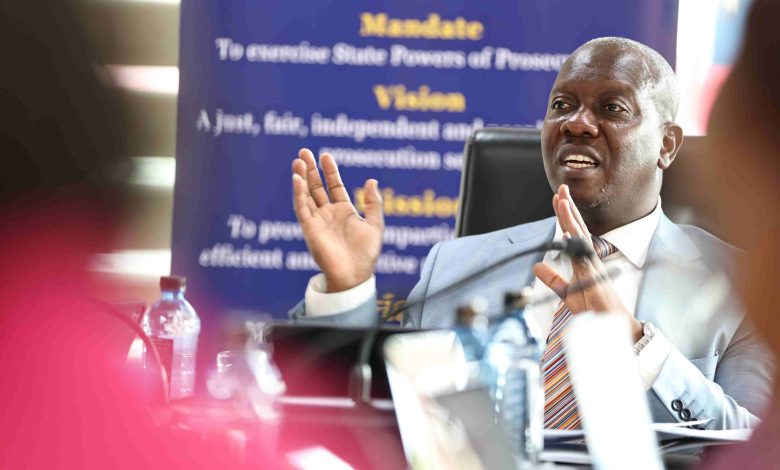
The Director of Public Prosecutions, Renson Ingonga, has criticised investigative agencies for delays that he says are stalling justice in cases involving police officers.
Speaking yesterday during the launch of the Counter Terrorism and Counter Financing of Terrorism (CT/CFT) Curriculum, Ingonga faulted the Independent Policing Oversight Authority (IPOA) and the Directorate of Criminal Investigations (DCI) for failing to promptly submit investigation reports in several high-profile incidents.
He said the delays have left cases unresolved and created public perception that the Office of the Director of Public Prosecutions (ODPP) is reluctant to act against rogue officers.
“No action can be taken unless investigations are completed and files forwarded to us,” Ingonga said, stressing that prosecutions are evidence-driven and cannot proceed without legally sufficient material.
His remarks come amid growing public concern over delayed investigations into incidents such as the Kitengela teargassing, the Witima church attack in Othaya, and police shootings in Huruma and Kakamega.
Ingonga urged the media to help Kenyans understand the distinct roles played by investigative and prosecutorial agencies, noting that the DPP’s office is the “tail end” of the criminal justice process.
“Kenyans often do not understand the roles of these institutions. Unless investigations are completed, the DPP cannot do much,” he said. “It is not enough for an incident to occur and assume prosecution will follow. Investigations and evidence collection are what guide the DPP to court.”
He emphasised that the ODPP will not pursue charges merely to appease public pressure, underscoring the need to protect the rights of all parties, including suspects.
“If the evidence does not meet legal standards, we do not proceed simply for the sake of prosecution. We must also protect the rights of all, including suspects,” he added.
The DPP was speaking at the launch of the CT/CFT curriculum, which he described as a landmark framework designed to strengthen Kenya’s capacity to combat terrorism and transnational organised crime. The programme will be integrated into training at the Prosecution Training Institute to equip prosecutors with specialised skills in handling complex terror-related cases.
Ingonga said lessons drawn from major cases, including the DusitD2 terror attack and a bio-terrorism plot involving anthrax, informed the curriculum’s development.
He highlighted support from international partners such as the British High Commission, the United States Department of Justice, OPDAT and the International Institute for Justice and the Rule of Law, noting that cross-border cooperation is critical in accessing digital and financial evidence through Mutual Legal Assistance mechanisms.
The curriculum also covers emerging threats, including cybercrime, cryptocurrency and decentralised finance platforms, as well as illicit revenue streams such as arms and human trafficking, environmental crimes and extortion networks used to finance terrorism.