Government steps up El Niño preparedness as rains loom
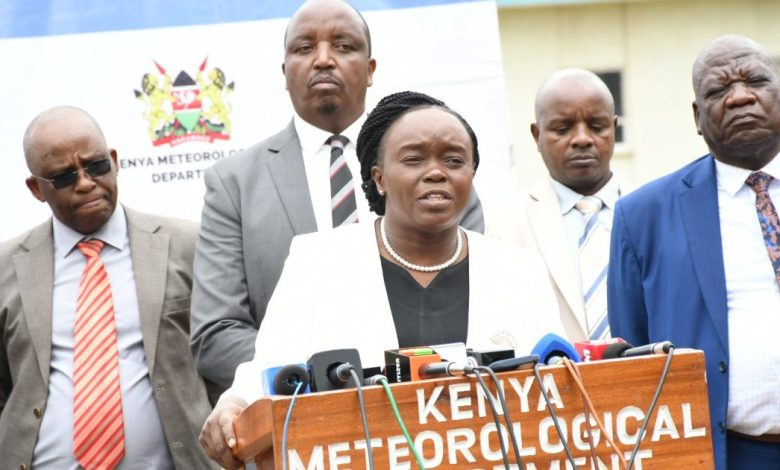
Environment, Forestry and Climate Change Cabinet Secretary Nancy Barasa said the government was moving from a largely technical approach to a people-centred weather forecasting and early-warning system capable of helping communities translate forecasts into practical action.

The government has stepped up preparations for the El Niño weather conditions expected to affect the country from October, warning Kenyans to remain alert, prepare early and rely only on verified information from official and technical agencies.
Speaking during a joint briefing, Broadcasting PS Stephen Isaboke and Government Spokesperson Charles Owino said the government was strengthening coordination and early-warning systems to ensure accurate and actionable information reaches Kenyans before and during the anticipated rains.
“There is no cause for panic. But there is every reason to prepare early, remain alert and follow verified government advisories,” officials said, while urging the public against sharing unverified information.
Environment, Forestry and Climate Change Cabinet Secretary Nancy Barasa said the government was moving from a largely technical approach to a people-centred weather forecasting and early-warning system capable of helping communities translate forecasts into practical action.
She said accurate, timely, science-based information must reach farmers, pastoralists, fishermen, aviation operators and other weather-dependent sectors through county structures, village elders and community forums.
“It is not enough for the focus to remain on the websites or computers. It has to reach the farmer,” Barasa said, adding that meteorological information would also guide decisions in health, transport, education, agriculture and the blue economy.
The government is also developing regulations to strengthen the legal and institutional framework governing meteorological services and plans to establish an ISO-accredited facility to improve quality and compliance with international standards.
Barasa said a 100-day action plan was already being implemented, covering legislation, staffing, infrastructure, observation and data systems, strategic and investment plans and early-warning mechanisms. All State departments will establish national standing committees for preparedness and El Niño incident management.
The government is coordinating with the National Disaster Operations Centre and the Ministries of Interior, Agriculture, Water and Health to mitigate risks including riverine and flash floods, urban flooding, landslides, lightning, strong winds and overflowing lakes, dams and water ponds.
Acting Director of Meteorological Services Edward Maina Muriuki said scientific evidence showed the El Niño signal was firmly established and intensifying, with World Meteorological Organisation forecasts indicating an almost 100 per cent likelihood of persistence through February 2027.
Most parts of Kenya are expected to receive above-normal rainfall, exceeding 125 per cent of seasonal averages, while temperatures are likely to remain warmer than normal, particularly in parts of the Coast and northeastern Kenya.
Muriuki cautioned against directly comparing the current event with the devastating 1997-98 El Niño, noting that the earlier episode coincided with a strong positive Indian Ocean Dipole, while the current IOD is neutral.
Rainfall is expected in western Kenya from September, while most other areas should receive rains between the second and fourth weeks of October.
Muriuki said the meteorological service was shifting from forecasting “what the weather will be like” to impact-based forecasting focused on “what the weather will do”.
The National Crisis Communication Standing Committee is also operationalising a National Crisis Communication Plan to coordinate public messaging before, during and after emergencies.