Dividend trap? How Kenya could lose Sh7billion in Safaricom share sale timing
"Should dividends be declared after the transaction is completed, then of course..........the person who is holding the shares is the one entitled to the dividends," said Ndegwa adding; "it is just like when you buy shares in the Stock Exchange."

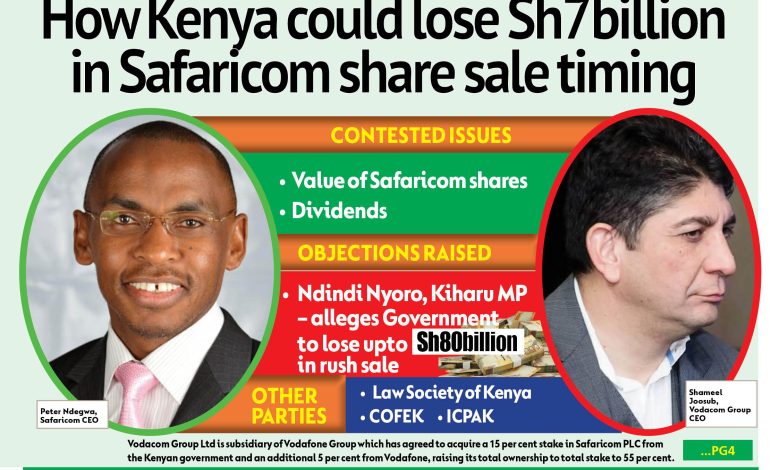
Fresh scrutiny has emerged over the Kenyan government’s proposed sale of a 15 per cent stake in Safaricom PLC to Vodafone-Kenya, amid fears that poorly timed execution and ambiguous contractual clauses could cost the state up to a whooping Sh7billion in dividends.
The controversy has unfolded before Parliament, exposing tension between commercial practice, public interest, and the urgency to raise cash for government spending.
At the centre of the debate is the timing of dividend declaration relative to the completion of the transaction.
Safaricom Chief Executive Officer Peter Ndegwa, appearing before a joint sitting of the National Assembly’s Finance and National Planning Committee and the Public Debt and Privatisation Committee, sought to allay fears that the government would lose dividend income once it sells part of its stake.
Ndegwa insisted that the government is protected by what he described as an “advance dividend clause,” arguing that the State will receive compensation equivalent to future dividends regardless of when Safaricom formally declares and pays them. “The government does not lose regardless of when the dividends are paid. The timing is not a factor because they are receiving the dividends in advance,” he told MPs.
However, his explanation raised more questions than it settled.
Under basic stock market principles, dividends belong to whoever holds shares at the time they are declared.
Ndegwa acknowledged this reality in his testimony. “If dividends are declared pre-transaction completing, it will go to the shareholders who hold those shares at the time,” he said. “Should dividends be declared after the transaction is completed, then of course the person who is holding the shares is the one entitled to the dividends,” Ndegwa said.
“It is a listed business. There is no other easier way of describing that. But if there is anything that I have got wrong there, I am sure the National Treasury can clarify,” the CEO told the MPs.
That statement immediately alarmed legislators, who noted that Safaricom is due to declare dividends within the same window Parliament has to approve and conclude the transaction. Safaricom typically announces interim dividends by late March and final dividends between May and July, with payments following about a month later.
The National Assembly has 28 days from February 10 to about March 10, 2026 to conclude its review of the divestiture. That period overlaps almost perfectly with the window in which Safaricom is expected to declare its interim dividend.
Kinangop MP Thuku Kwenya openly questioned whether the timing was coincidental. “We are dealing with a very informed public. The timing of this transaction is suspicious,” he told the committee. In blunt terms, Kwenya argued that if the sale is completed before dividends are declared, the government risks forfeiting billions of shillings to Vodafone. “In essence what the CEO is saying is that dividends that should have come to the government will be paid to Vodacom,” he said.
Finance Committee chairperson Kuria Kimani conceded that the concerns were legitimate. “You are raising a very valid point,” he told Kwenya, confirming that Parliament’s decision on timing would directly determine who pockets the dividend payout.
The figures involved are significant. Safaricom is Kenya’s most profitable company and a consistent dividend payer. A 15 per cent stake translates into billions of shillings in dividend income annually. MPs estimate that depending on when the sale is completed, the government could miss out on about Sh7 billion in dividends—money that would otherwise flow into the public purse.
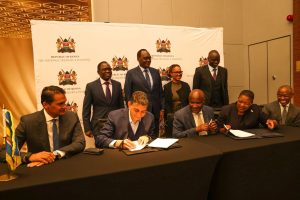
The government plans to sell the shares to raise an estimated Sh204 billion, funds Treasury says will be channelled into “priority” infrastructure projects and broader economic development. Once the sale is completed, the State’s shareholding in Safaricom will fall from 35 per cent to 20 per cent, while Vodafone’s stake will rise to 55 per cent, with public investors retaining 25 per cent.
Critics, however, argue that the dividend issue is only one layer of a much larger problem. Lawmakers, civil society groups and financial analysts have warned that the transaction risks being opaque and undervalued, potentially costing the country up to Sh80billion in the long term.
They argue that sacrificing predictable dividend income for a one-off cash injection could weaken the State’s future revenue stream.
Ndegwa attempted to shift responsibility away from Safaricom, reminding MPs that the company operates under strict rules set by the Capital Markets Authority and the Nairobi Securities Exchange. “Safaricom will run their business as they do,” Kimani echoed, noting that dividend declarations follow regulatory and corporate governance timelines, not parliamentary calendars.
Yet the CEO’s reliance on an “advance dividend” explanation has not been fully unpacked in public. MPs pressed him to clarify how such payments would be calculated, enforced and safeguarded, particularly if dividend performance changes after the sale.
Ndegwa conceded that if there were any misunderstandings, the National Treasury would need to provide further clarification, and he committed to submitting additional details in writing.
Ultimately, the power to delay or fast-track the sale lies with Parliament. As Kimani pointedly told MPs, “The decision to delay the transaction lies with you and not the CEO of Safaricom.”
Political leaders led by Kiharu Member of Parliament (MP) Ndindi Nyoro, professional bodies including the Institute of Certified Public Accountants of Kenya (ICPAK), Law Society of Kenya (LSK) and opposition leaders have warn that unresolved legal and valuation questions continue to shadow the transaction, urging Parliament to pause the process pending a forensic audit.
Appearing before Parliament’s Joint Committee on Finance and Privatisation, Kiharu Member of Parliament (MP) Ndindi Nyoro faulted the Treasury for opting for a non-competitive block sale to Safaricom’s foreign strategic partner, Vodacom.
Nyoro argued that bypassing an international bidding process denied Kenya fair value, insisting the shares should trade at no less than Sh45 each rather than the proposed Sh34. At that price, he warned, taxpayers stand to forfeit tens of billions of shillings.
“We would just cut corners, sell government assets for free, and purport to be the only buyers in the market… who said he is the only buyer?… We should not be discussing anything below Ksh.45 per share, but we have been held hostage by the buyer that we are now running out of breath,” Nyoro said.
Consumer watchdog COFEK has formally petitioned Parliament to halt the deal, branding it “asset stripping” disguised as fiscal reform.
The federation raised alarms over valuation, governance, and constitutional compliance, warning that Safaricom, by virtue of M-Pesa’s dominance constitutes critical national financial infrastructure.
COFEK argued that selling during Safaricom Ethiopia’s capital-intensive phase unfairly transfers risk to Kenyans while denying them future gains once the subsidiary matures.
The petition also accuses the Executive arm of government headed by the president of violating Article 10 of the Constitution by failing to conduct meaningful public participation, at a time when trust in government fiscal decisions remains fragile following the controversial Public Finance Bill 2024.