BusinessCrime WatchHomeMain StoryNational NewsNewsPolitics
Ruto endorses new law to fight public corruption
Those who violate the new law face penalties of up to Sh5 million fine or five years in jail

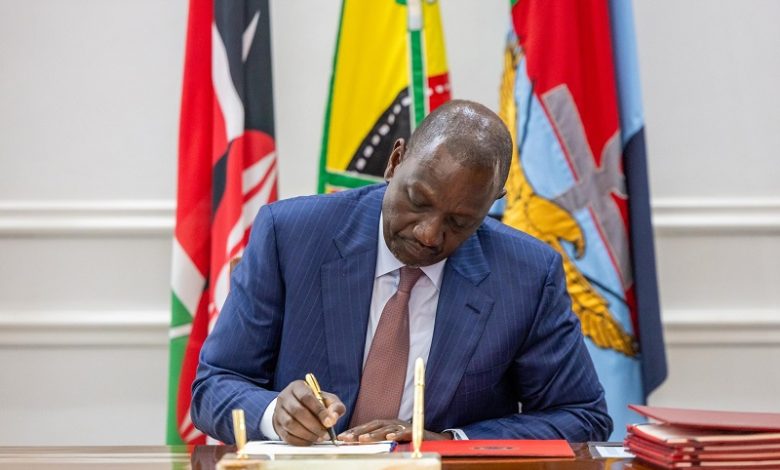
President William Ruto has finally assented to the Conflict of Interest Bill, 2023 tightening the legal framework for tackling public corruption.
The Act consolidates various laws relating to conflict of interest and repeals the Public Officer Ethics Act (Cap. 185B), establishing a comprehensive framework for managing conflict of interest in the discharge of public duties.
The new law, which sponsored by Leader of Majority Kimani Ichung’wah, was first passed, with amendments, by the National Assembly on November 30, 2023 and subsequently transmitted to the Senate for consideration. The Senate passed the Bill with amendments on May 28, 2024. These amendments were referred back to the National Assembly, which led to the formation of a Mediation Committee pursuant to Article 113 of the Constitution.
The two Houses mediated on provisions concerning the consolidation of all laws relating to conflict of interest and the repeal of the Public Officer Ethics Act. A mediated version of the Bill was approved by the National Assembly on December 5, 2024 and by the Senate on April 8.
Following its referral by the President with reservations, the Bill was reconsidered and passed with amendments accommodating the President’s reservations by the National Assembly on June 3 and the Senate on July 23.
The principal objective of the new law is to consolidate all laws related to conflict of interest and to provide a robust legal framework for managing such conflicts under the general supervision of the Ethics and Anti-Corruption Commission (EACC).
The administration of the law will fall under the EACC, in line with Article 79 of the Constitution, which mandates the Commission to oversee compliance with Chapter Six of the Constitution on leadership and integrity, including avoidance of conflict of interest.
The law prohibits public officers, in the performance of official duties, from granting preferential treatment beyond what is allowed by law or written policy. It disallows public officers from being influenced by offers of outside employment in the exercise of official powers, and bars them from entering into contracts with their reporting entities for the supply or disposal of goods.
It also prohibits them from acquiring interests in entities contracting with their public offices and restricts engagement in other gainful employment that conflicts with or impairs their official duties.
To ensure compliance, the law provides for mandatory recusal of public officers from decisions where they would face a conflict of interest. It also introduces a requirement for public officers to declare their income, assets, and liabilities, including those of their spouses and dependent children.
The law outlines procedures for lodging complaints with either a reporting authority or the EACC and bars concurrent investigations of the same matter by both bodies. Investigations must be concluded within 90 to promote efficiency.
Additionally, the law introduces an enhanced wealth declaration regime based on the repealed Public Officer Ethics Act. State and public officers are now required to submit wealth declarations every two years to their respective oversight entities, under the supervision of the EACC. It expands coverage to include previously excluded officials such as the Chief Justice, members of the Cabinet, and Members of County Assemblies.
Those who violate the new law face penalties of up to Sh5 million fine or five years in jail.
The passing of the legislation is part of key reforms demanded by the World Bank and its delay led to the Bretton Woods institution withholding Sh96.93 billion (US$750 million) in budget support to the country.