President Kiir dissolves South Sudan’s unity government ahead of first ever elections
The elections are expected to be contested under a dramatically altered political landscape. Kiir is the presidential candidate of his Sudan People’s Liberation Movement (SPLM), while no prominent challenger has so far emerged to mount a comparable campaign. Machar, the most prominent figure associated with the opposition, remains under house arrest and on trial.

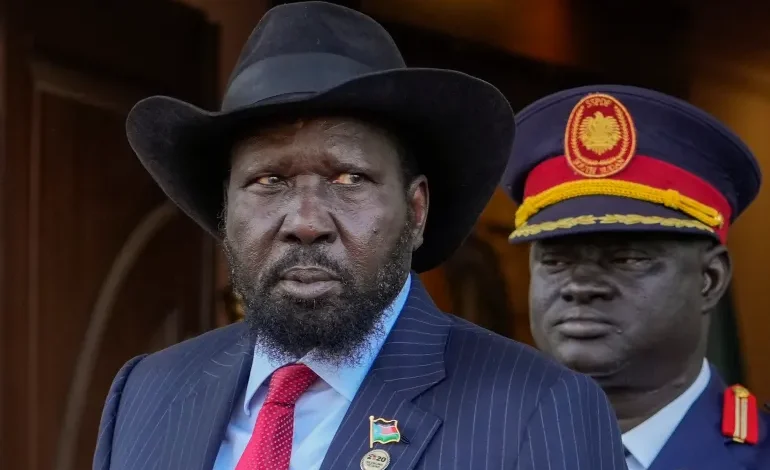
South Sudan President Salva Kiir has dissolved the country’s transitional unity government and appointed a caretaker administration, clearing the way for elections scheduled for December 22 but raising fresh concerns over the concentration of power in the presidency.
The decree, issued on Tuesday, September 22, 2026 brought to an end the power-sharing government established under the 2018 peace agreement that ended five years of civil war between forces loyal to Kiir and his longtime rival, Riek Machar.
Under the order, all Vice-Presidents, Ministers and local administrators were relieved of their positions, while the national and state legislative assemblies were dissolved.
However, the judiciary, security forces and other institutions required to continue operating under the law will remain in place.
Kiir, however, will remain president throughout the electoral period and until a newly elected president assumes office.
“The incumbent president shall remain in office as President of the Republic of South Sudan during the election period until the next elected president assumes office,” the decree said, according to the national broadcaster.
The dissolution came a day after Kiir signed amendments to the National Elections Act after parliament approved changes removing requirements that a permanent constitution and national census be completed before elections could take place.
The changes have enabled authorities to proceed with preparations for the December 22 vote despite several outstanding obligations under the 2018 peace agreement.
South Sudan has never held a national election since gaining independence from Sudan in 2011.
Elections initially expected in 2022 were postponed twice as the transitional authorities struggled to implement the peace deal.
Key tasks still outstanding include completing a permanent constitution, voter registration and the unification of armed forces aligned to rival political factions.
The Reconstituted Joint Monitoring and Evaluation Commission (RJMEC), which oversees implementation of the peace agreement, said South Sudan had entered a “critical phase” with only three months remaining before the scheduled elections.
It urged the parties to agree on a path towards credible elections and a peaceful conclusion to the transitional period.
The transitional period itself is formally due to end on February 22, 2027, following a 24-month extension agreed in 2024, while the National Elections Commission has set December 22, 2026, as the polling date.
Kiir’s move has nevertheless triggered concern among opposition figures and analysts, who argue that the amended electoral framework gives the president unusually broad powers during the election period.
Michael Wani, a lawyer and former member of the constitution-drafting committee, told AFP that Kiir would effectively be the only person in power following the dissolution.
“Kiir will be the only person in power, without vice-presidents, without the executive, without the parliament,” Wani said.
Independent analyst Machot Amuom also questioned the scope of the amended law, saying there was considerable “ambiguity” over the president’s powers.
“The new law gives the president full powers … He can decide even not to go for elections for another year or another two years,” Amuom told AFP.
The government, however, has portrayed the dissolution as a legally necessary step towards ending the prolonged transition rather than abandoning the peace process.
Kiir said the move was consistent with an agreement reached by political leaders in December 2025 to avoid another extension of the transitional period and proceed with elections.
The government has also said preparations for the polls are advancing, including political-party registration, civic education and preparations for voter registration.
The opposition has rejected the recent legal changes.
The main opposition Sudan People’s Liberation Movement-in-Opposition (SPLM-IO), led by Machar, has previously warned against participation in election preparations in areas under its control.
Machar himself remains under house arrest and is facing trial on charges including treason and murder, allegations he denies.
He was removed from his position as First Vice-President after political tensions with Kiir escalated, further complicating the implementation of the power-sharing arrangement created by the 2018 peace agreement.
The political uncertainty has been accompanied by heightened security in the capital, Juba.
AFP reported checkpoints and road closures around the government complex, with security personnel placed on heightened alert.
Soldiers and national security officers were also seen blocking access to government ministries and patrolling parts of the city. Some government employees were reportedly turned away from their offices and instructed to return the following week.
UN agencies in Juba asked staff to work remotely while the situation was monitored.
The government also recently replaced the chairman of the National Elections Commission. Abednego Akok Kacuol was dismissed without an explanation and replaced by commission Secretary-General Gabriel Bol Deng Majok, who was given what the South Sudan Broadcasting Corporation described as a “fresh mandate” to oversee preparations for the elections.
Akok had previously warned that the elections would require about $250 million, while only $21 million had been secured.
The elections are expected to be contested under a dramatically altered political landscape. Kiir is the presidential candidate of his Sudan People’s Liberation Movement (SPLM), while no prominent challenger has so far emerged to mount a comparable campaign.
Machar, the most prominent figure associated with the opposition, remains under house arrest and on trial.
The 2018 peace agreement followed a devastating five-year civil war that killed an estimated 400,000 people and displaced millions, according to the United Nations.
Amnesty International described the dissolution as a “decisive step” towards South Sudan’s first elections, but called on authorities to ensure that citizens and political candidates can participate in a safe and conducive environment.
The transitional government has now been replaced by a caretaker administration as South Sudan enters the final three months before the December 22, 2026 vote under a system in which Kiir remains president while parliament, vice-presidents and the previous power-sharing executive have been removed.