Ruto roots for post-Vision 2030 plan as Mudavadi warn against ethnic politics

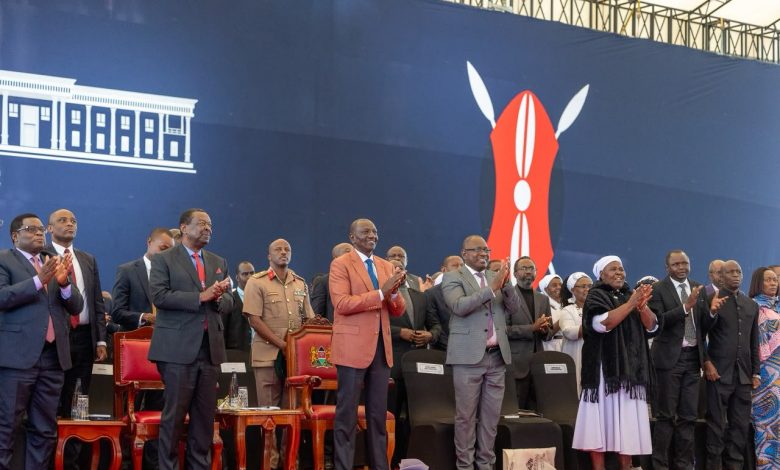
President William Ruto has today renewed his call for a national dialogue to chart Kenya’s development agenda beyond Vision 2030, saying the country’s improving economic stability provides the right moment for citizens to collectively define the nation’s future.
Speaking at State House, Nairobi, during a meeting with members of the Friends Church (Quakers), the president said Kenya had reached a critical stage where all citizens should participate in crafting a shared vision for the next 20 to 25 years.
“Sasa ni nafasi yetu kama Wakenya, tuketi chini pamoja, tupange destiny ya taifa letu la Kenya. Miaka ishirini, ishirini na tano ijayo, tunataka Kenya isimame mahali gani,” Ruto said.
He stressed that Kenya’s long-term future cannot be determined by the government, a single political party or a few individuals.
“Kenya haiwezi kupangwa na serikali pekee, haiwezi kupangwa na chama kimoja, haiwezi kupangwa na wachache, sisi wote tutaketi chini tupange,” he added.
Ruto said the proposed national conversation would build on the gains made under Vision 2030, the country’s long-term development blueprint introduced during former President Mwai Kibaki’s administration.
The President maintained that his administration had laid a strong economic foundation, enabling the country to shift its focus to long-term prosperity.
“Tumedhibiti uchumi, mambo ya matibabu tumepanga, maneno ya housing tumepanga, maneno ya masomo tumepanga,” he said.
Expressing optimism about Kenya’s economic future, Ruto said the country could move from a lower middle-income economy to an upper middle-income economy within the next decade before eventually attaining high-income status.
“Inawezekana… we become an upper middle-income economy in the next ten years. And we must progress into a higher-income economy,” he said, reiterating his ambition of transforming Kenya into a first-world economy within the next two decades.
At the same event, Prime Cabinet Secretary and Cabinet Secretary for Foreign and Diaspora Affairs Musalia Mudavadi cautioned Kenyans against reducing the 2027 General Election to an ethnic contest.
He urged voters to elect leaders based on their ability to serve all Kenyans rather than tribal affiliation, warning that ethnic politics would undermine national unity, democratic values and good governance.
“We must not change or give our sovereignty, our sovereign responsibility, and then reduce it to an ethnic poll,” Mudavadi said.
He argued that anyone seeking the country’s top leadership must put the interests of all Kenyans ahead of personal, political or ethnic considerations.
“The leadership of this nation is not about ethnic polling. It’s not about tribalism. It is about safeguarding the lives of all the 55, 56 million people in Kenya,” he said.
Mudavadi also cautioned against entrusting leadership to individuals motivated by bitterness or revenge.
“It is dangerous to give leadership and responsibility to an individual, be it a man or a woman, who is driven by vengefulness, vindictiveness and bitterness. Mtu kama huyo, do not give leadership,” he said.
He added that leading a diverse nation requires patience, humility and a commitment to national cohesion, arguing that leaders driven by personal grievances cannot be trusted to govern effectively.