DRC–Rwanda: Why the US-brokered peace deal signals a failure by African leaders and supra-national bodies

By Kinyuru Munuhe
Thursday’s December 4, 2025 signing of a US-brokered understanding between the Democratic Republic of Congo (DRC) and Rwanda, aimed at de-escalating the worsening conflict in eastern Congo, has been received with relief by the international community.
Yet beneath the diplomatic applause lies an uncomfortable truth: the very need for Washington to step in exposes a deeper failure by African leaders, regional mechanisms, and continental bodies that were expressly created to resolve such crises.
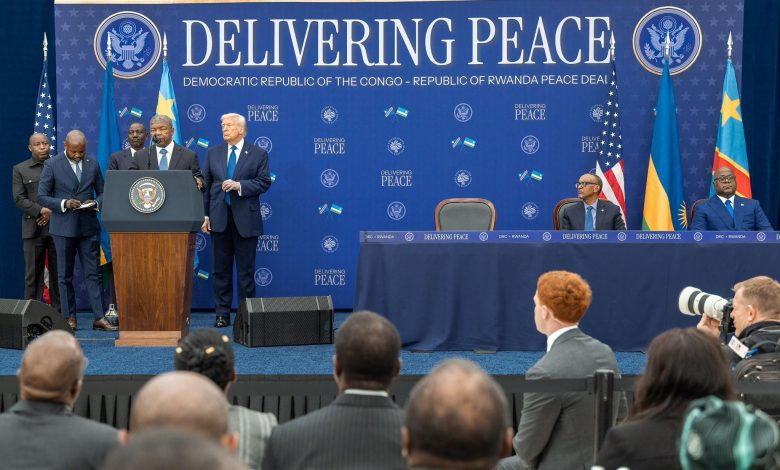
The signing of a peace deal between President Félix Tshisekedi of the DRC and President Paul Kagame of Rwanda in Washington witnessed by US President Donald Trump and President William Ruto among a host of other Heads of States and Government is not merely a foreign-policy development, rather, it is a mirror reflecting the impotence of African institutions and the political evasiveness of leaders who have repeatedly dodged responsibility for the continent’s most enduring conflicts.
For more than two decades, the conflict in eastern DRC has remained one of Africa’s most devastating, driven by a complex blend of ethnic tensions, resource plunder, competing national security interests, and proxy warfare.
Rwanda’s alleged backing of the M23 rebel group, which has seized strategic towns and displaced hundreds of thousands, has been repeatedly flagged by UN experts. Instead of confronting these realities, African leaders have often employed soft language, avoided much touted African led solutions to African problems and chosen the comfort of communiqués over concrete action. This posture created a diplomatic vacuum; one the United States readily stepped into.
The East African Community (EAC), which previously deployed the EAC Regional Force (EACRF) in eastern DRC, failed to impose a clear mandate or confront armed groups robustly.
The force withdrew unceremoniously after Kinshasa accused troop-contributing states of cozying up to rebels and failing to enforce neutralization measures. Yet the withdrawal did not prompt a rethinking of strategy; it only deepened mistrust and solidified the perception that regional leaders were either unwilling or unable to tackle the conflict head-on.
The Southern African Development Community (SADC), now deployed in eastern Congo, faces similar credibility tests. Its leaders have issued tough statements but have struggled to align military efforts with political realities.
The African Union (AU), meanwhile, has remained largely symbolic issuing appeals, forming committees, and renewing frameworks like the Addis Ababa Peace, Security and Cooperation Agreement, but failing to translate them into enforceable action. Supra-national bodies built to anchor African solutions to African problems have instead become passive observers.
The US mediation underscores another painful contradiction. African leaders frequently declare sovereignty and decry Western interference, yet often turn to global powers whenever domestic or regional mechanisms fall apart.
The DRC-Rwanda situation follows the same pattern, years of AU-led silence, EAC stagnation, and SADC inconsistency created conditions where foreign mediation appeared both unavoidable and more credible.
The result is a peace initiative shaped not by African priorities but by strategic Western interests chief among them regional stability, mineral supply chain protection, and countering growing Russian influence.
The failure is also moral. Millions of Congolese civilians have lived under continuous war because the continent’s most powerful voices refused to confront uncomfortable geopolitical truths.
In theory, supra-national bodies were designed to act collectively when bilateral relations break down. In practice, they have devolved into platforms for issuing statements rather than solving conflicts.
The DRC-Rwanda stalemate reveals how the AU lacks enforcement muscle, how the EAC continues to be undermined by shifting member-state interests, and how SADC struggles to impose a unified political strategy even when it deploys troops. Without structural reforms—mandates with teeth, funding autonomy, and neutral leadership—the continent will continue outsourcing its hardest problems to external actors.
Whereas the US-brokered deal should be seen as a success, it manifests a symptom of systemic failure on the part of African leaders. The measure of African leadership cannot be how quickly it praises external interventions but how effectively it builds institutions that prevent such interventions from becoming necessary.
A durable solution requires more than ceasefire pledges. I demands that African leaders confront Rwanda about its alleged support of rebels, hold the DRC accountable for governance failures, enforce demobilisation of armed groups, and establish a credible regional security mechanism insulated from political manipulation.
Unless the continent develops the courage and institutional capacity to address its conflicts proactively, foreign-imposed peace will continue to paper over deeper fractures. The DRC-Rwanda crisis is not just a regional conflict, it is a test of Africa’s political maturity. And right now, the continent is failing that test.
Kinyuru Munuhe is the Executive Director, Governance and Diplomacy Associates. He is also a Diplomacy, Statecraft & Strategic Communications specialist.