Oparanya terms KHRC report on Hustler Fund ‘skewed, elitist and politically motivated’
According to the CS, the Fund is very progressive in deepening financial inclusion and rehabilitating credit behaviour in the country, with more than nine million borrowing regularly and over five million showcasing good borrowing tendencies

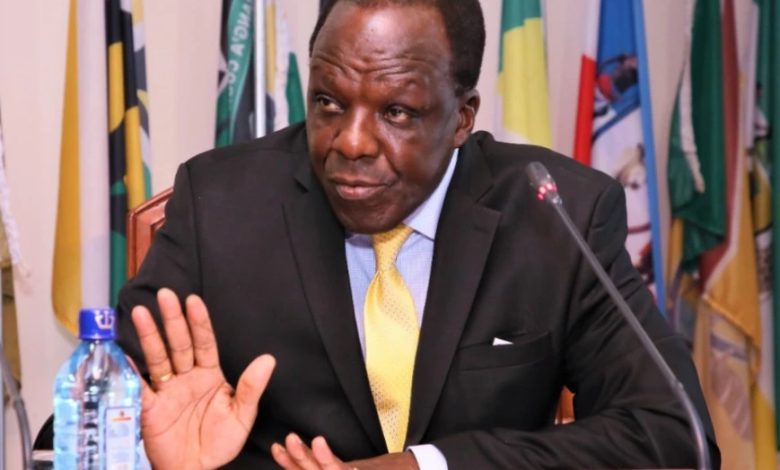
Cooperatives and MSMEs Development Cabinet Secretary Wycliffe Oparanya has dismissed a scathing report by the Kenya Human Rights Commission (KHRC), which called for the scrapping of the Hustler Fund, describing its as politically expedient but economically disastrous initiative that has failed to deliver on its promises of financial empowerment of low-income Kenyans.
In a statement issued on Monday, Oparanya said accused KHRC of conclusions that are skewed, elitist and politically motivated, adding that its title, Failing the Hustlers, explicitly betrays the whole purpose of the study.
“The report assessment period is indicative of the financial year 2022/2023, when the Fund was set up and was only 7 months old by the end of the said financial year. They have also weaponised the report by the Auditor General of the said financial year, when most of the issues raised in the report were not yet conclusive.
Of critical concern is the attempt by the report to generalise the findings of the first month of the Fund period (between November 2022- December 2022) to draw immature conclusions and recommendations. This questions the level of professionalism and the integrity of the data instruments and the processes that were deployed in the study,” he said.
In addition, Oparanya said that as the ministry in charge of the implementation of the Fund, they were never
approached, and have since confirmed from the management of the Fund that they too, were not approached to respond or give clarity to all the claims and nuances that have come out of the study.
“If the NGO was genuine in its pursuits, they would at the least have adhered to the professional ethical standards that govern such studies.”
He also noted that the initial launch for the said report had been scheduled for June 24 to coincide with the first anniversary of the Finance Bill 2024 protests.
“Now, looking at some of the conclusions and premature recommendations, it is sufficient to say that the purpose of this malicious and contemptuous unprofessional study was to provide a tool for public incitement
against the transformative reform agenda that President Ruto is presiding over. Having gone through the report and conclusions, we find the report wanting in facts and hence aimed at misleading the masses,” he added.
“Professionalism demands a response from the key players and the ministry was never approached. Therefore, the conclusions made are keen to sentencing the Fund to death without trial.”
In his statement, Oparanya noted that at the executive summary, the report falsely claims that we have
capitalised the Fund with Sh50 billion, stating that the amount so far injected into the Fund is Sh14 billion, which has been reinvested in a portfolio of over Sh72 billion as of Monday.
“The dependency on the exchequer has significantly reduced as the Fund diversifies into graduation products co-created with the banks to facilitate entry into the formal financial systems by our beneficiaries with proven good hustler Fund credit behaviour,” he said.
He added that it is untrue to insinuate that the fund is not accessible to Kenyans, whereas it’s available on *254#, for both feature phone and smartphone users, which has seen 26 million Kenyans access the fund across the
country.
“It is insufficient to use one financial year’s experience to conclude that the Fund is not helpful to Kenya, yet the two-and-a-half years’ experience so far has proven the contrary, as more than nine million people borrow regularly.”
He also said the findings assume the credit market realities of the digital lending landscape, where the average ticket size is about Sh250, adding that the KHRC report fails to acknowledge from the onset the very purpose of the fund including the credit repair mechanism that the Fund has offered, establishing a credit history of all the 26 million beneficiaries and according them a second chance to the majority of Kenyans who had been negatively listed by CRBs following the aftermath of the Covid pandemic that crushed many small businesses.
“The report lazily claims that we lend between Sh500 to Sh1,000 when in actual sense, the personal loan product cited provides limits up to Sh50,000. This was case from the onset. A properly conducted study should have brought up the true status. To date, Hustler Fund beneficiaries have continued growing their limits, and we have those who are borrowing up to Sh150,000 on the Bridge loan product.”
At the same time, Oparanya said the Hustler Fund base limit is way above the market ticket size of digital products in the country, which is around Sh250.
“Clearly, the NGO either don’t understand the credit market landscape or they feigned ignorance to buttress their political motive.”
He also noted that the report claims that a 14-day credit period is insufficient, which he said leaves one wondering whether they interrogated the digital loan period in the market, which Hustler Fund design leverages to correct the credit market failure.
“The personal loan product is not the only product of the Fund, and the bridge product provides a term loan limit of 30 days at 8% p.a and with a rollover of once up to 60 days. This is a business-oriented product that
targets to graduate the good hustler Fund beneficiaries to the formal financial system.”
According to the CS, the Fund is very progressive in deepening financial inclusion and rehabilitating credit behaviour in the country, with more than nine million borrowing regularly and over five million showcasing good borrowing tendencies, repaying in time and therefore earning eligibility to be graduated to higher loan limits on the current bridge product, where they can access up to Sh150,000 depending on their Hustler Fund credit scores.
He said the Fund is currently disbursing a daily average of Sh68 million on a personal loan product and about Sh27 million on the bridge, adding that it has disbursed a total of Sh72 billion in both personal and bridge loan
product and recorded a repayment of over Sh60 billion.
Oparanya said the average ticket size on the personal loan is Sh925 above the market ticket size of digital loans, which is about Sh200 while on the bridge, the average loan ticket is Sh3, 962.
He noted that the Fund also has a mandatory saving component of 5 per cent where 30 per cent short-term
and 70 per cent long-term, which is aimed at nurturing a culture of savings as a de-risking mechanism, and to date, over Sh5 billion has been mobilised in savings in both mandatory and voluntary savings.
“The Fund experience has created credit visibility of the 26million customers, which has now been crystallised in a Hustler Fund behavioural credit rating system ranging from A1, A2, A3, B1, B2, B3, C1, C2, C3, with A-scores being excellent while C-scores being very poor. We are currently institutionalising the credit score to take it to the market and encourage the market to adopt credit rating as opposed to the conventional collateral, which most.”