Journalists in Gaza facing starvation, four news outlets warn
Medical and relief workers have also said they are also facing 'famine' as the Israel blockade on entry of relief aid largely remains in place

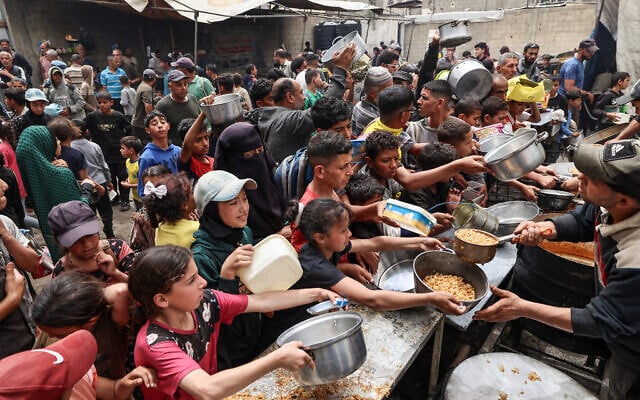
Journalists covering the war between Israel forces and Hamas militants in Gaza are facing the threat of starvation, four news outlets have warned.
In a joint statement, BBC, AFP, AP and Reuters said they are deeply concerned for their journalists in the strip who are increasingly unable to feed themselves and their families.
“For many months, these independent journalists have been the world’s eyes and ears on the ground in Gaza. They are now facing the same dire circumstances as those they are covering. Journalists endure many deprivations and hardships in warzones. We are deeply alarmed that the threat of starvation is now one of them,” the statement said.
The British broadcaster and the news agencies once more urged Israeli authorities to allow journalists in and out of Gaza, adding that it is essential that adequate food reaches the people there.
The statement comes a day after medical and relief workers in Gaza said they are also facing starvation as the Israeli blockade on entry of relief aid largely remains in place despite calls for it to be lifted to avoid famine with 111 people, especially children, said to have died of malnutrition.
A doctor in Gaza working with a UK medical charity said people are now experiencing “famine”.
“No matter how I tell you all day long, I won’t be able to describe to you the suffering of people. They are tired. They are fed up of the current situation,” Dr Aseel told the BBC.
“We have come to a disastrous situation. It’s not that we are close to famine, we are living it.”
“My husband went once [to an aid distribution point] and twice and then got shot and that was it,” she says.
“If we are to die from hunger, let it be. The path to aid is the path to death. It’s a treacherous road. It’s a one-way ticket in some cases.
“I see the injured people who come to the hospital in big numbers. We sometimes receive up to 50 injured a day. During the day, we don’t have any time to close our eyes and have some rest or even drink a cup of tea, if there’s any sugar.”
With supplies now totally depleted, humanitarian organisations are witnessing their own colleagues and partners waste away before their eyes.
Exactly two months since the Israeli government-controlled scheme, the Gaza Humanitarian Foundation, began operating, 109 organisations are sounding the alarm, urging governments to act: open all land crossings; restore the full flow of food, clean water, medical supplies, shelter items, and fuel through a principled, UN-led mechanism; end the siege, and agree to a ceasefire now.
“Each morning, the same question echoes across Gaza: will I eat today?” said one agency representative.
Massacres at food distribution sites in Gaza are occurring near-daily. As of July 13, the UN confirmed 875 Palestinians were killed while seeking food, 201 on aid routes and the rest at distribution points. Thousands more have been injured. Meanwhile, Israeli forces have forcibly displaced nearly two million exhausted Palestinians with the most recent mass displacement order issued on July 20, confining Palestinians to less than 12 per cent of Gaza. WFP warns that current conditions make operations untenable. The starvation of civilians as a method of warfare is a war crime.
The World Health Organisation has described the humanitarian situation in Gaza as “mass starvation” – and said it was “very clear” that this was “man made”.
Asked at a news conference what had caused this, WHO director-general Tedros Adhanom Ghebreyesus blamed the Israeli aid “blockade”.
This morning Cogat, an Israeli military agency, released a statement insisting it is continuing to “facilitate the entry of humanitarian aid into Gaza”.
More than 150 food trucks yesterday “were collected by the UN and international organizations from the Gazan side”, it says, “but over 800 still await pick up”.
Agencies have previously said at least 500 to 600 aid lorries are needed each day in Gaza.
As Israel faces mounting international pressure over aid, the UN’s humanitarian agency, Ocha, says the amount that has been entering Gaza “is a trickle compared to the immense needs”.
During a visit to Israel Defence Forces (IDF) soldiers, Israeli President Isaac Herzog, however, rejected accusations that Israel is responsible for a humanitarian crisis in the region.
“We are acting here according to international law. We are providing humanitarian aid according to international law,” Herzog told reservists from Battalion 969.
“The ones trying to sabotage this aid are Hamas and its people, who are willing to do everything to prevent our forces from dismantling infrastructure that could harm us and our citizens.”
And Herzog stressed that Israeli soldiers are “fighting to change the reality and to bring our hostages home”.
Israel waged war against Hamas following the October 7, 2023 assault on the country that killed 1,200 people, mostly civilians.
More than 55,000 people, including journalists and other civilians, have since been killed in the strip in the 21 months of war amid efforts to secure a 60-day ceasefire.
- Additional reporting by BBC