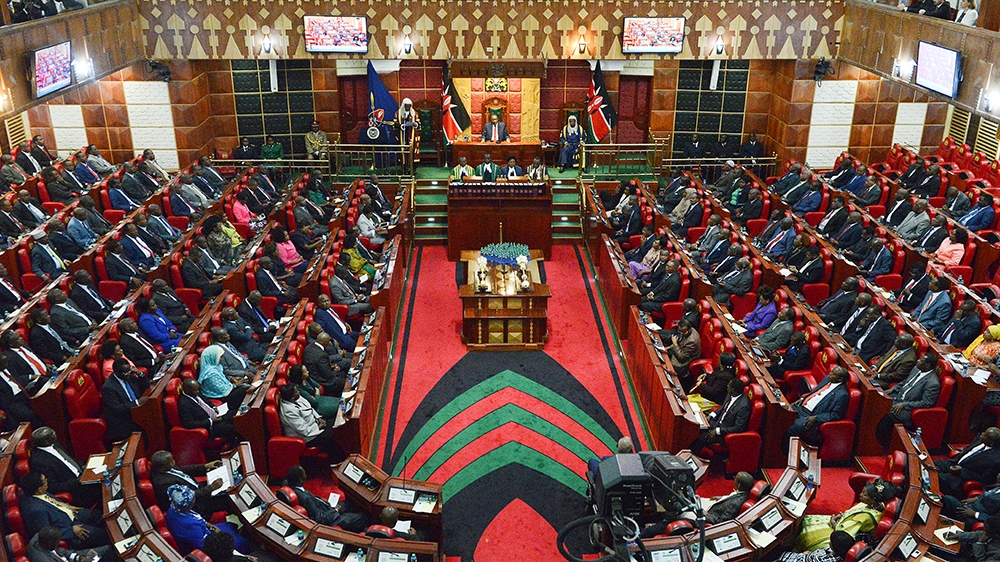
Legislators are working against the clock to change electoral laws to allow the physical delivery of election results in areas without network coverage, to impose strict rules on nominations to county assemblies and to ensure campaign finance secrecy.
National Assembly Speaker Justin Muturi reorganised the order paper yesterday to prioritise election-related Bills.
The Bills listed in Order Paper include the Majority Leader Amos Kimunya-sponsored Elections (Amendment) Bill, 2022; Nyeri Senator Ephraim Maina’s Elections (Amendment) Bill, 2021; the Election Campaign Financing (Amendment) Bill, 2021; and the Elections (Amendment) Bill, 2021. The last two are sponsored by Ndaragwa MP Jeremiah Kioni.
The controversial Elections (Amendment) Bill, 2022, seeks to allow the Independent Electoral and Boundaries Commission (IEBC) to declare election results from physically delivered forms, a big departure from the requirement to have all results transmitted electronically.
The Bill also seeks to alter the flow of results for a presidential election, with presiding officers only required to send images of the results to the national tallying centre and then personally delivering them to the constituency returning officer.
The Bill seeks to amend Section 39 (1d) of the Elections Act by, adding the words “and the physically delivered results”.
In the republished Elections (Amendment) Bill, 2021 sponsored by Maina, which is presently before the Senate, the lawmakers are seeking to be allowed to identify themselves on the ballot with nicknames instead of official names.
Those who have so far done so include Embakasi East MP Babu Owino, whose official name was Paul Ongili, former governors Mike Mbuvi ‘Sonko’ and Ferdinand Waititu (Babayao), Murang’a Governor Mwangi Wa Iria and Kiambu Senator Paul Kimani Wamatangi’, among others.
“The purpose of this Bill is to amend the Elections Act, No.24 of 2011 to allow a candidate to be presented to the electorate on party primary or election ballot papers in the way in which the candidate has chosen to familiarise himself to the electorate,” the Bill reads.
The Bill mandates the IEBC to approve the use of a popular name in an election.
A party candidate will be required to apply at least 21 days before submission of names to the Commission.
For an independent candidate, the name shall be submitted at the time of submission of the candidate’s symbol.
“The commission shall, within seven days of receipt of an application under subsection (2), notify the candidate of its decision in writing,” the Bill reads.
In the Bill sponsored by Kimunya and backed by the IEBC, MPs also want petitions challenging MCA elections to terminate at the High Court to avoid crowding other courts handling governor, senator and Member of National Assembly petitions.
The Elections (Amendment) Bill, 2021, is also set to generate debate in the House as it restricts political parties from nominating MCAs who are not registered in a particular ward.
For instance, if passed, it will bar parties from nominating a person to Nairobi County assembly if the person is not a registered voter within a particular ward in the city.
In the amendment to the campaign financing law, MPs do not want candidates to be compelled to issue receipts and keep records of contributions received towards their election war-chests.
The law currently requires candidates and political parties to issue a receipt for any received contribution exceeding Sh20,000.
“The disclosure of funds shall be confidential and details of such funds shall not be divulged except where such information is the subject of a complaint or an investigation, or is the subject of proceedings in a court of law,” says the Bill.
The regulation required parties and candidates to open bank accounts to be monitored by the IEBC in the course of the campaigns and elections.
The MPs are also expected to agree with the Delegated Legislation committee to throw out the election campaign regulations submitted by the IEBC.
The committee chaired by Tiaty MP William Kamket had rejected the regulations, faulting the IEBC for presenting them late. The Election Campaign Financing Act, 2013, requires that the limits are imposed one year to the polls.
“While Article 88 (4) of the Constitution mandates the commission with the responsibility of regulating the amounts of money that may be spent by or on behalf of a candidate or party in respect of elections, the commission can only exercise this power in accordance with the Constitution and national legislation,” the committee report reads.
In the IEBC regulations the MPs have rejected, the agency had capped presidential campaign financing at Sh4.4 billion; governor, senator and woman rep posts at Sh433 million; and MPs at a maximum of Sh33.4 million.