ICJ rules in favour of Somalia in Indian Ocean boarder row
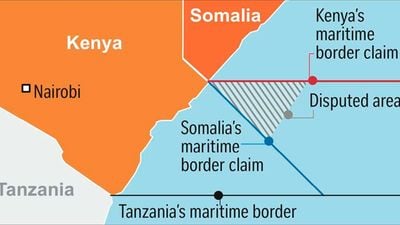
The International Court of Justice has largely ruled in favour of Somalia in the long-standing Indian Ocean boarder row.
The United Nation top court said Kenya has no compelling evidence that Somalia had previously agreed to its claimed boundary.
“…the court finds that there is no compelling evidence that Somalia has acquiesced to the maritime boundary claimed by Kenya and that, consequently, there is no agreed maritime boundary between the parties at the parallel of latitude. Kenya’s claim in this respect must therefore be rejected,” ICJ President Joan E. Donoghue said.
The court put up a provisional equidistance line in the disputed area between Kenya and Somalia, giving Mogadishu up to half of its claim of the disputed border.
Kenya got only a small slice of the potentially oil and gas-rich chunk of the Indian Ocean.
“The court decides that the starting point of the single maritime boundary delimiting the respective maritime areas between the Federal Republic of Somalia and the Republic of Kenya is the intersection of the straight line extending from the final permanent boundary beacon (PB 29) at right angles to the general direction of the coast with the low-water line, at the point with coordinates 1° 39′ 44.0″ S and 41° 33′ 34.4″ E (WGS 84),” the court ruled.
Somalia said the ruling was a result of “sacrifice and struggle” by the Horn of Africa country.
“I thank Allah for … for the fruit of the long struggle made by the Somalis in preventing Kenya’s desire to claim ownership of part of Somalia’s sea,” Somalia’s President Mohamed Abdullahi Mohamed said in a broadcast on his office’s Facebook page.
The ruling came after Nairobi last week said it had revoked recognition of the court’s jurisdiction.
“The delivery of the judgment will be the culmination of a flawed judicial process that Kenya has had reservations with, and withdrawn from, on account not just of its obvious and inherent bias but also of its unsuitability to resolve the dispute at hand,” Foreign Affairs Principal Secretary Macharia Kamau said.
According to Kamau, the Judgement of the Court will have profound security, political, social and economic ramifications in the region and beyond.
The court has said Kenya’s withdrawal is not retroactive and does not affect yesterday’s judgement.
Somalia took Kenya to the court in 2014 after years of efforts to resolve a dispute over the 100,000 square-kilometre (38,000 square-mile) tract failed.
The disputed area is believed to contain huge deposits of oil and gas.
Somalia claimed its maritime boundary should run in the same direction as the southeasterly path of the country’s land border, while Kenya argues the border should take a 45-degree turn at the shoreline and run in a latitudinal line.
Kenya argues that it has exercised uncontested jurisdiction over the maritime zone since 1979 when it proclaimed it as an Exclusive Economic Zone (EEZ) in line with colonial legacies embraced under the Africa Union Border Program which both Kenya and Somalia are signatories.
In addition, Kenya’s maritime border follows the same pattern as that of Tanzania and Mozambique.