Political storm over voter smuggling claims ahead of next year’s polls
Fresh allegations of Ugandans acquiring Kenyan IDs and being ushered into the voters’ register have triggered a political storm, piling pressure on IEBC and security agencies to establish who is telling the truth.

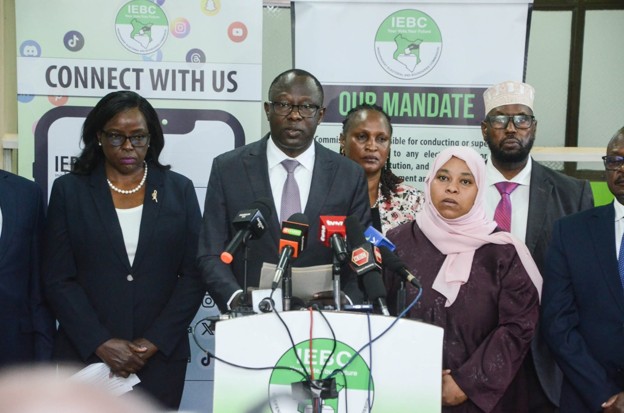
The noose is tightening around explosive claims of a cross-border voter recruitment scheme ahead of the 2027 General Election, with politicians demanding investigations into allegations that Ugandan nationals are being facilitated to obtain Kenyan identity cards and register as voters.
The allegations, contained in a KTN exposé, have placed the integrity of Kenya’s voters’ roll under fresh scrutiny, coming months after the Independent Electoral and Boundaries Commission (IEBC) completed a major continuous voter registration exercise that added more than 2.6 million voters to the register.
IEBC yesterday denied the claims dismissing the allegations as “sensationalised and unsubstantiated” and warning that such reports could undermine public confidence in the electoral process.
But the commission’s denial has failed to end the controversy, with opposition politicians and leaders from the border region demanding that the claims be subjected to independent investigation rather than dismissed outright.
“To date no entity, organisation, group or individual has submitted to the commission any credible evidence supporting any such allegations of illegality and malpractice,” IEBC said.
The commission, however, left the door open for investigations, saying credible evidence would trigger action against anyone found culpable.
“Where credible evidence is presented, the commission shall take appropriate action including disciplinary action, investigation into criminal conduct and where culpability is established, criminal prosecution and punishment shall be undertaken in accordance with the laws of Kenya,” it said.
Border alarm
In March this year, Trans Nzoia Governor George Natembeya raised the alarm over alleged issuance of Kenyan IDs to foreigners in areas bordering Uganda, claiming the documents were being used to facilitate their participation in Kenyan elections.
Natembeya alleged that the activity was part of a wider scheme to bring foreigners across the border to influence electoral outcomes.
“We know it’s part of a scheme to have the foreigners cross the border so that they come and elect leaders for us but that will not happen at all costs,” he said.
He warned that residents would not accept non-Kenyans participating in elections even if they acquired Kenyan IDs and voter cards.

But Trans Nzoia County Commissioner Gideon Oyagi disputed the allegations, saying his office had received no reports confirming the governor’s claims.
“If the governor has credible information on his allegations, let him forward the same to the police for investigations,” Oyagi said.
The competing claims have now assumed national significance as political parties intensify preparations for 2027.
‘Everyone has it’
The KTN investigation has added a new dimension to the controversy, with individuals identified as Ugandan nationals claiming that the process of acquiring Kenyan identification documents and subsequently registering as voters is straightforward.
“It is very easy. The same spot they register your Kenyan ID, you move a few desks and you are registered as a Kenyan voter. Everyone has it; we are only waiting for next year,” one Ugandan national was quoted as saying.
Other alleged beneficiaries claimed that some locations in Uganda were being used to facilitate the processing of Kenyan IDs.
Kalonzo demands answers
Wiper Patriotic Front leader Kalonzo Musyoka has called for investigations, questioning whether foreigners are being issued Kenyan IDs to participate in the 2027 election.
Speaking in Hola, Tana River County, on September 13, 2026, Kalonzo challenged IEBC to establish whether such an operation was taking place.

“IEBC, nataka mchunguze swala hili. Ikiwa IEBC imetoka Kenya, ikavuka mpaka upande wa Chwele, inaanza kupatia Waganda wengine ID, tunataka tujue,” he said.
Kalonzo linked the allegations to the political contest surrounding President William Ruto’s re-election bid, although the claims remain unsubstantiated.
People’s Party of Kenya leader Ndindi Nyoro has also accused the government of allowing foreigners into the country to register as voters.

Nyoro said opposition parties would oppose any attempt to allow non-Kenyans to participate in the 2027 election, insisting that only eligible Kenyan citizens should appear on the voters’ roll.
2.6 million new voters
The controversy comes against the backdrop of a massive expansion of the voters’ register.
IEBC says its continuous voter registration exercise conducted between September 29 and April 9, 2026, resulted in 2,612,725 new voters being registered.
The commission also processed 49,502 voter transfers and 1,066 changes of particulars.
The figures represent a significant increase from the 22.1 million registered voters recorded for the 2022 General Election, with IEBC targeting 28.5 million voters for 2027.
The commission is also expanding registration for eligible Kenyans living abroad from 12 to 26 countries.
ID cartel fears
The latest allegations have revived memories of previous cases in which foreign nationals were allegedly facilitated to acquire Kenyan government documents.
In January, the Directorate of Criminal Investigations (DCI) announced the arrest of nine people—including five National Registration Bureau officers, two brokers and two foreign nationals—in connection with an alleged scheme involving the unlawful issuance of Kenyan identity cards and other government documents.

Investigators recovered several documents, including Ugandan identity cards, during the operation in Zimmerman.
The case does not establish that the broader allegations of voter smuggling are true. It does, however, demonstrate that unlawful acquisition of Kenyan identification documents has previously been the subject of criminal investigations.
Under Kenyan law, the National Registration Bureau is responsible for identifying citizens and issuing national identity cards, while IEBC is responsible for voter registration.